Our Data Processing Agreement changes on 2 November 2026.
Version 3.0 changes what it says about how our AI service providers handle the data we send them. There is no new sub-processor.
Read what is changing
Our Privacy Policy changes on 9 November 2026.
Version 5.1 updates how we use information about your use of Opagio and our emails, how we handle enquiries, and the service providers that help us.
Read what is changing
IP Audit: What It Covers, a Checklist and UKIPO Funding
By David Stroll· 2026-10-12ip auditip audit checklistukipo ip auditip audit grantintellectual property auditchain of titleintellectual propertyintangible assets
An IP audit is a structured review of the intellectual property a business owns and relies on: what the rights are, who legally owns them, whether they are registered and in force, and which licences, risks and gaps attach to them. It produces an inventory of rights with the evidence of title against each, a list of defects to fix, and recommendations on how the IP should support the business plan. It is how an owner establishes what the company owns before a buyer, investor or lender tests it for them.
This guide is about intellectual property, not an audit of IP addresses on a network.
Last reviewed 12 October 2026. Written for UK companies. General information, not legal or tax advice.
£2,250UKIPO funding towards an IP audit, including VAT (GOV.UK, October 2026)
£750the business's own contribution to the audit
340+SMEs supported through the IP Audit scheme in 2025 to 2026 (UKIPO Innovation and Growth Report)
What Is an IP Audit?
An IP audit starts from the business, not from the registers. It asks four questions of every asset: what is it, does the company own it, is it protected and in force, and is it doing a job in the business plan. Registered rights such as patents and trade marks are the easy part. In most SMEs the larger share of the intellectual property is unregistered: copyright in software and content, know-how, confidential information, data and the goodwill in a brand.
Three neighbouring exercises are often confused with an audit. They answer different questions and are done by different people.
IP audit compared with related reviews
Review
The question it answers
Typical output
Usually done by
IP audit
What IP do we own and use, is title clean, and what should we do with it?
Inventory, evidence of title, a ranked list of defects, recommendations
IP attorney or solicitor, sometimes with an IP consultant
Register search
What rights are recorded in a given name?
Search results
IP attorney, or the business using the UKIPO's online services
Could a specific product infringe someone else's patents in a specific market?
A legal opinion on named products and territories
Patent attorney
IP due diligence
What is the buyer or lender acquiring or lending against, and what are the risks?
A report to the buyer or lender
The buyer's or lender's advisers
IP valuation
What are the rights worth?
A value or range on a stated basis and method
Valuer
★ Key Takeaway
An IP audit is the owner's own review, done before anyone else asks. IP due diligence covers the same ground from the other side of a deal, and a valuation puts a number on assets the audit has confirmed the company owns.
Once you know what the company owns, our IP valuation hub explains how each kind of IP is valued and when.
The UKIPO-Funded IP Audit Scheme (IP Audit Grant)
The UK Intellectual Property Office (UKIPO) part-funds IP audits for smaller businesses, and the scheme is running in October 2026. GOV.UK lists it under IP Advance, the UKIPO's support scheme for innovative SMEs, in an entry first published on 8 October 2026: IP Audit provides £2,250 including VAT towards the cost of an IP audit, and the business contributes £750. In its Innovation and Growth Report for 2025 to 2026, the UKIPO says it supported more than 340 SMEs through the scheme that year.
How the IP audit grant works (published terms, 12 October 2026)
Point
What the published terms say
Funding
Up to £2,250 including VAT towards the cost of the audit
Business contribution
£750 (Innovate UK Business Growth states it as including VAT)
Who delivers it
Not the UKIPO directly. Applications go through its regional partners; in England that is Innovate UK Business Growth
Who is eligible
Trading businesses with fewer than 250 staff where IP is, or will be, an essential part of their growth plans. The GOV.UK entry is tagged for every UK nation and region
Condition in England
The business must be receiving intensive growth support from an Innovate UK Business Growth innovation and growth specialist; the audit is part of that service
Who carries out the audit
A qualified IP professional
What it produces
Advice that identifies IP-related opportunities and risks, with recommendations on exploiting and managing the IP and, where appropriate, on further investigation
In England the route in is an Innovate UK Business Growth adviser rather than an open application form. A business already working with one asks them about IP Audit; a business that is not starts by contacting Innovate UK Business Growth. The GOV.UK entry names only the partner for England, so a business in Scotland, Wales or Northern Ireland should ask the UKIPO which regional partner covers it.
ℹ Note
Scheme terms change. The figures above come from the GOV.UK entry "IP Advance Grant Funding" (first published 8 October 2026) and Innovate UK Business Growth's "Exploit innovation" page, both read on 12 October 2026. Confirm the current terms with the delivery partner before you plan around them.
What an IP Audit Covers
A thorough IP audit works through nine areas. Each is set out below, and the checklist in the next section condenses them into one table.
Inventory of registered and unregistered rights
The inventory lists every right the business owns or uses, where it is used and what evidence exists for it. Registered rights come from the registers; unregistered rights come from interviews with founders, technical leads and marketing, and from the contracts and repositories where the work actually sits.
Types of intellectual property an audit inventories
Right
Registered?
Where the evidence sits
Duration and renewal (UK)
Patents
Yes
UKIPO, the European Patent Office and other national offices
Renewed every year from the fourth anniversary of filing, for up to 20 years
Records of how the data was collected and on what lawful basis
No renewal
Goodwill in an unregistered brand
No; protected by the law of passing off
Evidence of trading reputation
No renewal
Domain names
With a registrar, not an IP office
Registrar account and registrant record
Renewed for each registration term
Ownership and chain of title
Most of an audit's time goes not on what exists but on who owns it. The chain of title has to run from the person who created each asset to the company, and the rules differ by who that person was.
Employees
An employee's invention belongs to the employer in two cases: it was made in the course of the employee's normal or specifically assigned duties, in circumstances where an invention might reasonably be expected to result from them; or it was made in the course of duties that gave the employee a special obligation to further the employer's interests, as can apply to a director or senior manager (Patents Act 1977, s.39(1)). Otherwise it belongs to the employee. Copyright in a work made by an employee in the course of employment belongs to the employer, subject to any agreement to the contrary (Copyright, Designs and Patents Act 1988, s.11(2)). Check that the person was an employee at the time and that the work fell within their duties.
Contractors and agencies
There is no UK equivalent of the US "work made for hire" rule for contractors. Copyright in code, designs or content that a freelancer or agency produces stays with them unless they assign it, and an assignment of copyright must be in writing signed by or on behalf of the assignor (CDPA 1988, s.90(3)).
Founders
Anything a founder created before the company existed belongs to the founder until it is assigned to the company. Code, a brand or an invention that predates incorporation needs a written assignment.
Universities and collaborators
Ownership of jointly developed IP follows the collaboration or research agreement. Read the agreement; do not assume.
⚠ Warning
The most common defect in an SME audit is software or design work delivered by a freelancer or agency against an invoice, with no signed assignment. The freelancer still owns the copyright, and the company may have no more than an implied licence to use it. A written, signed assignment fixes it, and it is far easier to obtain before a buyer or lender is waiting.
Registrations and renewals
For each registered right the audit confirms the registered owner (the company, not a founder or a former group company), the status, the territories, the classes of goods and services, and the next renewal date. It checks that assignments and licences have been recorded at the UKIPO, because late registration limits what can be recovered for infringement in the meantime: a new owner or exclusive licensee that does not register the transaction within six months may be refused its costs for infringement before registration (Patents Act 1977, s.68; Trade Marks Act 1994, s.25(4)). It also confirms that an EU trade mark is not standing in for UK protection: an EU mark has not covered the UK since 1 January 2021. EU marks registered by the end of 2020 were given comparable UK marks automatically on 1 January 2021; EU applications still pending then, and EU marks filed since, were not, and need their own UK filing.
Licences in and out
Licensing agreements run both ways. Inbound, the audit lists every licence the business depends on, including third-party software, content and open-source components, and flags change-of-control clauses that let a licensor terminate on a sale, and copyleft obligations in software the business distributes. Outbound, it lists every licence the business has granted: exclusivity, territory, royalty, sublicensing and termination. Royalty terms on an outbound licence later become evidence in a valuation; see our guide to royalty rates from comparable licensing data.
Infringement and freedom-to-operate risk
Infringement risk runs in two directions. Outward: is anyone copying the business's products, using its marks or exploiting its designs? Inward: could the business's own products infringe someone else's rights in the markets it sells into? An audit flags the second question where the business is launching a product or entering a new territory. A full freedom-to-operate search and opinion is a separate, product-specific piece of work for a patent attorney.
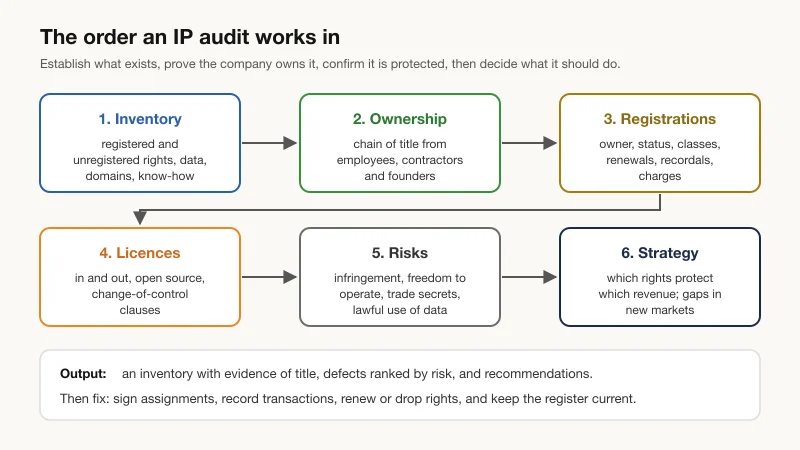
The order an IP audit works in: establish what exists, prove the company owns it, confirm it is protected, then decide what the IP should do for the business.
Trade secrets
Under the Trade Secrets (Enforcement, etc.) Regulations 2018, information is a trade secret only if it is secret, has commercial value because it is secret, and has been subject to reasonable steps to keep it secret. The third test is the one audits find failing. The audit lists the business's confidential know-how (formulae, processes, pricing models, unpublished source code), who has access to it, and the protection around it: confidentiality clauses in employment and contractor agreements, NDAs with partners, access controls and a leavers' process. Our FAQ on how to value trade secrets covers what follows once they are identified.
Data
For each significant data set (customer records, product usage data, data used to train models) the audit asks two questions. Does the business have the right to use the data as it does, under UK GDPR, its privacy notices and the terms of any third-party data licence? And is the data protected, through database right, confidentiality and security controls? A data set the business cannot lawfully use is a liability rather than one of its data assets.
Domain names
The registrant of every trading domain should be the company, not a founder, an employee or the web agency that built the site. The audit checks who controls the registrar account, when each domain renews, and that social media handles and app store accounts are held in the company's name.
IP strategy alignment
The last area turns the inventory into decisions. Which rights protect the revenue the business plan depends on? Where is protection missing in the markets the business is entering? Which rights cost renewal fees without protecting anything the business sells, and which could be licensed to others? Our masterclass lesson on building an intangible asset strategy sets out how IP fits the wider plan.
✔ Example
A software company with 40 staff commissions an IP audit before a Series A raise. The audit finds that its core product includes a module written by an agency with no assignment, and that its main brand, launched in 2022, is protected only by an EU trade mark, which does not cover the UK. The company obtains a signed assignment from the agency and files a UK trade mark application. When the investors' lawyers run their diligence, both points are already answered in the data room. (Illustrative.)
IP Audit Checklist
The checklist below is the working version of the nine areas. Use it to gather documents before an auditor starts, or as the index for your own review.
IP audit checklist: what to collect and the red flags
#
Area
What to collect
Red flag
1
Inventory
A schedule of every right, registered and unregistered, with its owner and where it is used
Assets the business relies on that appear on no list
2
Employee IP
Employment contracts with IP and confidentiality clauses; role descriptions for the people who invent or write code
Inventions or code made outside an employee's duties, with no assignment
3
Contractor IP
Signed written assignments from every freelancer, agency and consultant
Work delivered against an invoice and nothing else
4
Founder IP
Assignments to the company of anything created before incorporation
A core patent, mark or codebase still in a founder's name
5
Registrations
UKIPO, EPO, EUIPO and USPTO records: owner, status, classes, territories
A registered owner that is not the company; no UK mark for the main brand
6
Renewals
A diary of renewal dates for every registered right
Lapsed patents or marks; renewals paid by an individual
7
Recordals and charges
UKIPO recordals of assignments and licences; the Companies House charges register
Unrecorded assignments; an old charge over IP never satisfied
8
Licences in
Every licence the business depends on, including open source
Change-of-control termination rights; copyleft code in distributed software
9
Licences out
Every licence granted: exclusivity, territory, royalty, term
An exclusive licence that blocks a market the plan depends on
10
Infringement and freedom to operate
Known disputes, letters before action, any clearance searches
Products launched into new markets with no clearance
11
Trade secrets
A list of confidential know-how; NDAs; access controls; the leavers' process
No confidentiality terms for contractors; open access to source code
12
Data
Records of processing, the lawful basis for each data set, third-party data licences
Data used in ways the privacy notice does not cover
13
Domains and accounts
Registrant records; ownership of registrar, social and app store accounts
The main domain registered to a former employee or the agency
14
Strategy
A map of which rights protect which revenue lines
Renewal fees on rights that protect nothing the business sells
When to Commission an IP Audit
An IP audit earns its cost whenever a third party is about to examine the IP, and it should come early enough to fix what it finds. A defect the owner finds can be remedied; a defect the other side finds is usually priced.
When an IP audit pays for itself
Trigger
Why audit first
Read next
Selling the business
The buyer's IP due diligence will test title, registrations and licences
Lenders need clean, unencumbered title and rights in force. NatWest's High Growth IP Loan, for example, starts at £250,000 and lends up to around half of appraised IP value
An audit establishes what you own; a valuation sets what it is worth. The order matters. A valuer assumes the company owns the rights being valued and relies on the audit's evidence for it, so valuing a patent the company does not own, or a brand it cannot register, wastes the fee. Once title is confirmed, the method depends on the asset: relief from royalty for brands and licensable technology, excess earnings for the asset that drives the business, and the cost approach where income cannot be separated. Our guides to patent valuation, trade mark valuation and brand valuation cover each.
An audit can also show where tax reliefs may apply. Where it confirms that the company owns patents that earn profits, the Patent Box may let the company apply a 10% rate of Corporation Tax to the qualifying profits (GOV.UK). The conditions are detailed; see our FAQ on the UK Patent Box and take advice from a tax adviser.
★ Key Takeaway
Audit first, value second. The audit turns "we think we own it" into documented title, which is what every valuation, sale, loan and licence relies on.
How an IP Audit Is Carried Out
1. Scope
Agree the purpose (a sale, a raise, a loan, a licence or a strategy review), the entities in the group and the territories that matter. The purpose sets the depth.
2. Information request
The auditor sends a questionnaire and a document list: contracts of employment, contractor agreements, assignments, licences, register extracts and any past disputes.
3. Interviews
Founders, technical leads and marketing explain what the business has built, who built it and where it sits. Most unregistered rights surface here.
4. Register searches
Searches of the UKIPO and other offices for registered rights, and of the Companies House charges register for security over IP.
5. Report
An inventory of rights, the evidence of title against each, defects ranked by risk, and recommendations on protection and use.
6. Remediation and upkeep
Sign the missing assignments, record transactions, pay or drop renewals, file new registrations and tighten confidentiality terms. Then keep the inventory current, so the next audit starts from a maintained register rather than from scratch.
Gathering the documents usually takes longer than the review itself. A business that already keeps an up-to-date register of its intangible assets, with the evidence held against each one, shortens every step from the second onwards.
Where Opagio Fits
An audit report is a snapshot. Opagio Intangibles keeps the inventory current: it records each identified intangible asset, with its evidence, in the Opagio Value Drivers Register™, classified across Opagio 12, so the register an audit produces is maintained between audits and is ready when a buyer, investor or lender asks for it.
ℹ Note
Opagio does not carry out legal or statutory IP audits. It does not give opinions on title or freedom to operate, file registrations, or deliver the UKIPO-funded IP Audit scheme; those stay with IP attorneys, solicitors and the scheme's delivery partners. Opagio's own Intangible Asset Audit identifies and values intangible assets and is not a substitute for that legal work.
Keep the evidence for your intangible assets in one register
The Value Drivers Register gives your advisers, buyers and lenders one evidenced list of the intangible assets your business owns. See how owners preparing to sell use it at Opagio for exit-ready businesses, or start with the free Quick Assessment to see where your intangible assets stand today. Opagio is also running a waitlist for its Intangible Asset Audit, which identifies your intangible assets across Opagio 12 and values each one.
Frequently Asked Questions about IP Audits
What is an IP audit?
An IP audit is a structured review of the intellectual property a business owns and uses. It records each right, confirms the company owns it and that it is protected and in force, identifies licences and risks, and recommends what to fix and how the IP should support the business plan.
Is there a grant for an IP audit?
Yes. The UKIPO's IP Audit scheme, listed under its IP Advance programme, provides £2,250 including VAT towards an IP audit, and the business contributes £750. It is for trading businesses with fewer than 250 staff where IP is essential to their growth plans. In England it is delivered through Innovate UK Business Growth to businesses receiving its intensive growth support. Terms as published on 12 October 2026; check them with the delivery partner.
Who carries out an IP audit?
Usually an IP attorney or a solicitor specialising in intellectual property, sometimes working with an IP consultant. Under the UKIPO-funded scheme the audit is carried out by a qualified IP professional arranged through the delivery partner.
How long does an IP audit take?
It depends on the number of rights, entities and territories in scope, and on how quickly the business can produce its contracts and assignments. Gathering the documents is usually the slowest part, which is why keeping a current register of the business's intangible assets makes each audit faster.
Is an IP audit the same as IP due diligence?
They cover the same ground from different sides. An IP audit is commissioned by the owner to understand and fix its own position. IP due diligence is carried out for a buyer or lender to assess what it is acquiring or lending against. An audit done well ahead of a deal means the other side's diligence finds little that is new.
Related Reading
Further reading on IP audits, due diligence and valuation
David Stroll is Co-Founder and Chief Scientist at Opagio, where he leads research on intangible asset measurement, accounting standards and the productivity of intangible investment. Meet the team.
Share:
DS
David Stroll — Chief Scientist, Co-Founder
PhD in Productivity | 40 years in strategy and technical systems delivery
Intellectual property creates the legal protection for your innovation and differentiation. This lesson teaches you how to identify IP assets worth protecting, measure their strategic value, and communicate that value to investors.
A comprehensive guide to valuing patented technology as a technology-based intangible asset under IFRS 3. Covers the RFR method, portfolio valuation approaches, patent strength assessment, and the distinction between core and defensive patents.
How to value copyrights and literary works as artistic-related intangible assets under IFRS 3. Covers the RFR method for publishing portfolios, backlist valuation, and the impact of digital distribution.
How to value broadcasting rights as contract-based intangible assets under IFRS 3. Covers sports broadcasting rights, content distribution agreements, spectrum licences, and the income approach for media rights valuation.
We use essential cookies to make our website work. We'd also like to use analytics cookies to improve your experience. You can manage your preferences at any time.
Cookie Policy