Our Data Processing Agreement changes on 2 November 2026.
Version 3.0 changes what it says about how our AI service providers handle the data we send them. There is no new sub-processor.
Read what is changing
Our Privacy Policy changes on 9 November 2026.
Version 5.1 updates how we use information about your use of Opagio and our emails, how we handle enquiries, and the service providers that help us.
Read what is changing
Vendor Due Diligence: A Seller's Guide to VDD and Intangibles
By Tony Hillier· 2026-10-12vendor due diligencevendor due diligence reportvendor due diligence checklistVDDselling a business ukdue diligencewarranty and indemnity insuranceintangible assets
Vendor due diligence (VDD) is due diligence that a seller commissions on its own business before a sale, from independent advisers, so that every bidder starts from the same verified reports. The seller scopes it and pays for it; the report is addressed to the seller, and the buyer that wins, usually with its lenders, relies on it through a reliance letter that gives it a contractual claim against the advisers. Done well, VDD shortens the process, keeps more bidders in it and moves the arguments about price to before heads of terms rather than after them.
In M&A, "vendor" means the seller. The same phrase is used in procurement for vetting a supplier; this guide is about selling a business.
Last reviewed 12 October 2026. Written for sales of UK private companies under English law. General information, not legal, tax or investment advice.
6common VDD workstreams: financial, tax, legal, commercial, IT and cyber, ESG
3reports W&I insurers usually expect as a minimum: legal, financial and tax (HWF Partners, 2025)
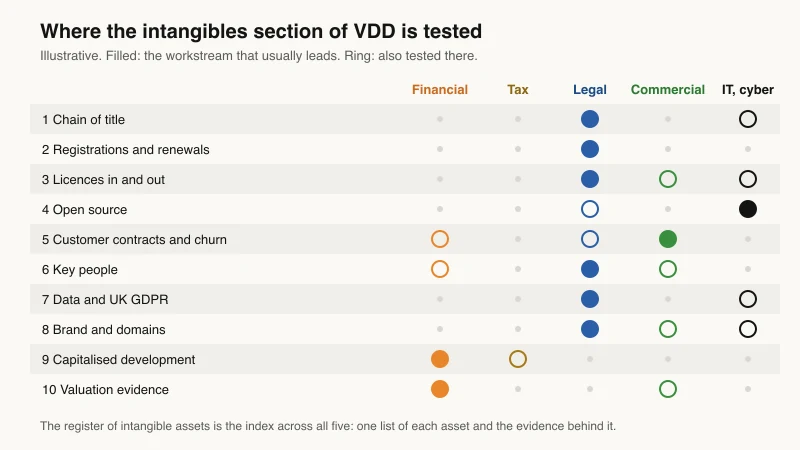
10areas in the intangibles section a buyer will test, set out below
What Vendor Due Diligence Is, and How It Differs from Buyer Due Diligence
In a sale without VDD, each bidder runs its own due diligence after heads of terms, on its own timetable, and every finding becomes a reason to revisit the price. VDD reverses the order. The seller's advisers investigate first, the seller deals with what they find, and bidders price from a shared, documented baseline. Buyers still do their own confirmatory work, but they start from the report rather than from a blank request list.
Vendor due diligence vs buyer due diligence, vendor assist and a red-flag review
Vendor due diligence
Buyer due diligence
Vendor assist
Red-flag review
Commissioned by
The seller
The buyer
The seller
The seller
Addressed to
The seller, with reliance extended to the buyer
The buyer and its lenders
The seller only
The seller only
Who can rely on it
The successful buyer and usually its lenders, under a reliance letter
The buyer
Nobody but the seller
Nobody but the seller
When
Before the process launches
After heads of terms
Before launch
Months before launch
Output
A full report per workstream
A full report per workstream
Prepared financial information and a databook, no opinion
A short list of issues to fix
★ Key Takeaway
The difference that matters is reliance. Vendor assist and a red-flag review help the seller prepare; only a VDD report, with a reliance letter, is something the buyer can treat as its own diligence. That is why VDD changes the buyer's behaviour and the lighter options mostly change the seller's.
Types of Vendor Due Diligence
VDD is a stack of reports, each from a different adviser. Most sellers commission two or three of them, not all six.
Underwriters read the diligence reports, and their quality shapes the cover
In a bilateral sale to one trade buyer, or a smaller deal where the buyer will run its own diligence regardless, a red-flag review or vendor assist usually gives most of the benefit for less. The principle is the same either way: find your own problems first.
Scope and timing
Scope the workstreams to the questions this buyer universe will ask, not to a standard list. Fees vary with scope, deal size and the number of workstreams, so obtain a quote for each and agree at the outset who will bear the cost of extending reliance to the buyer. Fieldwork starts once the data room is substantially populated and should finish before second-round bidders get access. If the process runs long, expect the advisers to update the financial report, because the figures date.
✔ Example
An illustrative software business expects bids from two trade buyers and one private equity fund. Its adviser recommends financial and legal VDD plus an IT report covering code ownership and open source, and no commercial report, because the trade buyers know the market better than any consultant. The fund still commissions its own commercial work; the trade buyers do not.
The Vendor Due Diligence Report: Structure, Reliance and Duty of Care
What a vendor due diligence report usually contains
Section
What it covers
Executive summary and key findings
The issues that matter for price and structure, on one or two pages
Scope and basis of preparation
What was and was not reviewed, the information relied on and the limitations
Earnings
Reported to normalised EBITDA, with each adjustment explained
Net debt, debt-like items and working capital
The items that move the equity price
Tax
Historic exposures and the position of the sale
Legal findings
Usually in red-flag form: issue, consequence, suggested remedy
Appendices
Databooks, contract schedules, registers and searches
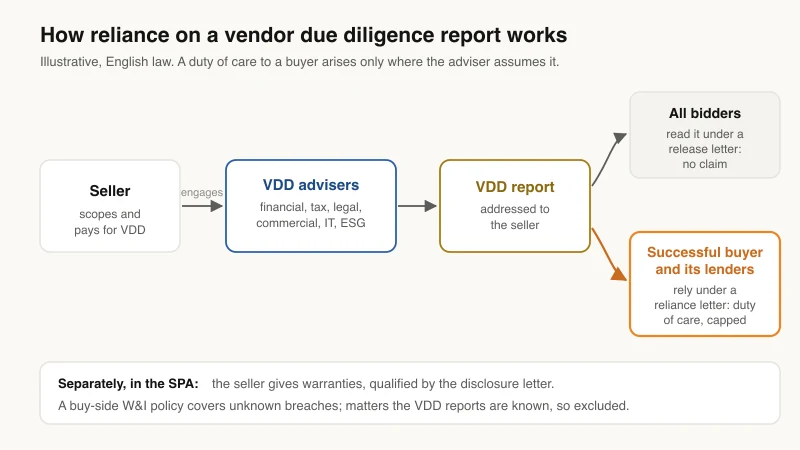
A buyer cannot sue on a report simply because it read it. Under English law, an adviser owes a third party a duty of care for a report only where it knew the report would reach that party, or a member of an identifiable class, for a specific transaction, and that the party would rely on it (Caparo Industries plc v Dickman [1990] 2 AC 605). Bidders in a sale process can come close to that test, so the VDD process allocates responsibility deliberately: release letters exclude it for bidders, and a reliance letter accepts it, on stated terms, for the right party.
1. Engagement
The seller engages each adviser. The report is addressed to the seller and scoped with the seller's corporate finance adviser.
2. Release letters
Bidders read the reports after signing a release (or non-reliance) letter: they may use the report to bid, but have no claim against the adviser.
3. Reliance letter
The successful buyer, and usually its lenders, sign a reliance letter. The adviser accepts a duty of care to them, subject to a negotiated liability cap, sometimes set by reference to its fee, and a time limit for claims.
4. Update before signing
Where the process has run on, the financial report is brought up to date so the buyer relies on current figures.
How reliance on a vendor due diligence report works: bidders read it, only the successful buyer and its lenders can rely on it, and the adviser's liability is capped.
⚠ Warning
Reliance runs against the adviser, not against you, and it is capped at an amount that is usually small next to the price. A buyer will therefore still want warranties from the seller. VDD changes what you disclose against those warranties; it does not remove them.
How VDD Interacts with Warranties, the Disclosure Letter and W&I Insurance
The sale and purchase agreement contains the seller's warranties: statements that the business is in a stated condition. The seller qualifies them in the disclosure letter, and a matter properly disclosed cannot later found a warranty claim. Sellers commonly seek to disclose the data room and the VDD reports generally against all the warranties; buyers resist, and how far a general disclosure counts is negotiated in every deal.
Warranty and indemnity insurance changes where a claim goes. Most W&I policies are buy-side: the buyer is the insured, and its claim for a breach of warranty goes to the insurer, which lets the seller agree a much lower cap on its own liability. The policy covers unknown breaches. Matters disclosed or otherwise known to the buyer are excluded, and so are price-adjustment items and forward-looking statements. Underwriters read the diligence reports and narrow the cover where an area was not adequately diligenced. According to HWF Partners (2025), a UK W&I broker, insurers expect legal, financial and tax diligence as a minimum; VDD is not required for a buy-side policy, but high-quality VDD can reduce the buyer's own diligence and improve the cover, and poor-quality VDD can do the opposite.
Where a vendor due diligence finding ends up
What happens to the finding
Warranty claim?
W&I cover?
Where the buyer's protection comes from
Fixed before the process launches
Not needed
Not needed
The fix: a signed assignment, a renewed registration, a consent
Disclosed in the VDD report or disclosure letter
Not once fairly disclosed
No, it is known
The price, a specific indemnity or a retention
In an area the diligence did not cover
Possibly
Often excluded
A seller indemnity or more diligence
Unknown, in an area the diligence covered
Yes
Usually covered
The W&I policy, within its limit
★ Key Takeaway
A finding in your own VDD cannot be warranted away or insured away. It is priced, indemnified or fixed. That is the argument for commissioning VDD early: a finding you discover a year out can be fixed, while one discovered in the last month can only be priced.
The same logic applies on a flotation, where the reporting accountant's long-form report plays a comparable role for the sponsor and the board; it is a separate exercise with different addressees and is not covered here.
The Intangibles Section of Vendor Due Diligence
Intangible assets fall between workstreams. The lawyers look at title, the accountants at capitalised costs, the commercial advisers at customers, and nobody owns the question a buyer actually asks: what are the assets this price is paying for, and will they all transfer? A buyer's intangible workstream will run a checklist like our buyer's intangible asset due diligence checklist. The seller's version of that work is the intangibles section of VDD, and the evidence behind it is something only the seller can assemble.
The intangibles section: what to evidence before a buyer asks
Signed IP assignments from founders, employees and contractors; consultancy agreements
That the company, not a founder or freelancer, owns the code, designs and content. Legal title to a contractor's copyright passes only by a signed written assignment (CDPA 1988, s.90(3))
2
Registrations and renewals
A schedule of UKIPO, EUIPO and USPTO rights with owner, status, classes and renewal dates
The registered owner, lapsed renewals, and a UK mark for the core brand (an EU mark has not covered the UK since 1 January 2021)
3
Licences in and out
Every licence relied on or granted, with term, exclusivity and assignment terms
A code scan or software bill of materials and the licence of each component
Copyleft code in software the business distributes or offers as a network service
5
Customer contracts
The top contracts, three years of revenue by customer, cohort retention
Concentration, termination rights and change-of-control terms in the largest contracts
6
Key people
Organisation chart, service agreements, notice periods, restrictive covenants
Key person risk: revenue or know-how that leaves with one person
7
Data and UK GDPR
Records of processing, the lawful basis for each dataset, privacy notices, PECR consents, the breach log
Whether customer and marketing data can be used lawfully after completion; in an asset sale it moves to a new controller
8
Brand and domains
Domain registrant records, registrar accounts, social handles, any disputes
That the company controls every trading domain and account
9
Capitalised development
The capitalisation policy, project cost schedules, timesheets, impairment reviews
Whether capitalised spend is supported and consistent with R&D tax relief claims. IAS 38 (paragraph 57) requires capitalisation once its criteria are met; under FRS 102 (paragraph 18.8H) it is a policy choice
10
Valuation evidence
Any prior valuation; revenue, churn, margin and royalty data per material asset
Whether the value attributed to each named asset is supported
Most of these items are documents the business already holds but has never assembled in one place; an IP audit a year or more before the sale is the usual way to gather the IP ones. The register of intangible assets is the index that ties them together, and the one most sellers do not have.
Where the intangibles section of vendor due diligence lands. Illustrative: each area has a lead workstream, and several are tested by more than one adviser.
The Value Drivers Register as the evidence base
Opagio Intangibles builds that index. It identifies and classifies a business's intangible assets across Opagio 12 and records each one, with its evidence, in the Opagio Value Drivers Register™. The Asset Valuator values the material assets with recognised methods (relief from royalty, MPEEM, with-and-without, the cost approach and others), and the Normalised P&L restates earnings through documented adjustments on a stated basis, which is the starting point for the financial report's discussion of normalised earnings. Co-branded reports let your adviser present the result under their own name.
ℹ Note
Opagio does not perform vendor due diligence. It does not give reliance, issue title opinions or advise on data protection; those stay with your accountants and lawyers. What it gives them is an organised, evidenced register of the intangible assets, so their fieldwork starts from your evidence rather than from an empty request list.
The Intangibles Section of an Information Memorandum
The information memorandum (IM) is the selling document: your adviser's case for the business, released to bidders under a non-disclosure agreement. It normally says that bidders cannot rely on it. The VDD report is what they can rely on. A buyer reads the two side by side, so every claim the IM makes about intangible assets should point to evidence the VDD has tested. Our FAQ on what an information memorandum is covers the rest of the document.
Intangible claims in the IM, and the evidence behind them
IM claim
Evidence in the data room
Where the VDD tests it
"A loyal, recurring customer base"
Cohort retention by year, contract terms, revenue by customer
Financial and commercial reports
"Proprietary technology"
Chain of title, open-source scan, capitalised development schedule
Legal and IT reports
"A recognised brand"
UK trade mark registrations in the right classes, domain control, revenue under the brand
Legal and commercial reports
"A management team that runs the business"
Organisation chart, service agreements, succession, who holds each relationship
Legal and commercial reports
"Valuable data"
Lawful basis for each dataset, privacy notices, security controls
Legal and IT reports
✔ Example
An IM describes "near-total customer retention". The financial VDD calculates net revenue retention at 88% once a lost contract is counted on the buyer's definition. The figure is still good; the claim was not. Bidders discount the IM's other claims, and the seller's adviser spends the second round rebuilding credibility. Writing the IM from the register, after the VDD numbers are known, avoids the gap. (Illustrative.)
A Seller's Vendor Due Diligence Checklist
Vendor due diligence checklist by stage
Stage
Action
Output
12 to 24 months out
Map the intangible assets and close the gaps: missing assignments, lapsed registrations, contracts with no change-of-control consent route
A register of intangible assets with the evidence against each
6 to 12 months out
Normalise the earnings and document every adjustment; review the capitalisation policy
A defensible normalised EBITDA
6 to 9 months out
Commission a red-flag review; fix what it finds
A shorter list of issues
3 to 6 months out
Decide with your adviser whether full VDD is justified; scope each workstream; agree the reliance terms
Engagement letters
During fieldwork
Populate the data room against an index; answer advisers' questions from the evidence, not from memory
A data room the reports cross-refer to
Before launch
Draft the IM from the register and the VDD findings
An IM whose claims the VDD supports
Before signing
Update the financial report if needed; prepare the disclosure letter from the VDD findings
Build the intangibles evidence before your advisers start
The Value Drivers Register gives your VDD advisers and your IM writer one evidenced list of the assets a buyer is paying for. See how owners preparing to sell use it at Opagio for exit-ready businesses, or start with the free Quick Assessment to see where your intangible assets stand today.
Frequently Asked Questions about Vendor Due Diligence
What is vendor due diligence?
Vendor due diligence is diligence a seller commissions on its own business before a sale, from independent accountants, lawyers and other advisers. The reports are shared with bidders, and the successful buyer and its lenders can rely on them through a reliance letter.
Who pays for vendor due diligence?
The seller commissions it and pays for it. Who bears the cost of extending reliance to the buyer is agreed with the advisers at the outset. Fees vary with the scope, the size of the deal and the number of workstreams.
Can a buyer rely on a vendor due diligence report?
Only the successful buyer, and usually its lenders, and only after signing a reliance letter. That letter gives them a contractual claim against the adviser, subject to a liability cap and a time limit. Other bidders read the report under a release letter and have no claim.
Is vendor due diligence worth it for a smaller business?
It depends on the process. Where several bidders, especially private equity, would each commission the same work, VDD usually earns its cost. In a sale to a single trade buyer, a red-flag review or vendor assist often gives most of the benefit for less. Either way, assemble the intangibles evidence first; it is needed whichever route you take.
Does vendor due diligence replace warranties or W&I insurance?
No. The seller still gives warranties in the sale and purchase agreement. What VDD changes is the disclosure: matters it reports are known to the buyer, so once disclosed against the warranties they cannot found a warranty claim, and W&I policies exclude them. The buyer's protection for those matters comes from the price, a specific indemnity or a fix before signing. For the warranties themselves, see earn-outs and warranties after the sale.
Related Reading
Further reading on selling a business and due diligence
Tony Hillier is Chairman of Opagio. His career spans structured finance, M&A and asset valuation, including executive board roles at NM Rothschild & Sons and GEC Finance. Meet the team.
Share:
TH
Tony Hillier — Chairman, Co-Founder
MA, Balliol College, University of Oxford | Harvard Business School MBA with Distinction
A data room is where a buyer's diligence either confirms your story or starts finding reasons to pay less. This is the seller's how-to — the folder structure, the evidence, and the gaps that chip the price.
A buyer prices your business through its intangible assets whether they name them or not. Here are the ones that earn a premium in a sale — and how to evidence them before diligence goes looking.
Business Asset Disposal Relief taxes qualifying gains at 18% from 6 April 2026 on up to £1m over a lifetime, against 24%. The conditions, the worked figures and the checks to make with an adviser before a sale.
Get the latest insights on intangible asset growth and productivity delivered to your inbox.
We use essential cookies to make our website work. We'd also like to use analytics cookies to improve your experience. You can manage your preferences at any time.
Cookie Policy