Intangible Asset Due Diligence: The Buyer's Checklist for M&A
By Tony Hillier· 2026-03-16intangible asset due diligenceintangible assets due diligence checklistIP due diligenceM&A due diligencechain of titlepurchase price allocationPE acquisitionintangible asset risk
Intangible asset due diligence is the buyer's investigation of the assets that carry most of a target's value but sit outside its balance sheet: intellectual property, customer relationships, brand, data, software and key people. It tests whether each asset exists, whether the target owns it outright, whether it will survive the change of ownership and what it is worth. Done before signing, it changes the price, the deal structure and the warranties; done after completion, it can only explain the goodwill.
Last reviewed: October 2026. Written for UK targets: UKIPO, Companies House, the PSC register and UK GDPR apply; IFRS 3 and FRS 102 alongside. Not legal advice.
The Intangible Assets Due Diligence Checklist
Request these ten areas from the seller in the first information request, and test each against an independent source where one exists.
Intangible asset due diligence checklist: what to request and the red flag
#
Area
What to request
Red flag
1
IP ownership and chain of title
IP assignments from founders, employees and contractors; employment and consultancy agreements; any university or joint-development agreements
Code, designs or content written by a founder before incorporation, or by a contractor, with no signed assignment
2
Registrations and renewals
Schedule of patents, trade marks and designs at UKIPO, EUIPO and USPTO, with owner, status, classes and renewal dates
Registered owner is a founder or a sister company; lapsed renewals; no UK mark for the core brand
3
Licences in and out
Every licence the target relies on and every licence it grants, with term, exclusivity, assignment and change-of-control clauses
A critical licence that terminates, or needs consent, on a change of control
4
Open-source exposure
Software bill of materials or a code scan, the licence of each component and the open-source policy
GPL code in software the target distributes, or AGPL code in software it distributes or offers as a network service
5
Customer contracts, concentration and churn
Top 20 contracts; revenue by customer for three years; cohort retention; renewal and termination terms
One customer above 10% of revenue, or top customers able to leave on a change of control
6
Key-person dependency
Organisation chart, service agreements, notice periods, restrictive covenants, who holds which relationships and know-how
Revenue or the product roadmap that depends on one person with a short notice period
7
Data and UK GDPR basis
Records of processing, the lawful basis for each customer and marketing dataset, privacy notices, processor contracts, ICO fee, breach log
Marketing lists with no lawful basis, or personal data that cannot lawfully pass to the buyer
8
Brand and domain control
Domain registrant records and registrar accounts, social handles, brand guidelines, any disputes
Domain or registrar account held by a founder, agency or former employee
9
Capitalised development costs
Capitalisation policy, project cost schedules, timesheets, impairment reviews, the link to R&D tax relief claims
Capitalised spend that rose ahead of the sale, or costs with no project-level support
10
Valuation evidence
Any prior valuation, PPA or impairment test; management's view of which assets drive revenue; royalty, churn and margin data
No evidence for the value the seller attributes to a named asset
★ Key Takeaway
Every row in the checklist answers one of four questions: does the asset exist, does the target own it, will it transfer, and what is it worth. A finding that cannot be tied to one of those questions is noise; a finding that answers one of them should change the price, the structure or the sale and purchase agreement.
Who This Checklist Is For
This guide takes the buyer's side. It is written for private equity deal teams, search fund principals and corporate acquirers running the intangible workstream on a UK mid-market acquisition, usually between a signed letter of intent and exchange. It sits alongside financial, legal and commercial diligence; it does not replace a legal opinion on title or a financial quality of earnings review, and it is not a substitute for either.
10areas in the intangible asset due diligence checklist
21 daysto register a charge at Companies House (Companies Act 2006, s.859A)
12 monthsIFRS 3 and FRS 102 measurement period to finalise the purchase price allocation
Most of what a buyer pays for in a services, software or brand-led business is intangible, and the seller's accounts show little of it: UK GAAP and IFRS both keep internally generated brands, customer lists and most know-how off the balance sheet. The diligence file is therefore the only place the buyer sees those assets before it owns them. Sellers preparing for these questions should read our guides to vendor due diligence, the IP audit and building a data room for selling a business, which cover the same ground from the other side of the table.
IP Due Diligence: Ownership and Chain of Title
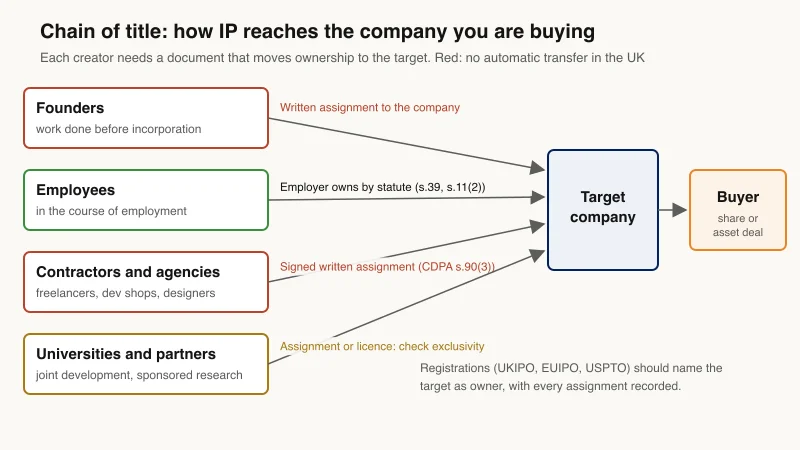
IP due diligence starts with a simple question that is often hard to answer: does the company that is being sold own the intellectual property the business uses? Chain of title is the unbroken documentary link from each person who created an asset to the company that claims it. In the UK, ownership depends on who created the work and under what arrangement.
Founders
Work a founder created before the company existed belongs to the founder. It reaches the company only by a written assignment, which is often missing in businesses that started as side projects.
Employees
An invention made in the course of an employee's normal or specifically assigned duties, where an invention might reasonably be expected to result, belongs to the employer (Patents Act 1977, s.39), and so does copyright in work made in the course of employment, unless agreed otherwise (Copyright, Designs and Patents Act 1988, s.11(2)). Check that the person was an employee at the time, and that the work fell within their duties.
Contractors and agencies
There is no UK equivalent of the US "work made for hire" rule for contractors. Copyright in code, designs or content a freelancer or agency produces stays with them unless they assign it, and an assignment of copyright must be in writing and signed (CDPA 1988, s.90(3)).
Universities and partners
Sponsored research and joint development usually come with a licence or a shared-ownership clause. Read the terms for exclusivity, field of use and what happens on a change of control.
Chain of title in IP due diligence: each creator needs a document, or a statutory rule, that moves ownership to the target before the buyer can rely on it.
⚠ Warning
A missing contractor assignment is the most common chain-of-title gap in software and design businesses. If the core product was built partly by freelancers or an outsourced development house without signed assignments, the buyer may not own what it is paying for. The usual remedy is a confirmatory assignment signed before completion, made a condition of the deal.
Registrations, Charges and the Registers to Search
Registered rights can be verified against public registers rather than taken from the seller's schedule. Search each register yourself and reconcile it to the disclosure.
Registers to search in intangible asset due diligence
Register
What it confirms
What to check
UKIPO (patents, trade marks, designs)
UK registered rights and their recorded owner
Owner is the target entity; status is live; trade mark classes cover what the business sells; renewal dates (UK marks renew every 10 years; patent renewal fees fall due each year from the fourth anniversary of filing)
EUIPO (EU trade marks and designs)
Rights across the EU
Since 1 January 2021 an EU trade mark no longer covers the UK; confirm the matching UK mark exists
USPTO (US patents and trade marks)
US registered rights
Maintenance fees on patents; declarations of use and renewals on marks
Companies House charges register
Security granted over the company's assets, including IP
Debentures or fixed charges over IP; whether charges shown as outstanding have been satisfied
Companies House PSC register
Who has significant control of each group company
Related companies under common control, outside the perimeter being sold, where key IP may sit
Two gaps recur. The first is an assignment that was signed but never recorded at UKIPO: recording matters, because an unrecorded transfer can leave the owner exposed to a third party who acquires a conflicting interest and can limit what it recovers in an infringement claim. The second is security: a lender's charge over IP must be released at completion, or the buyer acquires an encumbered asset.
ℹ Note
Unregistered rights still matter. Copyright, unregistered design right, know-how and an unregistered brand protected by the law of passing off carry no certificate, so the evidence is the chain of title, the history of use and the absence of disputes.
Licences, Change of Control and Open Source
The rights a target uses but does not own can matter as much as the rights it owns. A licence in (software, data feeds, a patented process) may be what the product runs on; a licence out may have given away exclusivity in a territory the buyer wants to grow in.
Licence clauses that decide whether value transfers
Lets the counterparty terminate or renegotiate when ownership changes
Triggers in a share deal, because the contracting company stays the same but its owner changes
Assignment restriction
Prevents the contract moving to a new entity without consent
Bites in an asset deal, where every contract must be assigned or novated
Exclusivity and field of use
Defines what the target can do with licensed rights, and what it has granted away
Travels with the contract in either structure
Termination for convenience
Lets a licensor or customer leave on notice regardless of performance
Unchanged by structure; price the notice period
Open-source software deserves its own line in IP due diligence. Almost every modern codebase uses it, and most licences are permissive (MIT, BSD, Apache 2.0), asking only for notices to be kept. Copyleft licences are different: the GPL requires the source code of software containing GPL code to be made available on GPL terms when that software is distributed, and the AGPL extends the obligation to modified versions that users interact with over a network, which brings SaaS products into scope.
✔ Example
A buyer's scan of a target's mobile app finds a GPL-licensed library compiled into the version distributed through the app stores. The finding goes three ways: a pre-completion remediation plan to replace the library, a specific indemnity in the sale and purchase agreement for any claim before remediation, and an engineering owner in the 100-day plan. The same library on an internal server, never distributed, would have been a much smaller finding.
Customers, Key People, Data and Brand
The remaining operational areas share a pattern: the asset is real, but its value depends on something that may not survive a change of owner.
Customer contracts, concentration and churn
Customer relationships are often the largest identified intangible in an acquisition. Request revenue by customer for at least three years and cohort retention by year of acquisition, then read the top contracts for term, renewal, termination and change-of-control terms. Concentration above about 10% of revenue in one customer deserves a specific answer on what happens if that customer leaves.
Key-person dependency
Key person risk is the share of value that leaves with an individual. Map who holds the largest customer relationships, the product knowledge and the supplier terms, then compare that map with service agreements, notice periods and restrictive covenants. In a UK asset purchase of the business as a going concern, employees assigned to it transfer to the buyer under TUPE; in a share purchase their contracts are unchanged. Neither keeps a founder who has decided to leave.
Data and the UK GDPR basis
Customer and marketing data is only an asset if it can be used lawfully after completion. Ask for the records of processing, the lawful basis relied on for each dataset under UK GDPR, the privacy notices in force when the data was collected, consent or soft opt-in records for electronic marketing under the Privacy and Electronic Communications Regulations (PECR), processor contracts, international transfer arrangements, the ICO registration and the breach log. In an asset deal the database moves to a new controller, so check that the privacy notices allow it.
Brand and domain control
Confirm that the company, not a founder, an agency or a former employee, is the registrant of every trading domain and controls the registrar account, the DNS and the social media handles. Losing a domain after completion can take a business offline in an afternoon. For the brand itself, pair the registration search above with evidence of use and any disputes.
★ Key Takeaway
For customers, people, data and brand, the question is less "does it exist" than "will it still be here, and still usable, on the first day after completion". Each answer should point to a consent, a retention arrangement, a remediation step or a price adjustment.
Capitalised Development Costs
Capitalised development costs are the one intangible that usually is on the seller's balance sheet, and they deserve scrutiny for that reason. Under IAS 38 (paragraph 57), development costs must be capitalised once six criteria are met. Under FRS 102 Section 18 (paragraph 18.8H), capitalising development costs that meet the criteria is a policy choice. Either way, capitalisation moves spend out of operating costs, which raises EBITDA.
Capitalised development: what to request
Request
What it tests
The capitalisation policy and when it was adopted or changed
Whether a policy change flatters the years the buyer is pricing on
Project-level cost schedules, timesheets and payroll allocations
Whether each capitalised pound is supported and relates to development, not maintenance
Evidence of technical feasibility and intention to complete for each project
Whether the recognition criteria were met when costs were first capitalised
Impairment reviews and abandoned projects
Whether the carrying amount still reflects a working asset
Projects included in R&D tax relief claims
Whether the technical narrative is consistent across the accounts and HMRC claims
✔ Example
A target capitalises £600,000 a year of developer time that it previously expensed. Its EBITDA rises by £600,000. At an illustrative multiple of 8x EBITDA, that is £4.8M of headline price for a change in accounting policy, not in the business. The buyer's normalisation should show EBITDA on both bases before the multiple is applied.
Valuation Evidence: From Findings to a Price Range
Diligence-stage valuation is not the formal purchase price allocation; it is a range for each material asset, good enough to test whether the price is justified and to prepare the PPA team. Our guide to intangible asset valuation methods covers each method in depth.
Revenue at risk without the covenant, probability of competition
Assembled workforce
Not recognised separately under IFRS 3
Recruitment and training cost, used as a contributory charge only
Add the identified intangibles to the fair value of the other identifiable assets, less the liabilities assumed (including any deferred tax on the intangibles), and compare the total with the consideration. The residual is goodwill. A large residual is not wrong in itself, since it can reflect the expected benefits of combining the businesses, an assembled workforce and market position, but it should be explained. An unexplained residual usually means assets have not been identified, or the price is high.
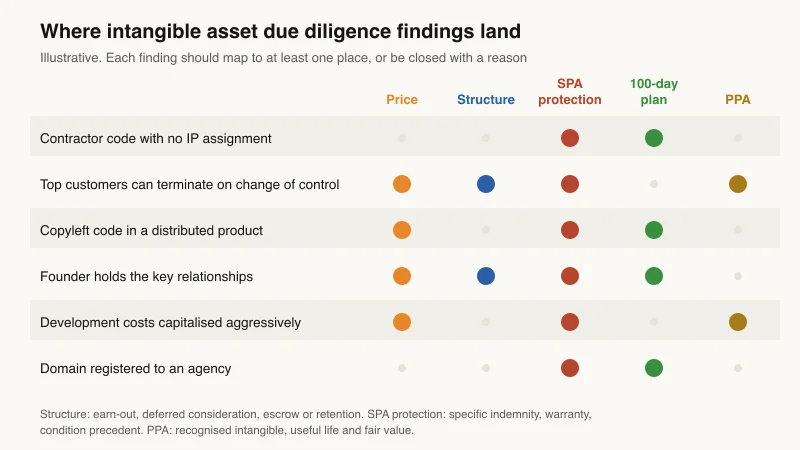
Where intangible asset due diligence findings land. Illustrative: each finding maps to a price adjustment, a structural term, a contractual protection, a post-completion owner or the PPA.
Converting each finding into a number in the model, a clause in the agreement or an owner after completion is a discipline of its own; our companion article on moving from diligence findings to deal terms works through it finding by finding.
Timing the Workstream and What It Should Produce
The intangible workstream should run in parallel with financial and legal diligence, not after them, because its findings change the price and the drafting.
Intangible asset due diligence timetable
Stage
Timing
Intangible workstream activity
Preliminary assessment
Before the letter of intent
Desktop review: registers, website, product, public filings and charges
Detailed diligence
After the letter of intent, before the SPA
The ten-area checklist, the valuation range and the risk scoring
PPA within the measurement period; the 100-day plan for each open finding
A complete exercise produces four deliverables: a register of every material intangible with ownership, transferability and evidence noted against each; a preliminary valuation range per asset with the method documented; a scored risk matrix with a proposed response to each finding; and a PPA readiness note, so the post-completion allocation reuses the diligence work rather than repeating it. After completion, that register becomes the acquirer's record for the intangible assets lifecycle: protection, amortisation, renewal and eventual disposal.
Sector Focus
The checklist applies everywhere; the weight on each area does not.
Where intangible asset due diligence concentrates by sector
Sector
Areas that usually carry the value
Specific checks
Software and SaaS
Software, customer relationships, data
Open-source scan, contractor assignments, cohort churn, third-party API dependencies
Professional services
Customer relationships, key people
Who holds each client, notice periods and covenants, partner retention
Life sciences
Patents, regulatory approvals, data
Remaining patent life, freedom to operate, approval transferability, clinical data rights
Consumer brands
Trade marks, brand, domains
Mark coverage in each sales territory, domain and channel control, licensing and disputes
Financial services
Regulatory permissions, customer relationships
FCA permissions and change-in-control approval, book retention, outsourcing contracts
ℹ Note
In regulated sectors the change of ownership itself may need approval. A buyer acquiring control of an FCA-authorised firm needs the FCA's approval before completion (the PRA's, for a dual-regulated firm such as a bank or insurer), which belongs in the deal timetable from the start.
Where Opagio Fits
Opagio Intangibles supports the intangible workstream; it does not perform legal due diligence. Title opinions, contract review and data-protection advice stay with the buyer's lawyers.
What it does is give the workstream a structure. It identifies and classifies a target's intangible assets across Opagio 12, values the material ones with the Asset Valuator's recognised methods (relief from royalty, MPEEM, with-and-without, cost approach and others), and records each one in the Opagio Value Drivers Register, the evidence base the post-completion purchase price allocation can reuse. The Normalised P&L restates the target's earnings through documented adjustments on a stated basis, which is where the capitalised development question can be tested.
It is the part of acquisition due diligence that examines the target's non-physical assets: intellectual property, customer relationships, brand, data, software and the people who hold the know-how. It tests whether each asset exists, is owned by the target, will survive the change of ownership and is worth what the price assumes.
What should an intangible assets due diligence checklist include?
At minimum: IP ownership and chain of title; registrations and renewals at UKIPO, EUIPO and USPTO; licences in and out with change-of-control terms; open-source exposure; customer contracts, concentration and churn; key-person dependency; data and the UK GDPR basis; brand and domain control; capitalised development costs; and valuation evidence. The table at the top of this guide sets out what to request for each.
What is IP due diligence?
IP due diligence is the intellectual property strand of intangible asset due diligence. It confirms that the target owns, or is properly licensed to use, the patents, trade marks, designs, copyright and know-how its business depends on, that registrations are valid and in the right name, and that nothing in a licence or charge stops the rights passing to the buyer.
When should intangible asset due diligence start?
Before the letter of intent, with a desktop review of the public registers, and in full straight after it. Findings that arrive after the price is agreed tend to become warranty claims rather than price adjustments, and the 12-month measurement period for the purchase price allocation is too late to discover them.
Who carries out intangible asset due diligence?
Usually a combination: lawyers for title, contracts and data protection; accountants for capitalised costs and the quality of earnings; valuers for the asset-level ranges; and technical specialists for code scans. The buyer's deal team owns the synthesis, which is where a single register of the assets, their evidence and their risks earns its keep.
Tony Hillier is Chairman of Opagio with 30 years of experience in structured finance, M&A advisory, and asset valuation. He has led due diligence on over 200 transactions across financial services, technology, and professional services sectors. Meet the team.
Share:
TH
Tony Hillier — Chairman, Co-Founder
MA, Balliol College, University of Oxford | Harvard Business School MBA with Distinction
Most intangible asset diligence stops at an inventory. The inventory is not the deliverable. What a buyer actually needs is the line from each finding to a number in the model, a clause in the agreement, and an owner in the first hundred days.
A step-by-step guide to purchase price allocation (PPA): a worked example that reconciles from consideration to goodwill, the PPA journal entries, deferred tax on the step-ups, and how IFRS 3, ASC 805 and FRS 102 change the answer.
IAS 38 measures intangible assets at cost. Valuation enters through IFRS 3, IAS 36 and IFRS 13. When each standard asks for a value, on what basis, and which method fits each kind of asset.
Private equity firms are acquiring AI-enabled targets at record rates, but traditional due diligence frameworks miss critical AI-specific risks. This article provides a comprehensive AI due diligence methodology covering technical, commercial, regulatory, and talent dimensions.
Get the latest insights on intangible asset growth and productivity delivered to your inbox.
We use essential cookies to make our website work. We'd also like to use analytics cookies to improve your experience. You can manage your preferences at any time.
Cookie Policy