Our Data Processing Agreement changes on 2 November 2026.
Version 3.0 changes what it says about how our AI service providers handle the data we send them. There is no new sub-processor.
Read what is changing
Our Privacy Policy changes on 9 November 2026.
Version 5.1 updates how we use information about your use of Opagio and our emails, how we handle enquiries, and the service providers that help us.
Read what is changing
Intangible Assets Lifecycle: A Strategy and Management Guide
By Ivan Gowan· 2026-10-12intangible assets lifecycleintangible asset lifecycle managementintangible asset managementintangible asset strategyias 38frs 102ip protectionvalue drivers register
Intangible asset lifecycle management is the discipline of running each intangible asset, from software, data and customer contracts to patents and trade marks, through seven stages: identify, create or acquire, protect, measure and value, exploit, maintain and renew, and retire or dispose. Each stage has a named owner, a record and an accounting consequence. An intangible asset strategy decides which assets deserve attention and when; the lifecycle is how that strategy is carried out, one asset at a time.
Last reviewed: October 2026. Written for UK companies reporting under FRS 102, with IAS 38 alongside for groups reporting under IFRS, and for UKIPO and Companies House practice. General information, not legal, accounting or tax advice. All examples are illustrative.
7stages in the intangible assets lifecycle, from identification to disposal
10 yearsmaximum amortisation period under FRS 102 where, exceptionally, a useful life cannot be reliably estimated (18.20)
20 yearsmaximum term of a UK patent, kept in force by yearly renewal fees from the fourth anniversary of filing
Most scale-ups manage their physical assets better than their intangible ones. The laptops are on a fixed asset register with a depreciation schedule; the code base, the customer data, the brand and the know-how that produce most of the company's value often have no owner, no record and no review date. The first time anyone lists them properly is usually in a diligence request, which is the worst time to discover that a contractor still owns the core algorithm or that a trade mark lapsed last year.
What is the intangible assets lifecycle?
📚 Definition
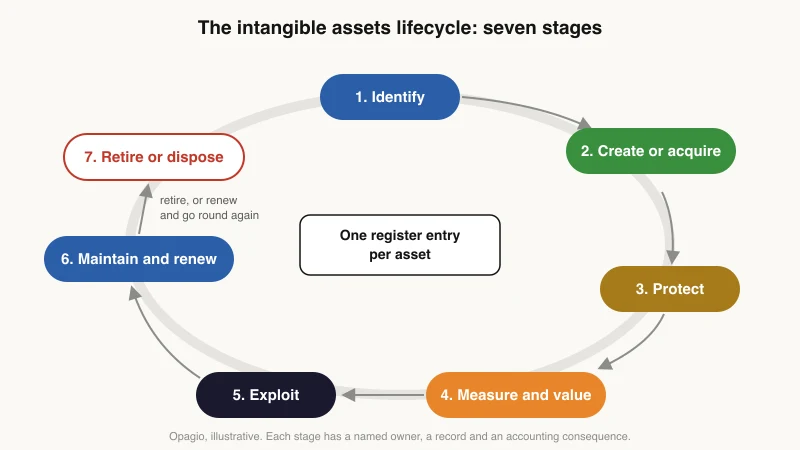
The intangible assets lifecycle is the sequence of stages an intangible asset passes through while a company holds it: identified, created or acquired, protected, measured and valued, exploited, maintained and renewed, and finally retired or disposed of. Lifecycle management assigns an owner, a record and a set of decisions to each stage, so that the asset keeps its legal protection, its accounting treatment stays correct and its value can be evidenced when it is needed.
Tangible assets wear out in a broadly predictable way. Intangible assets do not: a patent can be legally valid long after the technology it protects is obsolete, and a brand can gain value for decades while the accounts carry it at nothing. That is why every intangible asset runs on three clocks at once, and why managing it means watching all three.
The three clocks on every intangible asset
Clock
What it measures
What sets it
Example
Legal life
How long the legal right lasts
Statute and registration: a UK patent lasts up to 20 years; a UK trade mark 10 years, renewable indefinitely; copyright in software the author's life plus 70 years; a trade secret as long as it stays secret
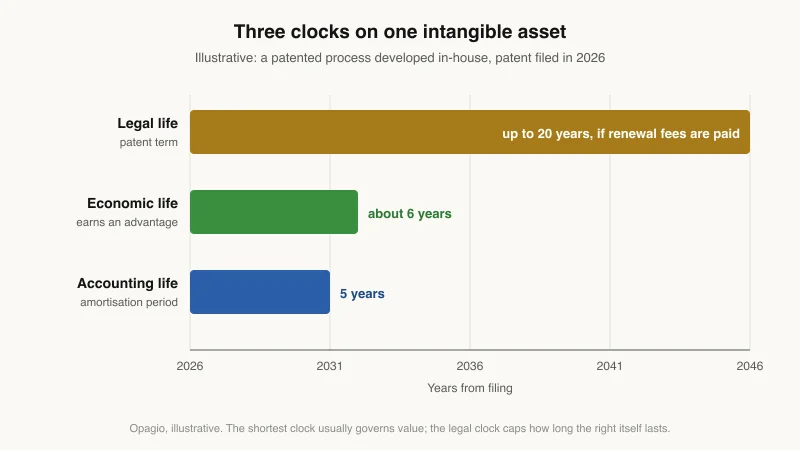
A patent filed in 2026 can run to 2046 if every renewal fee is paid
Capitalised development costs amortised over five years
The three clocks for one illustrative asset. The shortest clock usually governs value; the legal clock caps how long the right itself lasts.
The clocks need not end in order: some assets keep earning after their legal protection expires, as our comparison of useful life vs economic life shows. When the clocks drift apart unnoticed, value leaks. A company that keeps paying renewal fees on patents whose economic life has ended is spending cash on nothing; one that amortises software over ten years when it is rebuilt every four is overstating its assets; one that lets a trade mark lapse while the brand is growing has lost a right it will need at exit.
The seven stages of the intangible assets lifecycle
Each stage below has a typical owner and a record it should produce. The table is the summary; the sections that follow cover each stage in turn.
Intangible asset lifecycle stages at a glance
Stage
What happens
Key decisions
Record it produces
1. Identify
List what the company owns and relies on, on or off the balance sheet
What counts as a separate asset; which are material
An entry per asset in the register
2. Create or acquire
Build it, buy it separately or acquire it with a business
Who owns the result; whether development costs are capitalised
Ownership documents; cost records
3. Protect
Register, contract and keep confidential
Which rights to register, and where
Registrations, assignments, NDAs, access controls
4. Measure and value
Carry it in the accounts; value it when a decision needs a number
Accounting treatment; valuation method and timing
Carrying amount; valuation with method stated
5. Exploit
Use it, license it, borrow against it or sell it
Keep, license or monetise
Licences, security documents, sale agreements
6. Maintain and renew
Pay renewals, use the mark, review useful life, refresh the asset
Renew or let go; reinvest or harvest
Renewal log; useful-life and impairment reviews
7. Retire or dispose
Let it lapse, abandon it, sell it or license it out
When, how and at what value
Derecognition entry; register closed with reason
The seven stages of the intangible assets lifecycle. Retired assets leave the loop; renewed ones go round again.
1. Identify
Identification is the inventory: every asset the company owns or depends on, whether or not it appears in the accounts. Most of a scale-up's valuable intangibles never reach the balance sheet. Internally generated brands, customer lists and similar items are barred from recognition under both IAS 38.63 and FRS 102 18.8C(a), and many companies expense their development spend. A useful starting list is our guide to the types of intangible assets.
Treat an asset as separate when it could be described, owned and transferred on its own: the platform code, the customer data set, the brand and its trade marks, a material customer contract, a documented process. Group the rest. The test of a good inventory is whether a new finance director could find each material asset, its owner and its evidence without asking the founder.
2. Create or acquire
Assets arrive in three ways, and each sets up a different record. Built in-house, an asset's cost is its development spend, and the evidence trail starts on the day the work starts. Bought separately, it is recognised at cost. Acquired with a business, it is valued at fair value in the purchase price allocation and recognised separately from goodwill.
Ownership is decided at creation, and UK law does not always give it to the company. An employee's invention belongs to the employer under the Patents Act 1977 (s.39) when it is made in the course of the employee's normal or specifically assigned duties and an invention might reasonably have been expected to result from them, and copyright in an employee's work made in the course of employment belongs to the employer unless agreed otherwise (Copyright, Designs and Patents Act 1988, s.11(2)). A contractor or agency keeps the copyright in what it writes unless it assigns it, and an assignment of copyright is not effective unless it is in writing and signed by or on behalf of the assignor (CDPA 1988, s.90(3)).
⚠ Warning
The commonest gap in a scale-up's intangibles is code, designs or content written by freelancers, agencies or founders before incorporation, with no written assignment to the company. It costs little to fix while relations are good and a great deal once a buyer's lawyers find it. Collect signed assignments from every contributor as a matter of routine, not as a pre-deal clean-up.
3. Protect
Protection comes from three sources: registration, contracts and confidentiality. Registered rights are the strongest evidence of ownership because a public register confirms them. Contracts protect what cannot be registered and control how rights move. Confidentiality protects know-how, and only for as long as the company takes reasonable steps to keep it secret: under the Trade Secrets (Enforcement, etc.) Regulations 2018 (reg. 2), information is a trade secret only if it is secret, has commercial value because it is secret, and has been subject to reasonable steps to keep it secret.
Measurement happens on two tracks that should never be confused. The accounts measure a recognised asset at cost less amortisation and impairment, and most internally built intangibles are not in the accounts at all. A valuation measures what an asset is worth to a market participant, using a recognised method such as relief from royalty, the multi-period excess earnings method, with and without, a cost approach or a market approach; our explainer on intangible asset valuation methods covers when each fits.
Value an asset when a decision needs the number: a funding round, a sale, a loan secured on intangibles, an acquisition, an impairment test, or a choice between keeping and selling a right. A valuation with its method and assumptions written down is evidence; a figure in a pitch deck is not.
★ Key Takeaway
The accounts and the valuation answer different questions. The accounts say what the company spent and has not yet written off; the valuation says what the asset is worth. A lifecycle record keeps both, side by side, and never lets one stand in for the other.
5. Exploit
An asset earns its keep in four ways. The company can use it, which is how most intangibles create value: the platform runs the business, the brand wins the customer. It can license it to others for a royalty, as our guide to royalty rate benchmarking explains. It can borrow against it: UK lenders now take security over registered IP and contracted revenue, covered in our guide to IP-backed lending. Or it can sell it, by assignment, on its own or as part of the business.
Each route leaves a record that a later buyer or lender will read. A licence may restrict what the company can do with its own asset; a charge over IP must be delivered to Companies House for registration within 21 days beginning with the day after its creation, or it is void against a liquidator, administrator or creditor (Companies Act 2006, ss.859A and 859H), and our FAQ on registering a charge over IP explains how.
✔ Example
A scale-up licenses a non-core module of its software to a partner in another sector for a royalty on the partner's sales. The licence brings in income without diverting the product team, but it is exclusive in that sector for five years. Two years later a buyer for the whole company operates in that sector. The licence now sits in the data room as a restriction, and its terms affect the price. Recording each licence against the asset it covers, with its term and exclusivity, is what makes that discoverable before the buyer finds it.
6. Maintain and renew
Maintenance keeps both the right and the asset alive. Registered rights need renewal fees paid on time, and a UK trade mark can be revoked for non-use if, without proper reasons, it is not put to genuine use within five years of registration or its use is suspended for an uninterrupted five years (Trade Marks Act 1994, s.46). Copyright and trade secrets need the evidence kept current: version history, contributor assignments and access controls. The underlying assets need reinvestment: code refactored, data cleaned, the brand kept consistent, key people given successors.
The accounts need maintenance too. Under IAS 38 the useful life and amortisation method of an asset are reviewed at least at each financial year end (IAS 38.104); under FRS 102 they are reviewed when there is an indication that they have changed (18.24). A product roadmap that replaces a platform early is exactly such an indication, and our FAQ on the difference between amortisation and impairment covers what follows from it.
7. Retire or dispose
Every asset leaves eventually. Some are retired on purpose: a patent family no longer worth its renewal fees, a product brand merged into the main one, a data set deleted because the company has no lawful basis to keep it. Some are sold or licensed out because another owner can use them better. The failure case is the asset that lapses by accident: a renewal missed, a domain not renewed, a secret that leaked because nobody owned it.
In the accounts, an asset is derecognised on disposal or when no future economic benefits are expected from its use or disposal, and the gain or loss goes to profit or loss (IAS 38.112–113; FRS 102 18.26). Under IAS 38 a gain on disposal is not revenue. The register entry should close with the date, the reason and any proceeds, so the history survives the asset.
Intangible asset strategy: setting priorities across Opagio 12
A company cannot give every asset the same attention, and an intangible asset strategy is the decision about where that attention goes. Our masterclass lesson on building that strategy sets out the four-phase framework; this section is the practical question of priority.
At Opagio we organise intangible assets under the 12 value drivers of the Opagio 12™ framework: Brand & Reputation, Customer Capital, Technology & Innovation, Content & IP, Data & Intelligence, Switching Costs & Lock-In, Network Effects & Platforms, Human Capital, Organisational Capital, Culture & Ways of Working, Regulatory & Compliance, and Ecosystem & Partnerships. Using one consistent set of drivers means nothing falls between departments, and the board sees the same structure every quarter.
Priority follows three questions: how much value sits in the asset, how exposed it is, and what the company's next event will test. The next event matters most, because it decides who will read the record and when.
Where to start, by the company's next event
Next event
Drivers that usually need attention first
What the reader will test
Series B or later round
Technology & Innovation, Data & Intelligence, Customer Capital
Ownership of code and data, defensibility, quality of recurring revenue
Sale of the company
Customer Capital, Organisational Capital, Brand & Reputation, Human Capital
Whether value transfers without the founders; concentration; clean title
Borrowing against intangibles
Content & IP, Brand & Reputation, Customer Capital
Human Capital, Culture & Ways of Working, Switching Costs & Lock-In
Retention, documented processes, how hard customers find it to leave
This is a starting point drawn from what investors, buyers and lenders ask for, not a formula. A company whose value sits in a regulated licence will put Regulatory & Compliance first whatever the event; one built on a marketplace will start with Network Effects & Platforms.
★ Key Takeaway
Strategy sets the order; the lifecycle does the work. Pick the assets the next event will test, take each through the protect and measure stages first, and make sure each has a named owner before the event starts rather than during it.
Governance: who owns which asset
The commonest reason intangibles decay is that nobody owns them. Finance owns the numbers, legal owns the contracts, and the assets themselves fall between the two. Good intangible asset management gives every material asset one named owner who is accountable for its lifecycle, and gives the finance function ownership of the record.
A board needs a rhythm, not a one-off review. Three cadences cover it.
Quarterly: register changes in the board pack
New assets, disposals, renewals due in the next two quarters, and any asset whose owner has left. One page, the same every quarter.
Annually: a full lifecycle review
Useful lives and impairment indicators reviewed with the year-end accounts; renewals for the coming year approved or dropped; valuations refreshed for the assets that matter most.
Event-driven: before a raise, sale, loan or acquisition
A targeted review of the assets the event will test, run early enough to fix what it finds. Also triggered by a key person leaving or a dispute over ownership.
Share of material assets on the register with a named owner
Coverage of the inventory
Create or acquire
Share of development spend documented against the capitalisation criteria at the time
Whether the evidence trail exists when it is needed
Protect
Share of material assets with title confirmed in the company's name
Transferability to a buyer or lender
Measure and value
Material assets valued in the last 12 months, with the method recorded
Readiness for a raise, sale or loan
Exploit
Licence income; facilities secured on intangible assets
Whether assets earn beyond their own use
Maintain and renew
Renewals paid before the deadline; months of notice on the next one
Whether rights are at risk of lapsing
Retire or dispose
Assets retired by decision rather than by omission
Whether exits are managed
ℹ Note
Avoid measures that reward volume for its own sake. A rising patent count says little if half the families protect products the company no longer sells. Coverage, title and timeliness say more about whether the portfolio is under control.
Accounting touchpoints at each stage
The accounting treatment of an intangible asset changes as it moves through the lifecycle. In the UK, most private companies report under FRS 102 Section 18; groups reporting under IFRS apply IAS 38, with IFRS 3 for business combinations and IAS 36 for impairment. Our FAQ on FRS 102 and IFRS for intangible assets sets out the wider differences.
IAS 38 and FRS 102 Section 18 by lifecycle stage
Stage and event
IAS 38 (IFRS)
FRS 102 Section 18 (UK GAAP)
Create: research
Expensed as incurred (IAS 38.54)
Expensed as incurred (18.8E)
Create: development
Capitalised when all six criteria in IAS 38.57 are met; required, not optional
A policy choice: capitalise development that meets the criteria in 18.8H, applied consistently to all such spend (18.8K), or expense it all
Create: internally generated brands, customer lists and similar items
Never capitalised (IAS 38.63)
Never capitalised (18.8C(a))
Acquire: bought separately
Measured at cost (IAS 38.24)
Measured at cost (18.10)
Acquire: with a business
Separately from goodwill if separable or arising from contractual or legal rights (IFRS 3)
Separately from goodwill when separable and arising from contractual or legal rights; an entity may choose to also include those meeting only one of the two tests (18.8)
Measure: carrying amount
Cost less amortisation and impairment; revaluation only where an active market exists (IAS 38.75)
Cost less amortisation and impairment; revaluation only by reference to an active market (18.18, 18.18B), which is rare
Maintain: amortisation
Finite life: amortised over its useful life (IAS 38.97). Indefinite life: not amortised, tested for impairment at least annually (IAS 38.107–108)
Every intangible has a finite life (18.19); where, in exceptional cases, it cannot be reliably estimated, no more than 10 years (18.20)
Maintain: useful-life review
At least at each financial year end (IAS 38.104)
When there is an indication of change (18.24)
Maintain: impairment
IAS 36
Section 27 (18.25)
Retire: derecognition
On disposal or when no future benefits are expected; gain or loss in profit or loss, not revenue (IAS 38.112–113)
On disposal or when no future benefits are expected; gain or loss in profit or loss (18.26)
Any stage: costs already expensed
Cannot later be added to an asset's cost (IAS 38.71)
Cannot later be added to an asset's cost (18.17)
The development row is where UK companies most often have a choice to make. Under FRS 102 a company may capitalise development costs that meet the criteria, or expense all of them, but it must apply the policy it chooses consistently. Under IAS 38 capitalisation is required once the criteria are met. Either way, the decision is only as good as the records made at the time: once a cost has been expensed it cannot be reinstated later. Our guides to R&D capitalisation under IFRS and to setting an IAS 38 capitalisation policy cover the criteria in detail, and the FRS 102 Section 18 and IAS 38 glossary entries summarise each standard. Tax follows separate rules, so take advice before relying on the accounting treatment for a tax outcome.
The lifecycle also feeds the deal numbers. A buyer will usually treat recurring development spend as an operating cost when it builds normalised EBITDA, whatever the accounting policy, and the acquirer's purchase price allocation will revalue the assets the accounts never recognised.
ℹ Note
A register can hold assets the accounts will never show, and it must keep the two apart. Opagio keeps three sets of figures separate and never mixes them. Reported is the accounts as filed: the fact. Accounting-eligible shows what the accounting standards would let the accounts show. Management is a non-statutory model, useful for running the business, and never presented as reportable or auditable.
The Opagio Value Drivers Register™ as the operating record
The lifecycle needs one record that every owner updates and the board reads. Spreadsheets kept by different departments drift apart, and the version that reaches a buyer is rarely the one anyone maintained.
In Opagio Intangibles, the Opagio Value Drivers Register™ is that record: the register of an organisation's intangible assets across Opagio 12. Each named asset sits under its value driver with a description and its supporting evidence attached, together with its book value, useful life and amortisation method, the valuation method used and when it was last valued, and whether it is active, impaired or disposed. The register is auditable and exportable, and it is maintained continuously as the business changes rather than rebuilt before each event. The Asset Valuator values the material assets with recognised methods, the Growth Plan sets KPIs and targets against them, and the Normalised P&L carries the earnings side. The same record answers a diligence request, supports a lending application and gives the post-completion purchase price allocation a starting point.
It does not replace your IP counsel's renewal docket, your auditor or an independent valuer, and it does not file anything at UKIPO or Companies House. It holds the record they all work from.
Run the lifecycle from one record
Opagio Intangibles gives a scale-up one register of its intangible assets across the Opagio 12 framework, with evidence, accounting values and valuations held against each asset, so the board, investors and buyers read the same record. See how Opagio works for growing companies.
Frequently Asked Questions
What is intangible asset lifecycle management?
Intangible asset lifecycle management is the practice of running each intangible asset through the stages a company holds it for: identify, create or acquire, protect, measure and value, exploit, maintain and renew, and retire or dispose. Each asset has a named owner and a record, so its legal protection, accounting treatment and evidence of value stay current rather than being rebuilt before a raise or a sale.
What are the stages of the intangible assets lifecycle?
There are seven: identification, creation or acquisition, protection (registrations, contracts and confidentiality), measurement and valuation, exploitation (use, licensing, borrowing against it or selling it), maintenance and renewal, and retirement or disposal. Assets that are renewed go round the loop again; those that are retired leave it, with a derecognition entry if they were on the balance sheet.
What is the difference between intangible asset strategy and intangible asset management?
Intangible asset strategy decides which assets matter most and what the company wants from them, usually shaped by its next event: a funding round, a sale or a loan. Intangible asset management is the operational work that carries the strategy out: owners, registrations, contracts, accounting, renewals and the register. Strategy sets the priorities; lifecycle management delivers them asset by asset.
When is an intangible asset derecognised?
Under IAS 38 and FRS 102 Section 18, an intangible asset is derecognised when it is disposed of or when no future economic benefits are expected from its use or disposal. The gain or loss, the difference between any net proceeds and the carrying amount, is recognised in profit or loss. Under IAS 38 a gain on disposal is not classified as revenue.
Can you capitalise development costs under FRS 102?
Yes, as a policy choice. FRS 102 allows a company to capitalise development costs that meet the criteria in paragraph 18.8H, including technical feasibility, the intention and ability to complete and use or sell the asset, and reliable measurement, provided the policy is applied consistently to all qualifying spend (18.8K). The company may instead expense all development costs. Under IAS 38, capitalisation is required once the criteria are met.
Who should own intangible asset management in a scale-up?
Each material asset should have one day-to-day owner in the function that uses it: the CTO for software and patents, marketing for the brand and trade marks, the revenue lead for customer contracts. The chief financial officer should own the register and the accounting treatment, and the board should review the register every quarter and in full once a year.
Next steps
Start with the assets your next event will test. List them, give each an owner, confirm the company's title, and record the evidence and the accounting treatment in one place. Then set the quarterly and annual rhythm so the record stays current without a project to rebuild it.
Ivan Gowan is Founder and CEO of Opagio. He spent twenty-five years in fintech, including fifteen at IG Group building its trading platforms, before founding Opagio to help companies measure, manage and grow the intangible assets that drive their value. Meet the team.
How to account for SaaS implementation spend under IAS 38: the two IFRIC agenda decisions, configuration vs customisation, when the cost is expensed, prepaid or capitalised, and how US GAAP gives a different answer on the same ledger.
A development-cost capitalisation policy template for IFRS reporters, section by section, with the cost rules of IAS 38.66-67, the evidence auditors ask for against each of the six tests, and the FRS 102 policy-choice variant.
IFRS 1 governs a company's first IFRS financial statements. This guide covers the date of transition, the opening IFRS balance sheet, the exemptions that matter for goodwill and intangibles, and a checklist for UK companies.
We use essential cookies to make our website work. We'd also like to use analytics cookies to improve your experience. You can manage your preferences at any time.
Cookie Policy