Our Data Processing Agreement changes on 2 November 2026.
Version 3.0 changes what it says about how our AI service providers handle the data we send them. There is no new sub-processor.
Read what is changing
Our Privacy Policy changes on 9 November 2026.
Version 5.1 updates how we use information about your use of Opagio and our emails, how we handle enquiries, and the service providers that help us.
Read what is changing
Normalised EBITDA: The Adjustments and a Worked EBITDA Bridge
By Tony Hillier· 2026-10-12normalised ebitdaebitda bridgeadjusted ebitdaebitda normalisation adjustmentsselling a business ukfrs 102quality of earnings
Normalised EBITDA is a company's reported EBITDA restated to show the earnings a buyer would inherit under normal ownership at market terms. Adjustments run in both directions: one-off costs and personal spending are added back, while the extra cost of paying an underpaid owner or a below-market rent at market rates is deducted, as is a provision released into profit. Because a buyer applies its multiple to this figure, every £10,000 of normalised EBITDA is worth £50,000 of enterprise value at an illustrative 5.0x, and every adjustment has to survive a buyer's diligence.
Last reviewed: October 2026. Written for UK private companies reporting under FRS 102, with IFRS 16 alongside for groups reporting under IFRS. General information, not accounting or tax advice. All figures are illustrative.
£1.5m → £1.2mreported to normalised EBITDA in the worked bridge below
1 Jan 2026FRS 102 lease changes apply to periods starting on or after this date
£50kof enterprise value per £10k of EBITDA at an illustrative 5.0x
This guide is for owners and finance directors of UK businesses turning over roughly £1m to £100m who are preparing to sell. It covers the number itself: what normalised EBITDA is, how it differs from adjusted and underlying EBITDA, the adjustments a buyer will expect to see and which way each one goes, and how to build the bridge from reported to normalised EBITDA with arithmetic a buyer's advisers can check.
It is not a guide to valuation method. For how the multiple is chosen and applied, read how to value a business, whose first worked example normalises a different business from £850,000 to £1,000,000. For what a buyer is likely to pay for your company, see how much is my business worth.
What is normalised EBITDA?
EBITDA (earnings before interest, tax, depreciation and amortisation) is the usual starting point for valuing a profitable private company, because it removes the effect of how the business is financed and of its depreciation and amortisation policies. But the EBITDA in your statutory accounts reflects how you have chosen to run the company: what you pay yourself, where you rent from, what you run through the business, and the unusual events of the year. A buyer will not own the business on those terms.
📚 Definition
Normalised EBITDA is reported EBITDA adjusted to remove items that will not continue under new ownership and to restate non-market arrangements at market terms. It is the sustainable, owner-independent earnings figure that a buyer applies its valuation multiple to.
The adjustments matter far more than their face value. A buyer pricing your business on an EV/EBITDA multiple multiplies every adjustment by the same multiple. At 5.0x, a £60,000 add-back you can evidence adds £300,000 to the enterprise value; one you cannot evidence costs you that £300,000 and some of the buyer's trust in everything else you present.
The reconciliation from the reported figure to the normalised one is called an EBITDA bridge. It lists each adjustment, its direction, its amount and the evidence behind it. A well-built bridge is the most useful single financial document a seller can take into a sale process.
Adjusted EBITDA, normalised EBITDA and underlying EBITDA
The terms are often used interchangeably, including on this site, but they are not the same thing. None of them is defined in FRS 102 or IFRS, so whoever uses one should state what it includes. The table sets out how each is usually meant in UK practice.
EBITDA terms compared
Term
Where you meet it
What it removes or adds
Who defines it
EBITDA
Management accounts, lending covenants
Interest, tax, depreciation and amortisation only
Convention; a loan agreement defines its own
Adjusted EBITDA
Listed company results, investor reporting, loan agreements
Items management considers non-recurring or non-cash, such as restructuring or share-based payments
The company, as an alternative performance measure reconciled to its statutory profit
Underlying EBITDA
Listed company results
Usually the same as adjusted: items presented as exceptional or non-underlying
The company
Normalised EBITDA
Selling or buying a private company
One-off items, plus owner-specific and non-market arrangements restated at market terms, in both directions
The seller's bridge, tested and often revised by the buyer
Pro forma or run-rate EBITDA
Deal documents, lending
Adds the full-year effect of events part-way through the period, such as a new contract or an acquisition
The party presenting it; the riskiest of these figures
Maintainable EBITDA
Investor valuations, private equity
The earnings expected to continue, after normalisation, often with a forward view
The investor
Adjusted EBITDA describes what management chose to exclude; normalised EBITDA describes what a buyer would earn. The second asks a wider question, which is why it includes adjustments that make the figure smaller, such as paying an owner a market salary. Investors applying the IPEV Guidelines use a close cousin, maintainable earnings.
ℹ Note
When anyone quotes you an EBITDA multiple, ask which EBITDA it was calculated on. A multiple drawn from deals priced on normalised, pre-lease EBITDA applied to your reported EBITDA under the new FRS 102 lease rules gives a meaningless answer.
The EBITDA normalisation adjustments, and which way each one goes
Most normalisation adjustments fall into a small number of families. The direction depends on your facts: an owner can be overpaid or underpaid, and a rent can be above or below market. The table gives the usual direction and the evidence a buyer's advisers will ask for.
EBITDA normalisation adjustments at a glance
Adjustment
Usual direction
Evidence a buyer will ask for
Owner's remuneration restated to market
Either: add back if overpaid, deduct if underpaid
Payroll records, a market benchmark for the role, the post-sale management structure
One-off and non-recurring items
Add back costs; deduct one-off income
Invoices, settlement agreements, board minutes, three years of history
Related-party rent restated to market
Either; usually deduct, as owners often charge below market
The lease, an independent rent opinion
Non-trading and personal costs
Add back
Expense ledgers, a schedule of each item
Bad debts and stock provisions
Either: back to a normal level
Aged debtors, write-off history, stock counts and provisioning policy
Pro forma (run-rate) adjustments
Usually add
Signed contracts, delivery evidence, margin analysis
Leases under IFRS 16 or amended FRS 102
Usually deduct, to restore rent as an operating cost
Lease schedules, the transition note in the accounts
Capitalised development costs
Usually deduct, where the spend recurs
Capitalisation policy, timesheets, the development project list
Owner's remuneration restated to market
Many UK owner-managers pay themselves a modest salary and take most of their income as dividends. Dividends are paid out of profit, not charged against it, so EBITDA is overstated: a buyer will need to pay someone a full market package to do your job. The adjustment is a deduction equal to the gap between what you are paid and what the role would cost, including employer's National Insurance and pension. The reverse also happens: an owner drawing a large salary for a role that would cost less generates an add-back. Family members on the payroll who do not work in the business are added back in full.
One-off and non-recurring items
Costs that will not recur under new ownership are added back: a legal dispute settled in the year, the costs of the sale itself, a one-off office move. One-off income is deducted on the same logic: a grant, an insurance receipt, a profit on selling a property. The test is whether the item would recur if the business carried on as it is.
⚠ Warning
Buyers call it "recurring non-recurring": a cost labelled one-off that appears, under a different description, every year. Restructuring, redundancy, consultancy and "project" costs are the usual examples. If similar costs appear in each of the last three years, a buyer will treat them as part of the cost of running the business, and claiming them as one-off damages your credibility on every other adjustment.
Related-party rent restated to market
Owners often hold the premises personally, in a property company or in a pension scheme, and charge the trading company a rent that suits the family rather than the market. A buyer will either take a new lease on market terms or expect to, so the rent is restated to market. Where the current rent is below market, as it often is, the adjustment is a deduction. The same applies to purchases from, or services provided by, any other connected company.
Non-trading and personal costs
Costs that benefit the owner rather than the business are added back: personal vehicles, family phone contracts, club memberships, school fees, holidays, a second home. So is spending a new owner would not continue, such as a sponsorship that reflects the owner's interests. Keep a schedule of each item with ledger references. A buyer will accept a documented list of modest items far more readily than a single round number.
Bad debts and stock provisions
A normal level of bad debt is a cost of trading and stays in EBITDA. The adjustment brings an unusual year back to that normal level: a large write-off when a major customer enters administration is added back down to the average, and a year with an unusually low charge is adjusted the other way. Stock provisions work in both directions too. A provision released into profit after a stock review, with no matching sale, flatters EBITDA and is deducted; an exceptional write-down of obsolete stock may be added back, if it is genuinely exceptional. Buyers test both against your provisioning policy, and will ask whether it has changed.
Pro forma (run-rate) adjustments, and their risk
A pro forma adjustment adds the full-year effect of something that happened part-way through the year: a new contract won in the autumn, a price increase, a cost saving, a loss-making branch closed. It presents the earnings as if the change had applied for the whole period, in the way pro forma financial statements do.
These are the adjustments buyers trust least, because they describe earnings the business has not yet produced. A buyer will usually accept the full-year effect of a contract that is signed, started and delivering at a known margin. It will usually reject savings not yet made, contracts not yet signed and pipeline. Where a pro forma adjustment is large, expect the buyer to move part of the price into an earn-out that pays only if the earnings arrive.
Leases: IFRS 16 and the FRS 102 changes from 1 January 2026
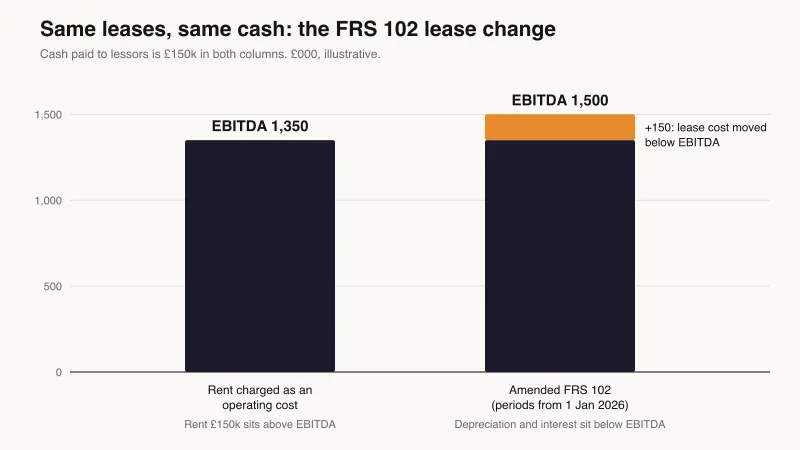
Under IFRS 16, which has applied to groups reporting under IFRS since 2019, a lessee recognises most leases on its balance sheet as a right-of-use asset and a lease liability. The rent no longer appears as an operating cost; it is replaced by depreciation of the asset and interest on the liability, both of which sit below EBITDA. EBITDA rises by roughly the rent, with no change in the cash the business pays.
The FRC's Periodic Review 2024 amendments bring a lessee model based on IFRS 16, with some simplifications, into FRS 102 Section 20, for accounting periods beginning on or after 1 January 2026. They apply to small companies reporting under Section 1A as well, because Section 1A relaxes disclosure, not recognition and measurement. Short-term leases and leases of low-value assets can still be expensed. On transition a lessee does not restate its comparative year (FRS 102 paragraph 1.47), so the first accounts under the new rules show the current year under the new rules and the prior year under the old ones.
The same leases and the same cash, before and after the amended FRS 102 lease rules (£000, illustrative).
For a seller, the result is a three-year earnings history that is not like for like. A December year-end company selling in 2027 will show 2024 and 2025 EBITDA with rent as an operating cost and 2026 EBITDA without it. The bridge must put every year on the same footing, and the earnings and the net debt must match. If the buyer prices on EBITDA with rent as an operating cost, the liabilities for leases that were operating leases under the old rules are left out of net debt. If it prices on EBITDA after the lease change, the lease liabilities are usually counted as debt-like items, which reduces the equity price. Counting the lease twice, or not at all, is an easy error to make in either direction.
Capitalised development costs
Under FRS 102, a company may choose a policy of capitalising development costs that meet the criteria in paragraph 18.8H, and must then apply it consistently (18.8K). Under IAS 38, capitalisation is required when the criteria are met. Either way, development spend that is capitalised leaves operating costs and returns as amortisation below EBITDA, so a company that capitalises reports a higher EBITDA than an identical company that expenses. Our glossary entry on development costs sets out the criteria.
Buyers usually look through the policy. Where development spend recurs every year to keep a product current, they treat it as an operating cost and deduct it in their view of normalised EBITDA. Spending on a genuinely new product may be accepted as investment, but it then appears as capital expenditure in the buyer's cash flow analysis, so it still affects the price. Present the capitalised amounts for each year, with the projects behind them, rather than leaving the buyer to find them.
A worked EBITDA bridge
Consider an illustrative UK distribution and services business with a 31 December year-end, preparing for a sale process in 2027. Its 2026 accounts are the first under the amended FRS 102 lease rules and show reported EBITDA of £1,500,000.
The facts behind the adjustments
Item
The facts in 2026
Leases
£150,000 a year of property, warehouse and vehicle leases, all operating leases under the old rules, including £40,000 for premises owned by the owner's pension scheme, now charged as depreciation and interest
Development
£180,000 of staff costs on the customer portal capitalised, with similar amounts in prior years
Owner
A £60,000 salary plus dividends, against £180,000 for a market managing director package including employer's National Insurance and pension
One-offs
£85,000 of legal costs to settle a dispute with a former distributor; £70,000 of restructuring costs, after £55,000 in 2024 and £60,000 in 2025
Rent
The related-party premises are let at £40,000 against an independent market rent of £70,000
Personal costs
£30,000 of the owner's car, family phones and a club membership
Provisions
A £75,000 bad debt charge after a customer entered administration, against an average of £20,000 a year over the previous three years; £35,000 of a slow-moving stock provision released into profit with no matching sale
New contract
Signed in September and invoiced from 1 October: £15,000 of contribution in the fourth quarter, £60,000 over a full year
The bridge sets out the accounting-policy adjustments first, to put the year on the same footing as the prior years and the buyer's comparables, and the normalisation adjustments second.
Worked EBITDA bridge: reported to normalised EBITDA (illustrative, £000)
Line
Direction
£000
Running total
Why
Reported EBITDA, 2026
1,500
1,500
First year under amended FRS 102 Section 20
Leases restated as an operating cost
Deduct
−150
1,350
Matches 2024, 2025 and a pre-lease pricing convention
Capitalised development treated as an operating cost
Deduct
−180
1,170
Recurring spend to keep the portal current
Like-for-like EBITDA
1,170
1,170
Subtotal of the accounting-policy stack
Owner's remuneration to market (£60k paid, £180k market)
Deduct
−120
1,050
A buyer must pay a managing director
One-off legal costs, distributor dispute
Add back
+85
1,135
Settled; no similar costs in prior years
Restructuring costs claimed as one-off
Not adjusted
0
1,135
Similar costs in each of the last three years
Related-party rent to market (£40k paid, £70k market)
Deduct
−30
1,105
A buyer will pay a market rent
Owner's personal costs
Add back
+30
1,135
Schedule with ledger references
Bad debts to the three-year average (£75k charged, £20k average)
Add back
+55
1,190
Customer administration; normal charge retained
Stock provision release reversed
Deduct
−35
1,155
A credit with no matching sale
Pro forma: full-year effect of the new contract (£60k less £15k)
Add back
+45
1,200
Signed, started, margin evidenced
Normalised EBITDA
1,200
1,200
Normalisation stack: +30
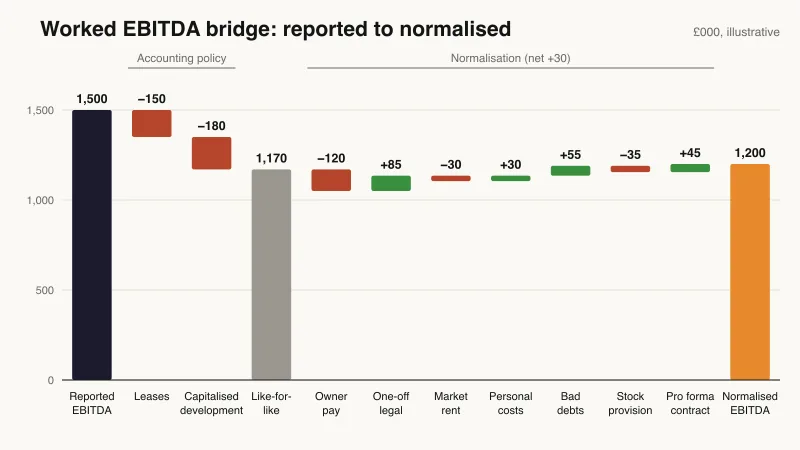
The bridge reconciles in two steps: 1,500 − 150 − 180 = 1,170, and 1,170 − 120 + 85 + 0 − 30 + 30 + 55 − 35 + 45 = 1,200.
The worked EBITDA bridge: accounting-policy adjustments, then normalisation (£000, illustrative).
Normalised EBITDA is £300,000 lower than the reported figure. The whole of the fall comes from the two accounting-policy adjustments (£330,000); the normalisation stack on its own adds a net £30,000, because the owner's under-market salary and rent offset the add-backs. That pattern is not unusual in owner-managed businesses, and it is the reason an honest bridge persuades: it shows the seller has made the adjustments that cost money as well as those that add it.
✔ Example
At the illustrative 5.0x multiple used in our how to value a business guide, the restructuring costs the seller chose not to claim would have been £350,000 of enterprise value (£70,000 × 5.0), and the owner's pay deduction alone is £600,000 (£120,000 × 5.0). Neither number is lost by leaving it out or putting it in: the buyer would have made both adjustments in diligence. The difference is whether the seller's bridge or the buyer's sets the agenda.
★ Key Takeaway
Build the bridge in two stacks, accounting policy first and normalisation second, with every year on the same footing. Show the adjustments that reduce EBITDA as clearly as those that raise it, and attach the evidence to each line.
What buyers push back on
A buyer's financial advisers will test every line of your bridge, and some adjustments draw challenge far more often than others. The table sets out the usual points of contention and how a seller can prepare for each.
Common buyer challenges to an EBITDA bridge
Item
Seller's case
Buyer's pushback
How to defend it
One-off costs
Will not recur
Similar costs appear every year
Three years of history showing the item is genuinely unusual
Pro forma contracts and savings
The run-rate is higher than the year shows
Not yet earned; savings not yet made
Signed contracts, invoices already raised, savings already in the monthly accounts
Owner's remuneration
Market salary is lower than assumed
A replacement will cost more, and may need a team
An external benchmark for the role and a credible post-sale structure
Capitalised development
It is investment, not cost
It recurs, so it is a cost of staying competitive
Project-level analysis separating new products from maintenance
Leases
EBITDA under the new rules is the reported figure
Rent is a real operating cost, or lease liabilities are debt
One consistent convention across all years and in net debt
Provision releases
The provision is no longer needed
The release flatters the year
Provisioning policy and a history of releases and charges
Share-based payments
Non-cash, so add back
Staff will need cash pay or new awards after the sale
Evidence of the post-sale incentive plan and its cost
Missing evidence
The adjustment is obvious
Not without documents
A schedule with ledger references and source documents for every line
Buyers also look at the trend. A business whose normalised EBITDA rises in the final year before a sale, driven by adjustments rather than trading, will be asked why, and the multiple will reflect the answer. The working capital peg is tested on the same logic: if provisions or payables have been managed at the year-end, the buyer will normalise working capital as well as earnings.
Normalised EBITDA and the quality of earnings review
The buyer's main test of your normalised EBITDA is the quality of earnings review: an accountant's report that rebuilds the bridge, checks each adjustment against evidence and asks whether the earnings are recurring, cash-backed and sustainable. Normalised EBITDA is the number; the quality of earnings report is the diligence document that tests it. Many sellers now commission their own sell-side review before going to market, so that the bridge a buyer sees has already been tested and the adjustments are agreed early rather than renegotiated late. Our FAQ on normalised EBITDA explained gives the short version for owners.
Normalisation is not capitalisation
Normalisation and capitalisation are different operations and should never be combined in one figure. Normalisation restates the earnings a buyer would inherit. Capitalisation, in the sense of treating spending on intangible assets as investment rather than cost, changes where costs sit in the accounts and raises EBITDA mechanically, without any change in what the business earns.
ℹ Note
Opagio keeps three sets of figures separate and never mixes them. Reported is the accounts as filed: the fact, and the starting point of every EBITDA bridge a buyer will read. Accounting-eligible shows what the accounting standards would let the accounts show. Management is a non-statutory model, useful for running the business, and never presented as reportable or auditable. A normalised EBITDA for a sale starts from Reported, and any capitalisation is shown as a separate, labelled step rather than folded into it. Opagio's Management view, which treats a wider range of spending as investment, is one such step: a model for running the business, not part of the normalised EBITDA a buyer prices.
This is why the worked bridge above treats the company's own capitalised development as an operating cost: the buyer's question is what the business earns, not how its accounting policies present it.
How to prepare your normalised EBITDA before a sale
Start twelve to twenty-four months before a sale, so that the adjustments you rely on are visible across more than one year of accounts.
1. Gather three years of accounts on the same footing
Statutory accounts, management accounts for the current year, and a note of every accounting policy change, including the FRS 102 lease transition and any capitalisation policy.
2. List every candidate adjustment, in both directions
Owner's pay, one-offs, related-party arrangements, personal costs, provisions, pro forma items, leases and capitalised costs. Include the ones that reduce EBITDA.
3. Test each against three years of history
Drop anything that recurs. A shorter list of evidenced adjustments is worth more than a long list of assertions.
4. Attach the evidence to each line
Ledger references, invoices, contracts, payroll records, rent opinions and board minutes, filed so a buyer's advisers can find them.
5. Build the bridge in two stacks and reconcile it
Accounting-policy alignment first, normalisation second, with a running total that ties to the penny and a convention for leases that matches your net debt.
6. Fix what you can before you go to market
Move the owner onto a market salary, put related-party leases on market terms and stop running personal costs through the business. Each fix removes an adjustment a buyer could dispute.
Build the bridge from your ledger
In Opagio Intangibles, the Normalised P&L holds every adjustment in one Adjustments table, each with its direction, amount, period, a narrative and links to its supporting documents, and draws the bridge from reported to normalised EBITDA. Capitalisation is shown as a separate, labelled stack, never inside the normalised figure, and the result feeds the valuation workspace. Alongside it, the Opagio Value Drivers Register™ evidences the intangible assets that set the multiple. It does not replace a quality of earnings review or a valuation of your business; it builds the evidence both will test. See how Opagio prepares a business for sale.
Frequently Asked Questions
What is normalised EBITDA?
Normalised EBITDA is reported earnings before interest, tax, depreciation and amortisation, adjusted to remove items that will not continue under new ownership and to restate non-market arrangements, such as the owner's salary and related-party rent, at market terms. It shows the sustainable earnings a buyer would inherit, and it is the figure a buyer applies its valuation multiple to.
What is the difference between adjusted EBITDA and normalised EBITDA?
Adjusted EBITDA is a company's own measure, excluding items management considers non-recurring or non-cash, and is common in listed company reporting. Normalised EBITDA is a deal measure: it removes one-off items and also restates owner-specific and related-party arrangements at market terms, which can reduce the figure as well as increase it. Both are undefined by accounting standards, so always ask what each includes.
What adjustments are made to normalise EBITDA?
The usual EBITDA normalisation adjustments are owner's remuneration restated to market, one-off costs and income, related-party rent restated to market, personal and non-trading costs, bad debts and stock provisions brought back to a normal level, the full-year effect of contracts already signed, lease costs under IFRS 16 or the amended FRS 102, and recurring development spend that has been capitalised. Each can move EBITDA up or down.
What is an EBITDA bridge?
An EBITDA bridge is a reconciliation from reported EBITDA to normalised EBITDA. It lists each adjustment with its direction, amount and supporting evidence, and shows a running total that ties exactly to both figures. A good bridge separates accounting-policy adjustments, such as leases and capitalised costs, from normalisation adjustments, and puts every year on the same footing.
Do the FRS 102 lease changes increase EBITDA?
Usually, yes. For accounting periods beginning on or after 1 January 2026, most leases under FRS 102 are recognised on the lessee's balance sheet, and the rent is replaced by depreciation and interest, both below EBITDA. Reported EBITDA rises by roughly the rent with no change in cash. Buyers adjust for this, either by restoring rent as an operating cost or by treating lease liabilities as debt.
Who prepares normalised EBITDA when you sell a business?
The seller, usually with their accountant or corporate finance adviser, prepares the first bridge. The buyer's financial advisers then test it in a quality of earnings review and produce their own view, and the two are negotiated. Sellers increasingly commission a sell-side review before going to market, so that the adjustments are agreed early and the price is less likely to be renegotiated.
Next steps
Normalised EBITDA is where the price of your business starts. Build it early, in both directions, on the same footing for every year, with evidence attached to each line, and the multiple becomes the main thing left to negotiate.
Tony Hillier is Chairman of Opagio with 30 years of experience in structured finance, M&A advisory, and asset valuation, including executive board roles at NM Rothschild & Sons and GEC Finance. Meet the team.
Share:
TH
Tony Hillier — Chairman, Co-Founder
MA, Balliol College, University of Oxford | Harvard Business School MBA with Distinction
A quality of earnings report tests whether the profit you are selling is real, recurring and backed by cash. What a QoE covers, when to commission a sell-side review, how it differs from an audit, and how its findings move the price.
How a private equity management incentive plan works in the UK: the institutional strip, sweet equity, the envy ratio, leaver terms, ratchets, the alternatives and the tax, with a worked exit waterfall.
A business valuation report is a written opinion of what a company is worth, on a stated date and basis. What a complete report contains, when you need an independent one, how to choose a valuer and how to read the conclusion.
Get the latest insights on intangible asset growth and productivity delivered to your inbox.
We use essential cookies to make our website work. We'd also like to use analytics cookies to improve your experience. You can manage your preferences at any time.
Cookie Policy