Our Data Processing Agreement changes on 2 November 2026.
Version 3.0 changes what it says about how our AI service providers handle the data we send them. There is no new sub-processor.
Read what is changing
Our Privacy Policy changes on 9 November 2026.
Version 5.1 updates how we use information about your use of Opagio and our emails, how we handle enquiries, and the service providers that help us.
Read what is changing
Business Valuation Report: What It Contains and Who Needs One
By Tony Hillier· 2026-10-12business valuation reportvaluation reportindependent business valuationwhat should a valuation report containbusiness valuationinternational valuation standardsbasis of valueselling a business ukshareholder disputeshmrc share valuation
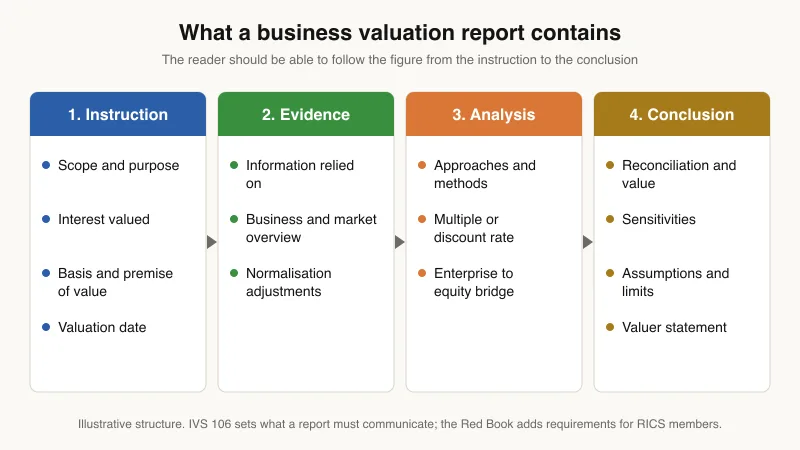
A business valuation report is a written opinion of what a company, or a shareholding in it, is worth at a stated date, for a stated purpose and on a stated basis of value, together with the evidence, methods and assumptions that produce the figure. A good one lets a reader who was not in the room, such as a buyer, a judge, HMRC or the other side of a dispute, follow the number from the accounts to the conclusion and see which assumptions it depends on. Under the International Valuation Standards, that means stating the scope, the basis of value, the valuation date, the information relied on, the approaches and methods used and why, how the results were reconciled, and the assumptions and limitations behind them.
Last reviewed: October 2026. Written for owners of UK private companies. Valuation references are to the International Valuation Standards (IVS) published by the International Valuation Standards Council (IVSC), 2025 edition, and to the RICS Red Book for RICS members. General information, not valuation, tax or legal advice. All figures are illustrative.
3principal valuation approaches under IVS: market, income and cost
£4.5m–£4.7mthe concluded equity value range in the worked example below
£1.7mbetween two credible discount rates on the same cash flows, which is why a report shows its sensitivities
This guide is for owners and finance directors of UK businesses turning over roughly £1m to £100m who have been told they need "a proper valuation": for a sale or a management buyout, a shareholder leaving, a divorce, an HMRC filing or a funding round. It covers the document: what a complete report contains, when it needs to be independent, and how to read one critically. How the figure itself is built, method by method, is in our guide to how to value a business.
This page is about the valuation of a whole business or a shareholding in it. Individual intangible assets, such as a brand, a customer base or a piece of software, can be valued in their own right, and that report is different in scope and method: see our guide to intangible asset valuation reports and the FAQ on what an intangible asset valuation report contains.
What is a business valuation report?
A valuation is a figure; a valuation report is the document that makes the figure usable by someone else. The same £4.6m means little on its own. In a report, it is the market value of 100% of the shares at 31 March, on a going concern basis, reached by an earnings multiple and cross-checked by a discounted cash flow, and the reader can see every step.
📚 Definition
A business valuation report sets out a valuer's conclusion of the value of a business or business interest, the basis of value and valuation date it applies to, the work done, the information relied on, the approaches and methods used, and the assumptions and limitations that apply. The International Valuation Standards set the reporting requirements in IVS 106, and the standard for businesses and business interests is IVS 200.
Owners often hold documents with a number in them that are not valuation reports. Knowing the difference matters, because each was written for a different reader and a different purpose.
A business valuation report and other documents that contain a value
Document
Who prepares it
What it is for
Why it is not a valuation report
Broker's or adviser's appraisal
A business broker or corporate finance adviser pitching to sell your business
The asking price and the achievable price in a sale
Usually a market view to win or run a sale, often with a fee tied to the price, so not independent
Indicative or calculation valuation
An accountant or valuer, on limited procedures
An early view, internal planning
Limited work and limited reliance; usually not suitable where a third party will rely on it
Telling a board whether a price is fair from a financial point of view
Answers whether a price is fair, not what the business is worth
Expert witness report
An independent expert instructed in litigation
Evidence to a court or tribunal
A form of valuation report with additional duties to the court, covered below
★ Key Takeaway
A valuation report is only as useful as its fit with the question being asked. A figure prepared to market a business, to test its earnings or to reassure a board is not a figure a court, HMRC or a departing shareholder will accept as a valuation.
What should a valuation report contain?
The International Valuation Standards set out what the valuer must agree before the work starts (IVS 101, scope of work) and what the report must communicate (IVS 106). RICS members also follow the RICS Red Book, which builds on IVS and adds its own requirements. The length of a report scales with its purpose: a valuation for a shareholder buy-back may run to a dozen pages, one for a contested dispute to many more. The core does not change.
Business valuation report checklist: what it should contain
Section
What it should state
What to check
Scope and purpose
Who instructed the valuer, why the valuation is needed, the intended users
That the purpose matches your use; a report for one purpose may not be relied on for another
Subject and interest valued
The company, and whether the value is of the whole business, 100% of the shares or a specific holding and class of share
A 10% holding is not worth 10% of the company
Basis of value
Market value, investment value, fair value or another basis, with its definition
That the basis is the one your purpose requires
Premise and level of value
Going concern or liquidation; controlling or minority; marketable or not
Any discount or premium, and why it applies
Valuation date
The single date the value applies to, and the report date
Events after the valuation date that were or were not taken into account
Information relied on
Accounts, management accounts, forecasts, interviews, market data, and what was and was not verified
Whether the forecast is management's, the valuer's or adjusted, and who stands behind it
Business and market overview
What the business does, its customers, people, assets and market
That it describes your business, not a generic one
Approaches considered
Market, income and cost, which were used and why the others were rejected
A reason for each choice, not just a list
Methods used
The method within each approach, such as an earnings multiple or a discounted cash flow
That the method suits the business: earnings for a profitable trader, assets for a holding company
Normalisation adjustments
Each adjustment to reported earnings, its amount and the evidence for it
Every adjustment, in both directions, with documents behind it
Multiple or discount rate
Where the multiple or discount rate came from: comparables, transactions, a risk build-up
The comparables named, and each premium or discount explained
Enterprise to equity bridge
Debt, surplus cash, working capital and debt-like items
Items you would argue about in a sale, treated consistently
Reconciliation and conclusion
How the results of different methods were weighed, and the concluded value or range
An explanation of any gap, not an average that hides it
Sensitivities
How the value changes with the key assumptions
Which assumption moves the value most
Assumptions and limiting conditions
General and special assumptions, restrictions on use, liability limits
Any special assumption that changes what is being valued
Valuer statement
The valuer's status, independence, qualifications, the standards followed, and a signature
Any previous involvement with the business, disclosed
The anatomy of a business valuation report: what the reader must be able to follow, from the instruction to the conclusion.
Scope, purpose and the interest valued
The first pages should tell you what question the report answers. A valuation of 100% of a company for a sale, of a 25% holding for a shareholder buy-out and of the same holding for inheritance tax can produce three different figures from the same accounts, and all three can be right. The scope also records who may rely on the report. A report prepared for the company's board is not addressed to a buyer or a bank, and the engagement terms usually say so.
Basis of value and standard of value
The basis of value is the precise question the valuer is answering. Under the 2025 edition of IVS the bases are set out in IVS 102. US practice calls the same idea the "standard of value". Two further choices sit alongside it: the premise of value, usually a going concern for a trading business, and the level of value, which is whether the interest carries control and whether it can readily be sold.
Bases of value a UK business valuation report may use
Basis
The question it answers
Where you meet it
Market value (IVS)
What a willing buyer and a willing seller, acting knowledgeably and without compulsion, would agree at arm's length after proper marketing
Most sale, lending and general-purpose valuations
Investment value, or worth (IVS)
What the business is worth to a particular owner or buyer, with its own plans and benefits
A specific buyer's view, or an owner's decision whether to sell
Equitable value (IVS)
A price that is fair between two identified parties, reflecting what each gains or loses
Some shareholder agreements and negotiated transfers
Synergistic value (IVS)
The value of two or more interests combined, where it exceeds their separate values
A buyer that can merge the business with its own
Liquidation value (IVS)
What the assets would realise if sold piecemeal, orderly or forced
Insolvency, lending against assets, a business that cannot continue
A hypothetical open-market sale, under tax rules and case law
Capital gains tax, inheritance tax, employee share schemes
The last two rows are where reports most often go wrong. "Fair value" in a company's articles is not the IFRS 13 definition, and a minority holding valued for tax is not a pro rata share of the whole. Whether a minority discount or a discount for lack of marketability applies depends on the basis, the documents and, in a dispute, the court. A report should state which applies and why.
⚠ Warning
Check the basis of value before you read the number. A correct valuation on the wrong basis is the wrong answer, and a report prepared on market value for a sale will not usually serve for a leaver valuation under your articles, or for HMRC.
Valuation date and information relied on
Every figure in a report is at one valuation date. Events after that date are generally reflected only if they were known, or knowable with reasonable due diligence, at that date, although tax rules and the courts have their own approaches, and the report should say how it treated anything that happened in between. The information section lists what the valuer used, and, just as important, what it did not verify. Most business valuations rely on management's forecast without auditing it; the report should say so, and should say whether the valuer adjusted the forecast and why.
Approaches and methods
IVS 103 sets out three valuation approaches: the market approach, the income approach and the cost approach. For a business, the cost approach is usually applied as an adjusted net asset method, which is why our how to value a business guide calls it the asset approach. A report should say which approaches it used, which it considered and rejected, and why. For a profitable trading business, a typical report applies an earnings multiple as the primary method, cross-checks it with a discounted cash flow, and sets the adjusted net assets as a floor.
Normalisation adjustments
Most of the argument about a private company's value is about its earnings, not its multiple. A report should list every adjustment from reported to normalised earnings: owner's pay restated to market, one-off costs removed, related-party rent re-based, and the adjustments that reduce earnings as well as those that increase them. Our guide to normalised EBITDA sets out each adjustment and a full EBITDA bridge, and a buyer's quality of earnings review will test each one against evidence.
Multiple or discount rate derivation
This is the section that most often decides whether a report is credible. "We have applied a multiple of 5.0x" is an assertion. A report should show where the multiple came from: named comparable companies or transactions, how they differ from your business in size, growth and risk, and the adjustment made for each difference. For a discounted cash flow, it should show how the discount rate was built up, including any premium for company-specific risk such as owner dependency or customer concentration, and the evidence for it. The FAQ on choosing a valuation multiple explains the main multiples.
✔ Example
Two reports value the same business at 5.0x and 6.0x normalised EBITDA. The first names five comparable transactions and deducts a turn for customer concentration, with the revenue analysis in an appendix. The second cites "market multiples for the sector". On £1.0m of earnings the gap is £1.0m, and only one of the reports lets a reader decide which figure to believe.
Reconciliation, sensitivities and assumptions
When two methods give different results, the reconciliation explains why and states how the valuer reached a conclusion, as a point or a range. Sensitivity analysis then shows how far the value moves when the main assumptions change. The assumptions section lists the general assumptions (for example, that the information supplied is accurate) and any special assumptions, which are facts the valuer has been told to assume that differ from reality at the valuation date, such as a contract being renewed. A special assumption changes what is being valued, so it should be prominent, not buried in an appendix.
Valuer independence and qualifications
The report should end with a statement of who the valuer is, what qualifies them, whether they are independent of the business and the parties, any previous involvement with the business, and the standards the report complies with. RICS members working under the RICS Red Book must disclose their status and any material involvement. Our comparison of IVS 210 and the RICS Red Book shows how the two frameworks fit together in a lending context.
Worked example: the reconciliation and sensitivity pages
Take the illustrative UK services business from our how to value a business guide: normalised EBITDA of £1.0m, borrowings of £0.8m, surplus cash of £0.3m, adjusted net assets of £1.5m, and a five-year forecast of free cash flow from £600,000 to £750,000. Here is how the closing pages of a report on 100% of its shares, at market value on a going concern basis, would present the result.
Reconciliation of methods (equity value, illustrative)
Method
Role in the report
Key input
Equity value
Earnings multiple
Primary method
5.0x normalised EBITDA of £1.0m, less £0.5m net debt
£4.50m
Discounted cash flow
Cross-check
15% discount rate, 2% long-term growth, less £0.5m net debt
£4.66m
Adjusted net asset value
Floor
Net assets of £1.2m plus £0.3m property uplift
£1.50m
Concluded range
The multiple and the DCF agree within about 4%
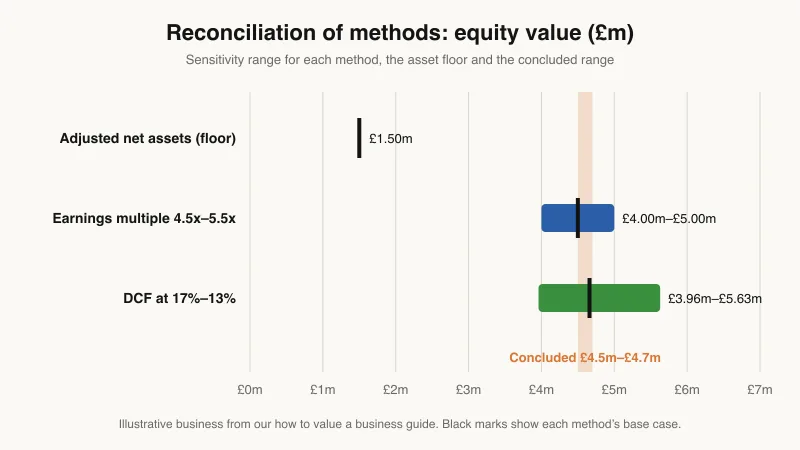
£4.5m–£4.7m
Sensitivity of equity value to the key assumptions (illustrative)
Assumption
Low
Base
High
EBITDA multiple (4.5x / 5.0x / 5.5x)
£4.00m
£4.50m
£5.00m
DCF discount rate (17% / 15% / 13%)
£3.96m
£4.66m
£5.63m
How a valuation report presents its conclusion: each method's sensitivity range, the asset floor and the concluded range (£m, illustrative).
Three things in these pages tell a reader the report is doing its job. The methods agree, and the report says by how much. The sensitivity table shows that two percentage points on the discount rate moves the value by more than either change in the multiple, so the risk assessment behind the rate deserves the closest reading. And the asset floor, £3.0m below the concluded range, shows how much of the value depends on things the balance sheet does not record.
★ Key Takeaway
Read a valuation report from the back. The reconciliation tells you how confident the valuer is; the sensitivities tell you which assumption to challenge; the assumptions tell you what the figure is not.
Who needs an independent business valuation?
An independent business valuation is one prepared by a valuer who has no interest in the outcome: not paid by results, not acting for one side in the transaction, and free of any relationship with the business that would compromise their objectivity. Not every situation needs one. A sale is usually priced by negotiation, and a buyer will form its own view whatever you show it. Where a figure has to be accepted by someone who did not choose it, such as a court, HMRC or a departing shareholder, independence is usually what makes it acceptable.
When an independent business valuation is usually needed
Situation
Who usually asks for it
Basis usually used
What the report has to withstand
Sale to a third party
Rarely required; sometimes the board or minority shareholders
Market value
The buyer's own diligence; a report sets expectations, the market sets the price
In litigation, the report becomes evidence and the valuer becomes an expert witness. In England and Wales, Part 35 of the Civil Procedure Rules makes the expert's overriding duty one to the court, not to the party paying the fee, and the report has to comply with the court's requirements for expert evidence. Our FAQ on expert witnesses in valuation disputes covers the role.
ℹ Note
For tax, the relevant value is generally market value on a hypothetical open-market sale, and HMRC's Shares and Assets Valuation team may review valuations used for tax purposes, including for capital gains tax, inheritance tax and employee share schemes. The processes HMRC offers for checking or agreeing some of these valuations are described in our guide to how to value a business. This is general information, not tax advice: take advice from a UK tax adviser before relying on any valuation for tax.
Choosing a valuer and commissioning the report
In the UK there is no single licence for valuing a business, so the valuer's qualifications, experience and standards matter. Business valuations are commonly prepared by chartered accountants, including members of the ICAEW, with corporate finance or valuation experience; by valuation specialists, some of whom hold the CFA charter; and by RICS Registered Valuers, who work to the Red Book. For a dispute, choose a valuer with expert witness experience; for HMRC, one who prepares tax valuations regularly.
Cost and timing vary widely with the purpose, the size and complexity of the business, the number of entities, the state of the records and whether the report must stand up in court. Ask two or three valuers to quote against the same written scope, and ask what the fee covers if the report is challenged. Our FAQ on the cost to sell a business puts valuation and diligence among the other costs of a sale.
1. Define the purpose, the interest and the basis
Why you need the valuation, whether it is the whole business or a holding, and which basis of value the purpose requires. Check your articles and shareholders' agreement first.
2. Choose a valuer who fits the purpose
Qualifications, experience of the purpose (sale, dispute, tax), independence from you and the other parties, and the standards they will follow.
3. Agree the engagement letter
The scope, valuation date, basis of value, intended users, reliance, fee and timetable, in writing, before work starts.
4. Prepare the information
Three years of accounts, current management accounts, a forecast you can defend, and the evidence for every normalisation adjustment.
5. Review the draft for facts, not for the number
Correct factual errors in the draft. Pressing an independent valuer to change the conclusion undermines the report's independence.
6. Use the report for the purpose it was written for
A report for one purpose, date or basis may not serve another. Ask the valuer before relying on it elsewhere.
How intangible assets show up in a valuation report
The multiple and the discount rate are where a valuer prices risk, and most of that risk sits in assets the balance sheet does not record. In the worked example, £3.0m of the £4.5m equity value sits above the net assets. The report's derivation section is where that gap is explained, and the explanation is only as strong as the evidence behind it.
Valuation report sections and the intangible evidence behind them
Report section
The question behind it
Evidence that answers it
Normalisation adjustments
Will these earnings continue under a new owner?
Contracts, renewal history, documents for each adjustment
Multiple derivation
Is this business better or worse than the comparables?
How dependent is the business on the owner or a few customers?
Who holds each key relationship, documented processes, customer concentration
Forecast and DCF
Are the growth assumptions supported?
Pipeline, retention data, ownership of the technology and know-how that deliver growth
Reconciliation
Why is the earnings value well above net assets?
A register of the intangible assets that produce the earnings, with evidence for each
A valuer can only reflect what can be evidenced. An owner who arrives with the contracts, retention data and relationship maps already organised gives the valuer something to cite in the derivation section, rather than a judgement to defend.
Prepare the evidence a valuer will test
In Opagio Intangibles, the Opagio Value Drivers Register™ records your intangible assets across Opagio 12, with the supporting evidence attached to each one. The Normalised P&L holds every earnings adjustment with its direction, amount, period, narrative and linked documents. The Asset Valuator values individual intangible assets with recognised asset-level methods, such as relief from royalty and the multi-period excess earnings method, and reports on them. Opagio does not prepare independent business valuations or business valuation reports, and it does not replace a valuer; it organises the evidence an independent valuer, a buyer or HMRC will look for. See how Opagio prepares a business for sale.
Keep reported figures separate
A valuation report starts from the statutory accounts and the management accounts that reconcile to them. Any figure you give a valuer should say which set it belongs to.
ℹ Note
Opagio keeps three sets of figures separate and never mixes them. Reported is the accounts as filed: the fact, and the starting point of every valuation report. Accounting-eligible shows what the accounting standards would let the accounts show. Management is a non-statutory model, useful for running the business and for explaining where value sits, but never presented as reportable or auditable, and never as the earnings a valuer should apply a multiple to.
Frequently Asked Questions
What is a business valuation report?
A business valuation report is a written opinion of the value of a business or a shareholding in it at a stated date, for a stated purpose and on a stated basis of value. It sets out the information relied on, the approaches and methods used, the reconciliation of their results, the sensitivities and the assumptions, so a reader can follow and test the conclusion.
What should a valuation report contain?
At minimum: the scope and purpose, the interest valued, the basis and premise of value, the valuation date, the information relied on, the approaches and methods used and why, the normalisation adjustments, how the multiple or discount rate was derived, the bridge to equity value, the reconciliation and conclusion, sensitivities, assumptions and limiting conditions, and a statement of the valuer's independence, qualifications and the standards followed.
What is an independent business valuation?
An independent business valuation is prepared by a valuer with no interest in the outcome: not paid on results, not acting for one side, and with no relationship with the business that would compromise their objectivity. It is usually needed when a figure must be accepted by someone who did not choose it, such as a court, HMRC or a departing shareholder.
How much does a business valuation report cost?
It varies widely with the purpose, the size and complexity of the business, the state of the records and whether the report must withstand a dispute. A short report for a simple shareholder transfer costs far less than an expert report for litigation. Ask several valuers to quote against the same written scope.
Who can prepare a business valuation report in the UK?
There is no single licence for valuing a business in the UK. Reports are commonly prepared by chartered accountants with valuation or corporate finance experience, by valuation specialists, some holding the CFA charter, and by RICS Registered Valuers working to the Red Book. Choose a valuer whose experience matches the purpose and who is independent of the parties.
Will HMRC accept my business valuation report?
HMRC's Shares and Assets Valuation team may review valuations used for tax purposes and can disagree with them. A report prepared on the correct basis for tax, by a valuer experienced in tax valuations, with its evidence and reasoning set out, is better placed to withstand that review. Take advice from a UK tax adviser.
Is a valuation report the same as what a buyer will pay?
No. A report on market value estimates what a hypothetical buyer would pay; an actual buyer pays what it negotiates, based on its own diligence, its plans and the competition for the deal. Our guide to how much is my business worth covers the buyer's view of the multiple.
Next steps
A business valuation report is only as good as its fit with the question being asked and the evidence it can cite. Settle the purpose and basis of value first, choose a valuer independent of the outcome, and prepare the evidence for the earnings and the intangible assets behind them before the valuer asks.
Tony Hillier is Chairman of Opagio with 30 years of experience in structured finance, M&A advisory, and asset valuation, including executive board roles at NM Rothschild & Sons and GEC Finance. Meet the team.
Share:
TH
Tony Hillier — Chairman, Co-Founder
MA, Balliol College, University of Oxford | Harvard Business School MBA with Distinction
Eight ways to exit a UK owner-managed business, compared on price, speed, certainty, control and tax: trade sale, private equity, MBO, MBI, employee ownership trust, IPO, family succession and an orderly wind-down.
Your business is worth a multiple of its normalised earnings, and a buyer sets that multiple on assets your balance sheet never shows. Here is how the number is built, and how to move it before you sell.
Normalised EBITDA is the profit a buyer multiplies. Here is every common adjustment and which way it goes, the 2026 FRS 102 lease change, and a worked EBITDA bridge from £1.5m reported to £1.2m normalised.
Get the latest insights on intangible asset growth and productivity delivered to your inbox.
We use essential cookies to make our website work. We'd also like to use analytics cookies to improve your experience. You can manage your preferences at any time.
Cookie Policy