Our Data Processing Agreement changes on 2 November 2026.
Version 3.0 changes what it says about how our AI service providers handle the data we send them. There is no new sub-processor.
Read what is changing
Our Privacy Policy changes on 9 November 2026.
Version 5.1 updates how we use information about your use of Opagio and our emails, how we handle enquiries, and the service providers that help us.
Read what is changing
Business Exit Strategies Compared: Trade Sale, MBO, EOT or IPO
By Mark Hillier· 2026-10-12business exit strategiesexit strategyemployee ownership trustmanagement buyouttrade saleIPOselling a business ukintangible assets
There are eight main business exit strategies for a UK owner: a trade sale to a strategic buyer, a sale to private equity, a management buyout (MBO), a management buy-in (MBI), a sale to an employee ownership trust (EOT), a stock market flotation (IPO), passing the business to the family, and an orderly wind-down. Trade sales and competitive private equity processes usually pay the highest price, and most of it at completion; MBOs and EOTs usually pay market value or less, much of it over several years; an IPO raises capital and sets a public price but is rarely a full exit on the day. Choose by ranking what matters most to you (price, certainty, speed, your role afterwards and legacy), then by which buyer will pay most for the assets your business actually has.
Your exit strategy is the plan; the route is the transaction that delivers it. This guide compares the routes, explains each, and shows how the intangible assets in your business change the price on each one.
Last reviewed 12 October 2026. UK law and tax as at that date. General information, not tax, legal or investment advice.
8main exit routes for a UK owner-managed business
18%Business Asset Disposal Relief rate from 6 April 2026, on up to £1m of lifetime gains
50%of the gain on a sale to an EOT is chargeable, for disposals from 26 November 2025
Business exit strategies at a glance
The table compares the main exit strategies for business owners on the points that usually decide the choice. Read the tax column as a pointer to the question to ask your adviser, not as an answer: reliefs depend on your facts, and several changed in 2024, 2025 and 2026. Timings are indicative ranges and vary deal by deal.
Exit routes compared: price, speed, certainty and control
Route
Price potential
Typical speed
Certainty
Your control after the deal
Tax position (pointer)
What buyers scrutinise
Best for
Trade sale
Highest where the buyer gains cost savings or extra revenue
Owners who put staff and legacy ahead of cash at completion
IPO (AIM or Main Market)
Can be high, but only part is sold at flotation
12 to 24 months
Low: depends on markets on the day
Diluted; public company duties
CGT on shares sold; AIM shares get 50% Business Relief
Track record, governance, reporting, the equity story
Larger growth companies that need capital
Family succession
Usually below market, often a gift
Years
High to agree; the outcome rests on the successor
Shared during the handover
Gift Hold-Over Relief; Business Relief for IHT
The successor's capability; fairness across the family
Family firms with a willing, able successor
Orderly wind-down or MVL
Net assets only, unless intangibles are sold first
3 to 12 months
High
None
Distributions usually capital; anti-avoidance rules apply
Solvency (a declaration of solvency)
Owner-dependent businesses with no buyer
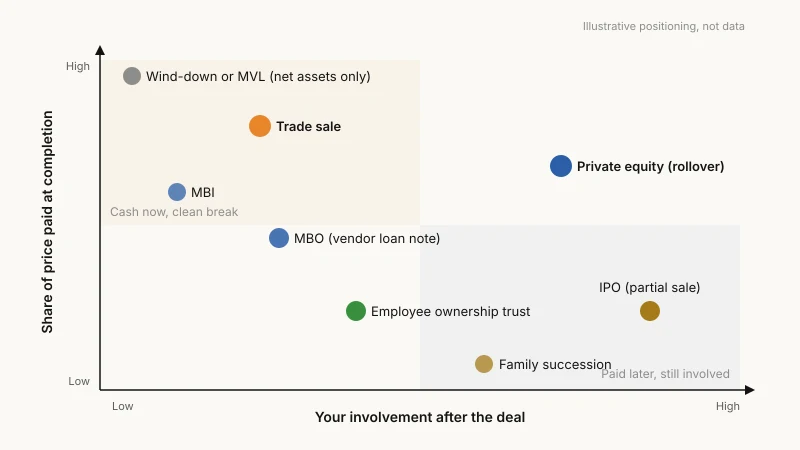
The eight exit routes by cash at completion and your involvement afterwards. Illustrative positioning; actual terms vary deal by deal.
Pros and cons of each exit route
Route
Main advantage
Main drawback
Trade sale
Highest price where the buyer gains from combining, mostly in cash
Warranties, earn-outs and integration can keep you exposed after completion
Private equity
Cash now, plus a second payout when the investor sells
You work to an investor's plan, with debt in the structure
MBO
Continuity for staff and customers; a buyer who knows the business
Much of the price is deferred and ranks behind the bank
MBI
A route when no insider can take over
Owners who are new to the business; more diligence and funding risk
EOT
A ready buyer, a lower tax rate and continuity for staff
No premium above market value; you are paid over years from profits
IPO
Capital for growth and a public market for your shares
Cost, disclosure, lock-ins and market risk; rarely a full exit
Family succession
Keeps the business in the family
Little or no cash, and tension if roles are unclear
Wind-down or MVL
Simple and certain
Goodwill and most intangibles are lost unless sold separately
★ Key Takeaway
No route wins on every column. Trade sales and competitive processes maximise price and cash at completion; MBOs and EOTs trade price and timing for certainty and continuity; an IPO is a financing event first and an exit second.
Trade sale vs private equity
A trade sale is a sale to a strategic buyer: a competitor, customer, supplier or a company moving into your market. Strategic buyers can pay more than financial buyers because they price the benefits of combining the two businesses, such as cost savings and cross-selling, and part of that value can be negotiated into your price. They usually want all the shares, a short handover, and warranties and indemnities that keep you exposed for a period after completion. Where the buyer doubts the forecast after due diligence, part of the price moves into an earn-out; our guide to earn-outs, warranties and life after the sale covers the terms.
Private equity buys a business to grow it and sell it again. For a founder, the first private equity deal is usually a primary buyout; a secondary buyout is when one fund sells to another. A private equity buyer pays most of the price in cash, funded partly by debt, and usually asks you and the management team to reinvest part of the proceeds as rollover equity. That stake is your second bite: if the next owner pays more, it can be worth a great deal. It also means you stay, typically on the board, working to the investor's plan. The managers who stay are usually offered sweet equity as well, through a management incentive plan.
✔ Example
A business with £2m of normalised EBITDA receives two offers. A trade buyer offers £14m for all the shares, in cash at completion, with a 12-month handover. A private equity house offers £13m, of which the owner reinvests £3m for a minority stake in the new holding company. If the investor sells four years later at a higher value, the stake can more than close the gap; if the plan misses, the trade offer was the better deal. The choice is a judgement about risk, not a sum. (Illustrative figures.)
Management buyout vs trade sale
In a management buyout the people running the business buy it. Its strength is continuity: customers, staff and suppliers deal with familiar faces, and a team that already knows the business needs less diligence than an outside buyer. Its weakness is money. Managers rarely have the capital to pay full value, so the price is assembled from bank debt, some management equity, sometimes a private equity investor, and very often the seller.
That last element is vendor financing. Part of the price is left in the business as a vendor loan note or other deferred consideration, repaid from future profits. Against a trade sale, an MBO usually pays a similar or lower headline price, with much less of it at completion.
✔ Example
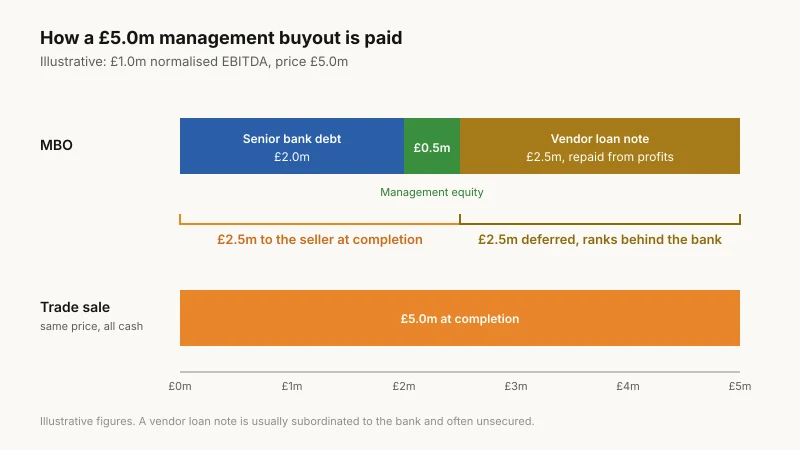
A management team agrees to buy a business with £1.0m of normalised EBITDA for £5.0m. The bank lends £2.0m, the managers invest £0.5m, and the seller leaves £2.5m in as a vendor loan note, repaid from profits once the bank debt has been paid down, typically over four to six years. The seller receives half the price at completion and becomes the second-ranking lender for the rest. (Illustrative figures.)
How the illustrative £5.0m management buyout is funded, and how much of the price the seller receives at completion.
⚠ Warning
A vendor loan note usually ranks behind the bank and is often unsecured. If trading falls, the bank is repaid first and your deferred consideration waits, or is lost. Negotiate interest, security, information rights and what happens on default before you sign, and compare the risk-adjusted value with a trade offer that pays more at completion.
When the buyer is an outside team: the MBI
A management buy-in brings in an external management team, usually backed by private equity or debt. It suits owners with no internal successor, but outsiders lack the insider's knowledge, so diligence is heavier and funding takes longer. Some deals combine the two, with an outside chief executive joining the existing team. Our FAQ on MBO vs MBI sets out the difference in more detail.
Employee ownership trust vs trade sale
An employee ownership trust (EOT) buys a controlling stake in the company and holds it for the benefit of all employees. The regime was introduced by the Finance Act 2014, in sections 236H to 236U of the Taxation of Chargeable Gains Act 1992. The trust is usually funded by the company itself: the sellers receive part of the price at completion from cash in the business, and the rest over several years from future profits that the company contributes to the trust.
For the sale to qualify for relief, the legislation sets eight relief requirements. Among them, the company must be a trading company or the holding company of a trading group; the trust must benefit all eligible employees on the same terms; the trust must hold more than 50% of the shares, votes and profit rights by the end of the tax year; and employees or directors who hold 5% or more of the company, together with employees connected to them, must not make up more than two-fifths of the workforce. The Autumn Budget 2024 added three requirements and tightened the rest of the regime.
The Autumn Budget 2024 changes to EOTs
Change (disposals on or after 30 October 2024)
What it means for a seller
The trustees must be UK resident, as a single body
No offshore trustee structures
Former owners and people connected to them must be fewer than half the trustees, and must not control the trust
You cannot keep control of the company through the trust
The trustees must take reasonable steps to ensure the price does not exceed market value, and that interest on deferred consideration is at a reasonable commercial rate
Expect an independent valuation; no premium above market value
Relief can be withdrawn from the seller if the conditions are broken before the end of the fourth tax year after the year of sale
Your relief depends on how the trust is run for years after you sell
Claims must state the sale price and the number of employees (claims made on or after 6 April 2025)
More disclosure to HMRC
The larger change came in Budget 2025. For disposals to an EOT on or after 26 November 2025, 50% of the gain is chargeable to Capital Gains Tax now, and the other 50% is held over, reducing the trustees' base cost so that it comes into charge if the trust later sells. Business Asset Disposal Relief cannot be claimed on a disposal where EOT relief is claimed, so the chargeable half is taxed at the normal CGT rates (24% for a higher-rate taxpayer).
£1.14mCGT on a £5m gain from a trade sale, using BADR on the first £1m
£0.60mCGT on the same gain from a sale to an EOT
4tax years after the year of sale in which EOT relief can be clawed back
ℹ Note
Illustrative only: a higher-rate taxpayer with a nil base cost, a £5m gain and the full £1m BADR lifetime limit unused, before the annual exempt amount. Trade sale: £1m at the 18% BADR rate plus £4m at 24%. EOT: half the gain (£2.5m) at 24%, with no BADR. Rates from gov.uk for disposals from 6 April 2026. This is general information, not tax advice; the tax on deferred consideration, and when it is payable, needs advice on your facts.
The EOT still offers a lower effective rate (12% in this example, against about 23% on the trade sale), but the gap is narrower than it was. It also carries two costs a trade sale does not: no premium above market value, and payment from the company's future profits, which leaves you exposed to how the business trades after you have handed over control.
The inheritance tax point
Inheritance tax belongs in the same conversation. A disposition by a close company to an EOT is not a transfer of value where the conditions in section 13A of the Inheritance Tax Act 1984 are met, so funding the trust does not in itself create an inheritance tax charge. For the seller, a wider point applies to every route: shares in an unlisted trading company can qualify for Business Relief, while the cash, or the debt owed to you by a trust or buyer, that replaces them generally does not. Since 6 April 2026, 100% Business Relief is capped at £2.5m of qualifying business and agricultural property, with 50% relief above that. Take inheritance tax advice before the sale, alongside the Capital Gains Tax advice.
IPO vs trade sale, and the dual track exit
A flotation, or initial public offering (IPO), lists the company's shares on a stock exchange. In the UK the choice is between AIM, the London Stock Exchange's growth market, and the Main Market. An IPO is first a financing event: the company usually raises new money, and existing shareholders sell only part of their holding at admission. Founders and directors usually agree lock-ins that restrict further sales for a period afterwards, and investors expect the people who built the business to stay. As an exit, it is gradual.
ℹ Note
The accounting framework depends on the venue. A Main Market listing requires UK-adopted IFRS. Since 5 August 2026, UK-incorporated AIM companies may prepare their accounts under UK GAAP (FRS 102) instead of IFRS. A later move from AIM to the Main Market would still require IFRS.
IPO or trade sale: how they compare
IPO
Trade sale
Proceeds to you on the day
Part of your holding, at the offer price
Usually most of the price in cash, less any deferred or earn-out element
Who sets the price
Institutional investors in the offer, then the market
One negotiated buyer, ideally in competition with others
Your role afterwards
Typically a director of a public company
Usually a handover, then out
Ongoing obligations
Disclosure, governance and market scrutiny; a nominated adviser on AIM
Warranties, indemnities and any earn-out, for a period
Preparation
Typically 12 to 24 months
Typically 6 to 12 months
Inheritance tax on shares you keep
AIM shares: 50% Business Relief; a minority Main Market holding: none
Not applicable: you hold cash
Best when
The business is large and growing, can bear public company costs, and has a story investors will back
A strategic buyer values the business above what the market would
Investors in a flotation price the business on its growth story and on how comparable listed companies trade; a trade buyer prices what the business is worth to them, including the benefits of combining it with their own. Which is higher depends on the market at the time. Before choosing, compare how IPO valuation methods would price the business with what trade and private equity buyers would pay, and work through an IPO readiness checklist covering the intangibles and valuation workstreams, ideally 18 to 24 months ahead. For the intangible assets that matter in a listing, see the public listing playbook; for an alternative to a conventional float, see direct listing vs IPO.
Dual track exit: an IPO and a sale in parallel
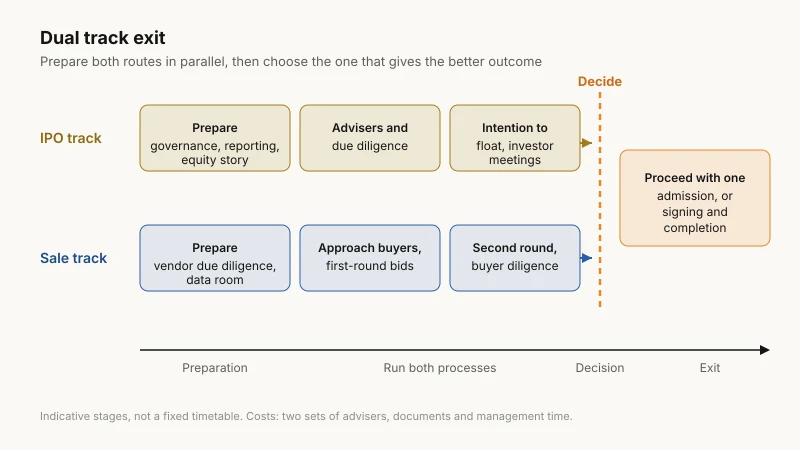
A dual-track exit runs IPO preparation and a sale process in parallel, and chooses between them late. The public route sets a reference price; the sale route offers cash and certainty if markets close. Buyers who know a flotation is credible have a reason to bid firmly, because the owner has a real alternative.
A dual track exit: both routes are prepared in parallel and the owner chooses late. Indicative stages, not a fixed timetable.
The cost is real: two sets of advisers, two sets of documents and a management team stretched across both. A dual track is credible only where the business could float on its own merits, so in practice it is a strategy for larger companies. For most owner-managed businesses, a competitive sale process with several trade and private equity bidders creates the same tension at lower cost.
Family succession and an orderly wind-down
Passing the business to the family
Family succession transfers the business by gift, by sale at an undervalue, or gradually over several years. Gift Hold-Over Relief can defer the Capital Gains Tax on a gift of shares in a trading company that is unlisted or is your personal company, so the recipient takes on the gain. Shares in an unlisted trading company can also qualify for Business Relief from inheritance tax, subject to the £2.5m cap on 100% relief from 6 April 2026. A gift drops out of your estate if you survive seven years, and if you do not, the recipient generally needs to still own the shares, and they must still qualify, for the relief to apply.
The hard question is rarely tax. It is whether the successor can run the business, and whether family members who are not involved are treated fairly. If customer and supplier relationships sit with you, they must pass to the successor, which is key person risk under another name. Succession usually pays the owner little in cash, so it works best where retirement does not depend on the proceeds.
Orderly wind-down or members' voluntary liquidation
If no buyer will pay more than the net assets, the remaining option is to stop trading, collect debts, sell the assets and distribute the cash, usually through a members' voluntary liquidation (MVL). An MVL is only available to a solvent company: the directors must make a statutory declaration that the company can pay its debts in full within twelve months. Distributions in an MVL are usually taxed as capital, and BADR may apply where the conditions are met, but anti-avoidance rules can tax them as income if you held 5% or more, go on to carry on a similar trade within two years, and avoiding income tax is a main purpose of the winding up.
⚠ Warning
In a wind-down, goodwill and most intangible assets are lost by default. Before you close, test whether the brand, software, content or customer relationships can be sold separately in an asset sale. Personal data can only be transferred lawfully, which limits what a customer list is worth to a buyer.
How intangible assets change the price on each route
Every route above prices the same business through a different lens. Most of what a buyer pays for (customer relationships, the brand, the technology, the know-how in the team) is not on the balance sheet, so it has to be evidenced in the sale. The Opagio 12 framework groups those assets into twelve categories. The table shows which of them move the price most on each route, and what each buyer will ask to see.
Which intangible assets each buyer pays for
Route
Who sets the price
Opagio 12 drivers that move it most
Evidence they will ask for
Trade sale
A strategic buyer pricing the benefits of combining
Clean IP title, governance, reporting and a growth case the assets support
Family succession
The family, usually below market
Brand & Reputation, Customer Capital, Human Capital
Whether relationships and know-how can pass from the owner
Wind-down or MVL
Asset buyers, piece by piece
Content & IP, Brand & Reputation, Data & Intelligence
Title, transferability and lawful transfer of data
The pattern matters when choosing. If your value sits in assets a strategic buyer can integrate, a trade sale or a competitive process will usually pay most. If it sits in a team and processes that run without you, private equity and an MBO become realistic. If the business depends on you, every route pays less, and the first job is to reduce founder dependency before you choose.
★ Key Takeaway
Decide which route values the assets you actually have, then use the run-up to build the evidence that buyer will test. The same asset is worth more on any route when its ownership, performance and transferability are documented.
Opagio Intangibles builds a Value Drivers Register of the named intangible assets in your business across the Opagio 12 value drivers, with the evidence for each. The Asset Valuator values individual assets using standard asset-level methods, including relief from royalty, MPEEM and with-and-without, and the company valuation workspace brings DCF, trading comparables and a growth bridge together for the business as a whole, so you can see which assets carry the price before a buyer prices them for you. Start with the free Quick Assessment, or see how Opagio supports exit readiness.
How to choose an exit route: a decision checklist
Work through these questions with your adviser 18 to 24 months before you want to leave; our exit planning guide sets out what to do in each window.
Exit route decision checklist
#
Question
If yes, look first at
1
Is the highest price, mostly in cash, your main goal?
A trade sale run as a competitive process, with private equity bidders in it
2
Would you keep a stake and stay three to five years for a second payout?
Private equity
3
Is there a management team that could run the business without you?
An MBO, probably with vendor financing
4
Do staff, independence and legacy matter more than cash at completion?
An EOT
5
Is the business large and growing, with a story public investors will back?
An IPO, or a dual track with a sale
6
Is a family member willing and able to lead?
Family succession
7
Is no buyer likely to pay more than the net assets?
Frequently asked questions about business exit strategies
What is the best exit strategy for a small business?
There is no single best route. For a profitable owner-managed company, a trade sale or a competitive process including private equity usually pays the most, and most of it at completion. An MBO or an EOT suits owners who value continuity and can wait to be paid. The right answer depends on what you want from the exit and on which buyer values your assets most.
What are the pros and cons of an employee ownership trust?
The advantages are a ready buyer, continuity for staff and customers, and a lower tax rate than most other routes, because only half the gain is chargeable on disposals from 26 November 2025. The drawbacks are that the price cannot exceed market value, most of it is paid over several years from the company's profits, the former owners cannot control the trust, and the relief can be clawed back if the conditions are broken before the end of the fourth tax year after the sale.
Is an employee ownership trust better than a trade sale?
It depends on the buyer you could find. If a trade buyer would pay a premium for what it gains by combining, in cash at completion, the trade sale can leave you better off even after tax. If the realistic trade price is close to market value and continuity for staff matters to you, the EOT's lower tax rate and certain buyer can win. Model both on your own figures, with advice.
Should I choose an IPO or a trade sale?
A trade sale usually pays more on the day and lets you leave. An IPO raises capital and gives the shares a public market, but you normally sell only part of your holding, stay on, and take on the cost and disclosure of a public company. An IPO suits larger, growing companies; most owner-managed businesses are better served by a sale.
What is a dual-track exit?
A dual-track exit prepares for an IPO and runs a sale process at the same time, choosing the better outcome late. It adds competitive tension and a fallback, at the cost of two sets of advisers and more management time, so it suits companies large enough to float on their own merits.
Does Business Asset Disposal Relief apply to every exit route?
No. BADR can apply to a qualifying sale of shares on a trade sale, a sale to private equity, an MBO or an MBI, and to capital distributions in an MVL, at 18% on up to £1m of lifetime gains from 6 April 2026. It cannot be claimed where EOT relief is claimed, and a gift to family usually relies on Gift Hold-Over Relief instead. See what is Business Asset Disposal Relief and check the conditions with your adviser.
Every business valuation rests on one of three approaches: income, market or assets. Here is how each works, which suits which business, and four worked examples that reconcile to the pound.
A buyer prices your business through its intangible assets whether they name them or not. Here are the ones that earn a premium in a sale — and how to evidence them before diligence goes looking.
A data room is where a buyer's diligence either confirms your story or starts finding reasons to pay less. This is the seller's how-to — the folder structure, the evidence, and the gaps that chip the price.
Get the latest insights on intangible asset growth and productivity delivered to your inbox.
We use essential cookies to make our website work. We'd also like to use analytics cookies to improve your experience. You can manage your preferences at any time.
Cookie Policy