Our Data Processing Agreement changes on 2 November 2026.
Version 3.0 changes what it says about how our AI service providers handle the data we send them. There is no new sub-processor.
Read what is changing
Our Privacy Policy changes on 9 November 2026.
Version 5.1 updates how we use information about your use of Opagio and our emails, how we handle enquiries, and the service providers that help us.
Read what is changing
How to Value a Business: UK Methods and Worked Examples
By Tony Hillier· 2026-10-12how to value a businessbusiness valuationbusiness valuation methodsbusiness valuation ukebitda multiplediscounted cash flowintangible assets
There are three ways to value a business: on the income it will generate, on what the market pays for comparable businesses, or on the net value of its assets. Most profitable UK owner-managed businesses are valued on a multiple of normalised earnings, which draws on the first two; recurring-revenue businesses that are not yet profitable are valued on a revenue multiple or a discounted cash flow; and asset-rich or loss-making businesses are valued on their net assets, which also sets the floor for everyone else. A credible valuation applies more than one method and explains why the results differ.
Last reviewed: October 2026. Written for UK private companies. Valuation approaches follow the International Valuation Standards; accounting references are to FRS 102, with IAS 38 alongside for groups reporting under IFRS.
3valuation approaches: income, market and asset
E × Mnormalised earnings times a multiple, the most common basis for a UK SME
NAVnet asset value, the floor beneath a going concern
This guide is for owners of UK businesses turning over roughly £1m to £100m who want to understand how a business valuation is actually built: which method a valuer reaches for, what inputs it needs, and why two credible valuations of the same company can differ. It works through four examples on one illustrative business, with arithmetic that reconciles at every step, so you can follow the numbers rather than take them on trust.
It is a guide to method. If your question is the narrower one of what a buyer is likely to pay for your company, read our companion guide, how much is my business worth, which covers the buyer's view of the multiple in depth. If you are on the other side of the table, see how to value a business you want to buy.
How to value a business: the three approaches
📚 Definition
The International Valuation Standards group valuation methods into three principal approaches: income, market and cost. UK accountants, corporate finance advisers and specialist valuers use the same framework, even when they call the methods by different names.
The income approach values the cash or profit the business will generate. Discounted cash flow is the purest form; an earnings multiple is a shorthand for it.
The market approach values the business by reference to prices paid for comparable businesses, either listed companies or private transactions.
The cost, or asset, approach values the business as the sum of its assets less its liabilities, restated to current values.
Business valuation methods compared
Approach
Common methods
Best suited to
Key input
Main watch-out
Income
Earnings multiple (EBITDA or SDE), discounted cash flow
Profitable, stable or predictably growing businesses
Normalised earnings or forecast free cash flow
Forecasts and discount rates are judgements; small changes move the answer
Businesses with clear peers or an active deal market
Multiples from comparable companies or deals
Few true comparables for a small private company; disclosed deals skew large
Asset
Net asset value, adjusted net asset value, liquidation value
Property and investment companies, asset-heavy or loss-making businesses
Balance sheet restated to market values
Ignores most intangible value, so it understates a profitable trading business
In practice the first two approaches overlap. An earnings multiple is derived from the market (what comparable businesses sell for) but applied to the business's own income. That is why it dominates SME valuation in the UK: it is simple to explain, anchored in real deals, and built on the one number every buyer and lender looks at first.
★ Key Takeaway
No method is "the" value. Each answers a different question: what the business earns, what the market pays, what the assets are worth. A good valuation picks the approach that fits the business, cross-checks it with a second, and explains the gap between them.
How to value a business based on profit: earnings multiples
For most profitable owner-managed businesses, the valuation starts from earnings. The valuer settles on a sustainable profit figure, applies a multiple, and arrives at enterprise value: the value of the business before considering how it is financed. Two questions decide the answer: which profit, and which multiple.
Which profit: EBITDA or SDE
The usual measure is EBITDA (earnings before interest, tax, depreciation and amortisation), because it removes financing and accounting choices and approximates the cash the business generates. It is then normalised: owner's pay is reset to a market salary for the role, one-off items are stripped out, and related-party arrangements are re-based to market terms. The result is normalised EBITDA, the figure the multiple is applied to. Our guide to normalised EBITDA sets out each adjustment, which way it goes and a full EBITDA bridge, and the FAQ on normalised EBITDA explained gives the short version.
Smaller businesses, where the owner is the business, are often valued on seller's discretionary earnings (SDE) instead, a measure business brokers use: EBITDA before the whole of one working owner's remuneration and benefits. SDE suits a business a buyer will run personally, because the buyer is effectively buying the owner's income plus the profit. For the same business SDE is a larger number than EBITDA, because nobody has yet been paid to do the owner's job, so the multiples applied to it are lower. At an illustrative 2.5x, an SDE of £200,000 gives a value of £500,000.
ℹ Note
Make sure the multiple and the earnings measure match. A multiple quoted on EBITDA applied to SDE, or one quoted on SDE applied to EBITDA, gives a meaningless answer. Ask which profit any multiple you are quoted was calculated on.
Worked example A: valuing a business on normalised EBITDA
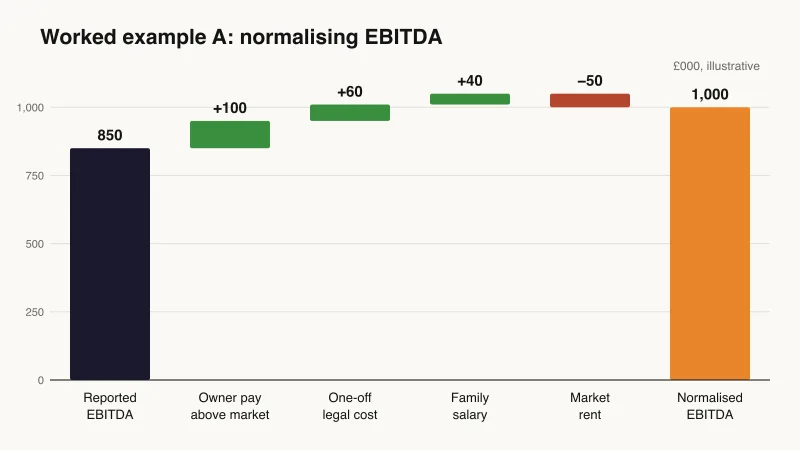
Consider an illustrative UK services business, the one we use throughout this guide. Its accounts show EBITDA of £850,000. The owner pays herself £250,000 against a market salary of £150,000 for a managing director, carried a one-off £60,000 legal cost this year, employs a family member who does not work in the business at £40,000, and rents premises from her own property company at £30,000 a year against a market rent of £80,000.
From reported EBITDA to enterprise and equity value (illustrative)
Less: rent re-based to market (£30k paid, £80k market)
−50
A new owner would pay a market rent
Normalised EBITDA
1,000
The base the multiple is applied to
× illustrative multiple
5.0x
Set by comparables and the quality of the earnings
Enterprise value
5,000
1,000 × 5.0
Less: borrowings
−800
Repaid from the price at completion
Add: surplus cash
+300
Cash beyond normal working needs
Equity value
4,500
What the shares are worth
Notice that the adjustments cut both ways. The rent adjustment reduces the earnings because the owner has been subsidising the business; an honest normalisation includes it. Every adjustment must be supported by documents a buyer's advisers can check, because they will test each one in a quality of earnings review.
Worked example A: normalising EBITDA before a multiple is applied (£000, illustrative).
The bridge from enterprise value to equity value matters because UK private company sales are usually priced on a cash-free, debt-free basis with a normal level of working capital. A valuation that stops at enterprise value has not yet told you what your shares are worth.
Which multiple
The multiple is where judgement enters. It reflects how risky and how durable the earnings are, how fast they are growing, and what comparable businesses have sold for. An EV/EBITDA multiple of 5.0x is used here purely to make the arithmetic clear; it is not a benchmark for your sector or size. The sections on comparables and on intangible assets below explain where a real multiple comes from and what moves it. Because the earnings are multiplied, every £10,000 of normalised EBITDA is worth £50,000 of enterprise value at 5.0x, which is why the normalisation deserves as much care as the multiple.
How to value a business based on revenue
Some businesses are valued on revenue rather than profit. It is the norm for recurring-revenue software and subscription businesses that are reinvesting heavily in growth and are not yet profitable, or whose profit does not yet reflect what the business could earn at scale. The method applies an EV/revenue multiple to revenue, usually annual recurring revenue (ARR) for a subscription business.
Revenue multiples are simple, and that is their weakness. Revenue says nothing about margin, retention or the cost of winning it. Two businesses with the same revenue can be worth very different amounts, and a revenue multiple applied without those checks will price them the same.
Worked example B: two businesses, one revenue multiple
Two illustrative SaaS businesses each have £2.0m of ARR. At an illustrative 3.0x ARR, each is valued at £6.0m. Look underneath the revenue and the two are not the same business.
Same revenue, different quality (illustrative)
Business A
Business B
Annual recurring revenue
£2.0m
£2.0m
Gross margin
80%
50%
Gross profit
£1.6m
£1.0m
Gross revenue retention
95%
80%
Value at 3.0x ARR
£6.0m
£6.0m
Implied multiple of gross profit
3.75x
6.0x
At the same revenue multiple, a buyer of Business B pays 6.0 times its gross profit against 3.75 times for Business A, and B loses a fifth of its revenue base each year against A's 5%. The revenue multiple hides both facts. This is why investors in recurring-revenue businesses look through revenue to gross revenue retention, net revenue retention, gross margin and growth before agreeing a multiple.
⚠ Warning
A revenue multiple always implies an earnings multiple. A business with £5m of revenue and a 10% EBITDA margin, valued at 1.0x revenue, is being valued at 10x its £500,000 of EBITDA. Before accepting a revenue-based valuation, convert it to the earnings multiple it implies and ask whether that is defensible.
Revenue multiples are rarely the right primary method for a profitable, mature UK SME. Where a business has stable profits, the profit-based methods above say more. Revenue multiples earn their place where profit is not yet a meaningful measure of what the business will earn, and where the recurring revenue can be evidenced contract by contract.
Discounted cash flow (DCF)
A discounted cash flow valuation is the income approach in its fullest form. It forecasts the free cash flow the business will generate, usually for five years, and discounts each year back to today at a rate that reflects the risk of achieving it. A terminal value captures the cash flows beyond the forecast. Their sum is the enterprise value.
Three inputs drive the answer. The forecast of free cash flow, after tax, capital expenditure and working capital. The discount rate, which for a small private company sits well above the rate for a listed one, because a buyer requires a higher return for higher risk; it is often built up from the cost of capital plus a specific company risk premium for factors such as owner dependency and customer concentration. And the terminal value, usually calculated by assuming the final year's cash flow grows at a modest constant rate for ever.
Worked example C: a five-year DCF
The same illustrative business forecasts free cash flow of £600,000 next year, rising to £750,000 in year five. We use an illustrative 15% discount rate and 2% long-term growth. Discount factors are 1 ÷ 1.15 raised to the year, shown to four decimal places; figures are rounded to the nearest £1,000.
DCF of the illustrative business (£000)
Year
Free cash flow
Discount factor at 15%
Present value
1
600
0.8696
522
2
640
0.7561
484
3
680
0.6575
447
4
720
0.5718
412
5
750
0.4972
373
Forecast period
2,238
Terminal value at year 5: 750 × 1.02 ÷ (0.15 − 0.02)
5,885
0.4972
2,926
Enterprise value
5,164
Less: net debt (800 borrowings − 300 surplus cash)
−500
Equity value
4,664
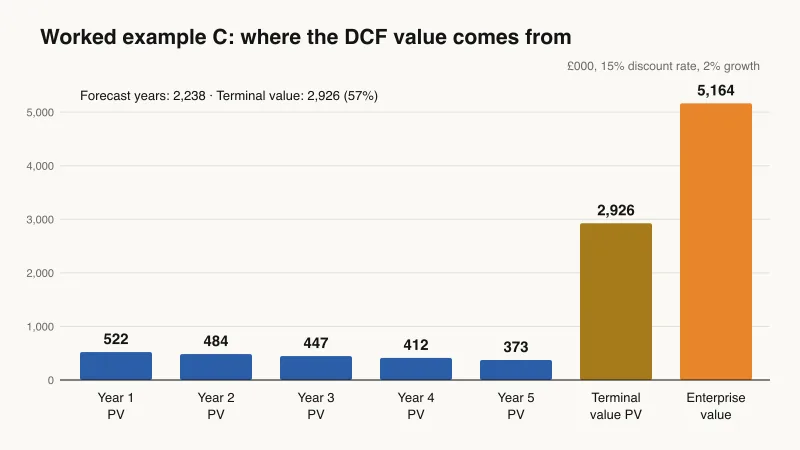
The DCF gives an enterprise value of £5.16m, about 5.2 times the £1.0m of normalised EBITDA in worked example A. The two methods land about 3% apart, which is what you want to see: when a DCF and a market multiple disagree sharply, one of the inputs needs explaining.
Worked example C: where the DCF value comes from. The terminal value is 57% of the total (£000, illustrative).
Two features of the example are typical. First, the terminal value is £2.93m of the £5.16m, or 57% of the total: more than half of the value depends on years the forecast does not cover. Second, the answer is sensitive to the discount rate. On the same cash flows, a 13% rate gives an enterprise value of about £6.1m and a 17% rate about £4.5m. Two percentage points either way moves the value by between £0.7m and £1.0m.
✔ Example
A buyer and a seller agree the forecast but not the risk. The seller argues for 13% because the contracts are long and renewals are strong; the buyer argues for 17% because two customers are a third of revenue and the founder holds both relationships. The £1.7m gap between their valuations is not a disagreement about cash flows. It is a disagreement about the intangible assets behind them, and evidence settles it faster than negotiation.
DCF is most useful where cash flows are forecastable and the business is changing, for example after an investment that will lift margins. It is least useful for a small business with a short trading record, where the forecast is little more than hope. For the method in a financing context, see our overview of valuation methods for scale-ups.
Asset-based valuation: net asset value and the floor
An asset-based valuation starts from the balance sheet. Net asset value is total assets less total liabilities; an adjusted net asset value restates each item to its current market value, most often by revaluing property and writing down stock or debtors that will not realise their book value. For a going concern, that adjusted figure is the floor: a rational owner would not sell a viable business for less than its assets would fetch.
It is the primary method in a narrower set of cases: property and investment holding companies, whose value is their assets; businesses making losses with no realistic prospect of recovery; and businesses being wound up, where the relevant figure is the lower liquidation value, after the costs and discounts of a forced sale.
Worked example D: net assets against earnings value
The illustrative business has net assets of £1.2m in its accounts. They include a freehold storage unit the company owns outright (separate from the premises it rents from the owner), carried at its original cost and worth £0.3m more today. Its adjusted net asset value is £1.5m.
Net assets against earnings-based value (£000, illustrative)
Line
£000
Net assets per the balance sheet
1,200
Add: storage unit restated to market value
+300
Adjusted net asset value
1,500
Equity value on the earnings multiple (worked example A)
4,500
Value the balance sheet does not hold
3,000
Two-thirds of the equity value in this example, £3.0m of £4.5m, is not on the balance sheet. That gap is goodwill in the broad sense: customer relationships, brand, know-how, systems and the team. Under FRS 102, as under IAS 38, internally generated brands, customer lists and similar items cannot be recognised as assets, so their cost is expensed as it is incurred. The balance sheet records what the business cost to build; the earnings-based value records what it will earn. For a profitable trading business, the asset approach therefore understates value, and its main role is to set the floor.
★ Key Takeaway
If an earnings-based valuation comes out close to net asset value, the market is saying the business earns little more than a fair return on its assets. If it comes out well above, the difference is intangible value, and the better that value is identified and evidenced, the more of it a buyer will pay for.
Comparables and precedent transactions
The market approach values a business by reference to what comparable businesses are worth. It comes in two forms.
Trading comparables use the multiples at which similar listed companies trade on a stock exchange. They are current and transparent, but a listed company is larger, more liquid and more diversified than most private SMEs, so a valuer adjusts the multiple down for size and applies a discount for lack of marketability to reflect that private shares cannot be sold quickly. Our glossary entry on comparable company analysis covers how a peer set is screened.
Precedent transactions use the multiples paid in completed acquisitions of similar businesses. They reflect what buyers actually paid for control, often including a premium for the cost savings or extra revenue a particular buyer expected from combining the businesses. The data is harder to find for small private deals, and older deals reflect market conditions that may no longer apply. The glossary entry on precedent transaction analysis explains the adjustments for recency and control.
Trading comparables vs precedent transactions
Trading comparables
Precedent transactions
Source
Listed company share prices and accounts
Completed acquisitions with disclosed terms
What the multiple reflects
A minority stake in a liquid, listed business
A controlling stake, sometimes with a buyer-specific premium
Main adjustments
Size, growth, and a discount for lack of marketability
Recency, control premium, gains only one buyer could make
Typical weakness for an SME
Listed peers are much larger
Few disclosed small deals; data skews large
In the UK, published indices of private-company deal multiples, such as BDO's Private Company Price Index, which tracks the EV/EBITDA multiples paid for UK private companies, are a useful sense check on market conditions. They are built from completed deals where enough was disclosed to calculate a multiple, which tends to mean larger transactions, so they describe the market rather than your business. The question a valuer must answer is where your business sits relative to them, and why.
Rule-of-thumb sector multiples, and why to treat them with caution
Owners often hear that businesses in their sector "go for three or four times profit", or a set multiple of fees for an accountancy practice or of recurring revenue for a software company. These rules of thumb are passed between brokers and peers, and they are rarely sourced. We do not publish sector multiples in this guide, for three reasons.
First, the range within a sector is wider than the gap between sectors: two businesses in the same trade can sell several turns of earnings apart. Second, rules of thumb rarely say which earnings measure they apply to, or whether they describe enterprise value or equity value. Third, they move with interest rates and buyer appetite, so a figure that was accurate when it was first repeated may not be now.
What tends to push a sector's multiples up or down
Higher in the range
Lower in the range
Contracted or subscription revenue
Project revenue re-won each year
Scalable delivery that does not depend on headcount
Revenue tied to the hours of specific people
Owned technology, data or registered IP
Little that a competitor could not replicate
Fragmented customers with low churn
A few large customers, or high churn
Active acquirers consolidating the sector
Few natural buyers
⚠ Warning
Treat any sector multiple you are quoted as a question, not an answer. Ask what earnings measure it uses, what size of business it describes, when it was observed, and on how many deals it rests. If no one can say, it should not anchor your valuation.
Putting the methods together
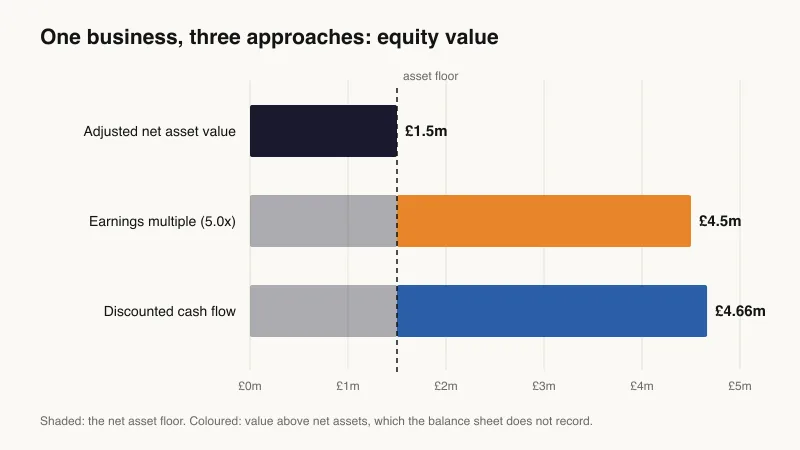
A professional valuation rarely relies on one number. It applies the approach that fits the business, cross-checks it with at least one other, and explains the differences. For the illustrative business in this guide, the three equity values line up as follows.
The illustrative business valued three ways: equity value by approach (£m). The gap above net assets is the intangible value the balance sheet does not record.
The earnings multiple and the DCF agree closely, at £4.5m and £4.66m, and both sit about £3m above the asset floor. A valuer would report a range, here roughly £4.5m to £4.7m of equity value, and explain that net assets of £1.5m set the floor. Where the methods diverge, the explanation is usually the most useful part of the report: it shows which assumption, and which asset, the value depends on. Our guide to the business valuation report sets out what a complete report should contain, including this reconciliation.
What moves the multiple: why intangible assets matter
Every income and market method above contains a judgement about risk and durability: the multiple in worked example A, the discount rate and growth in worked example C, the retention behind the revenue in worked example B. Those judgements turn on assets the balance sheet does not record. Customer contracts and recurring revenue make earnings durable. A brand people recognise, owned intellectual property and documented processes make them transferable. A business that depends on its owner makes them fragile.
At Opagio we organise these assets through the Opagio 12 framework, twelve categories of intangible value driver. The table below shows where six of them show up in a business valuation, method by method.
Where intangible assets show up in each valuation method
Opagio 12 driver
In an earnings multiple
In a DCF
In an asset-based valuation
Customer Capital
Recurring, contracted revenue supports a higher multiple; concentration lowers it
Higher retention lifts forecast cash flows and the terminal value
Not recorded, unless acquired
Brand & Reputation
A brand that transfers beyond the founder supports the multiple
Supports pricing and growth assumptions
Not recorded, unless acquired
Technology & Innovation
Owned, defensible technology widens the gap to competitors
Supports margins and the forecast
Recorded only if acquired, or where development costs meet the capitalisation conditions
Content & IP
Registered rights with clean title remove a diligence risk
Protects the cash flows the forecast relies on
Not recorded at its value, unless acquired
Human Capital
Know-how held only by the owner lowers the multiple
Raises the specific company risk premium
Not recorded
Organisational Capital
A business that runs without the owner supports a higher multiple
Lowers the risk premium; makes the forecast credible
Not recorded
Owner dependency deserves particular attention, because it touches every method at once. If the key relationships and decisions sit with you, a buyer lowers the multiple, raises the discount rate, or defers part of the price into an earn-out. The glossary entry on key person risk explains how buyers test for it, and our FAQ on customer concentration risk covers the related test on your largest customers. For the seller's view of each lever, see how much is my business worth, and for the mechanism in depth, how intangibles affect your exit multiple.
Individual intangible assets can also be valued in their own right, using methods such as relief from royalty for a brand or the multi-period excess earnings method for customer relationships. That is a different exercise from valuing the whole business, and our guide to intangible asset valuation methods explains how each works.
Evidence the assets behind your valuation
Opagio Intangibles identifies and classifies your intangible assets across Opagio 12, values them with recognised asset-level methods (relief from royalty, MPEEM, with-and-without and cost), and produces the Opagio Value Drivers Register™ and a Normalised P&L. It does not replace a valuation of your business; it builds the evidence a valuer, broker or buyer will test. See how Opagio prepares a business for sale.
Who values a business in the UK
Who you ask depends on why you need the valuation. For a sale, the valuation is usually prepared by an adviser who will help achieve it; for a tax or legal purpose, it must meet a defined standard and may be checked by HMRC or tested in court.
Who prepares a business valuation in the UK
Who
Typically used for
What to expect
Your accountant
An initial view, shareholder changes, tax planning
A multiple-based valuation from the accounts; varies with the firm's corporate finance experience
Corporate finance advisers and business brokers
Selling or buying a business
A market-led view of achievable price, built from comparables and buyer appetite
Specialist valuers
Disputes, tax, financial reporting, lending
A formal report under recognised standards such as the International Valuation Standards, which RICS Registered Valuers apply through the RICS Red Book
HMRC's Shares and Assets Valuation team
Checking valuations used for tax
Reviews valuations for capital gains tax, inheritance tax and employee share schemes
For tax purposes, the relevant value is generally market value on a hypothetical open-market sale, which for a minority shareholding often differs from a pro rata share of the whole company. HMRC operates processes for agreeing or checking some of these valuations: a post-transaction valuation check for capital gains tax (form CG34), and advance agreement of share valuations for Enterprise Management Incentive options (form VAL231).
ℹ Note
This section is general information, not tax advice. Tax valuations follow their own rules and case law, and the right figure for a sale may not be the right figure for a tax return. Take advice from a UK tax adviser before relying on any valuation for tax, and see share sale vs asset sale in the UK for how deal structure changes the tax position on a sale.
How to value a business, step by step
Whichever method suits your business, the work follows the same sequence.
1. Define the purpose and the basis of value
A sale, a shareholder buy-out, a tax return and a dispute each call for a different standard of value. Decide which you need, and whether you are valuing the whole business or a shareholding.
2. Gather three years of accounts and a forecast
Statutory accounts, management accounts for the current year, and a realistic forecast. Most valuations look at the last three years to separate the trend from a one-off.
3. Normalise the earnings
Reset owner's pay to market, strip out one-off and non-trading items, and re-base related-party arrangements. Document every adjustment.
4. Choose the primary method
An earnings multiple for most profitable businesses, a revenue multiple or DCF for pre-profit recurring-revenue businesses, net assets for asset-rich or loss-making ones.
5. Set the multiple or discount rate from evidence
Use comparables and precedent transactions for the multiple, and a build-up of risk for the discount rate, adjusted for your size, growth and the quality of your earnings.
6. Cross-check with a second method and the asset floor
Compare the result against a second approach and against adjusted net assets. Explain any significant gap rather than averaging it away.
7. Bridge to equity value and state a range
Deduct debt, add surplus cash, adjust for working capital, and present a range with the assumptions that drive it.
Frequently Asked Questions
How do you value a business in the UK?
Most profitable UK private businesses are valued by applying a multiple to normalised earnings, usually EBITDA after adjusting owner's pay and one-off items, then deducting net debt to reach equity value. Valuers cross-check the result with a discounted cash flow or comparable transactions, and use net asset value as the floor. Asset-rich and loss-making businesses are valued mainly on their net assets.
How do you value a business based on profit?
Take the business's profit, usually EBITDA, and normalise it: reset owner's pay to a market salary, remove one-off costs and income, and re-base any related-party arrangements. Multiply the normalised figure by a multiple drawn from comparable businesses and adjusted for risk and growth. That gives enterprise value; deduct net debt to reach the value of the shares. Very small owner-run businesses often use seller's discretionary earnings instead, with a lower multiple.
How do you value a business based on revenue?
Multiply revenue, or annual recurring revenue for a subscription business, by a revenue multiple drawn from comparable businesses. The method suits recurring-revenue businesses that are not yet profitable. Check what earnings multiple the revenue multiple implies, and adjust for gross margin, customer retention and growth, because two businesses with the same revenue can be worth very different amounts.
What are the main business valuation methods?
There are three approaches. The income approach values future earnings or cash flow, through an earnings multiple or a discounted cash flow. The market approach uses multiples from comparable listed companies or completed transactions. The asset approach values the net assets restated to current values. Most valuations use one as the primary method and another as a cross-check.
Which valuation method is best for a small business?
For a profitable small business, an earnings multiple is usually the most appropriate method, applied to EBITDA or, where the owner is the business, to seller's discretionary earnings. A discounted cash flow adds little where the forecast is uncertain. Net asset value is the right primary method only for asset-rich or loss-making businesses, and otherwise sets the floor.
Who can value my business?
Your accountant can usually give an initial view, and a corporate finance adviser or business broker will give a market view when you are selling. For a formal valuation for a dispute, financial reporting or tax, use a specialist valuer working to recognised standards. HMRC's Shares and Assets Valuation team checks valuations used for tax, and some can be agreed with it in advance.
Next steps
Valuing a business means choosing the approach that fits it, normalising the earnings honestly, setting the multiple or discount rate from evidence, and cross-checking against the asset floor. The method sets the arithmetic. The intangible assets behind the earnings decide where in the range the answer lands: how durable the revenue is, how transferable the brand and know-how are, and how far the business runs without you.
If you are preparing to sell, start with the sell-your-business hub and see how Opagio supports an exit. For the buyer's view of the number, read how much is my business worth; for the choice between multiples, see our FAQ on EV/revenue or EV/EBITDA. To start on the evidence, take the free Quick Assessment, which scores your business across the Opagio 12 drivers without producing a £ figure, or the Single-Asset Value Check, which gives an indicative estimate for one intangible asset such as a brand. Neither values the whole business; both are a starting point for the evidence a valuer will look for.
About the Author
Tony Hillier is Chairman of Opagio with 30 years of experience in structured finance, M&A advisory, and asset valuation, including executive board roles at NM Rothschild & Sons and GEC Finance. Meet the team.
Share:
TH
Tony Hillier — Chairman, Co-Founder
MA, Balliol College, University of Oxford | Harvard Business School MBA with Distinction
A business valuation report is a written opinion of what a company is worth, on a stated date and basis. What a complete report contains, when you need an independent one, how to choose a valuer and how to read the conclusion.
A complete guide to portfolio valuation inside the Opagio Intangible Asset Valuator — how to roll up multiple individual asset valuations into a single, defensible portfolio view ready for boards, investors, lenders, and acquirers.
A complete guide to the free Opagio Intangibles Questionnaire: 36 anchored questions across six categories of intangible investment, a 0-100 score for each, and a report that shows where to invest next.
Get the latest insights on intangible asset growth and productivity delivered to your inbox.
We use essential cookies to make our website work. We'd also like to use analytics cookies to improve your experience. You can manage your preferences at any time.
Cookie Policy