Our Data Processing Agreement changes on 2 November 2026.
Version 3.0 changes what it says about how our AI service providers handle the data we send them. There is no new sub-processor.
Read what is changing
Our Privacy Policy changes on 9 November 2026.
Version 5.1 updates how we use information about your use of Opagio and our emails, how we handle enquiries, and the service providers that help us.
Read what is changing
Quality of Earnings: What a QoE Report Tests Before a Sale
By Tony Hillier· 2026-10-12quality of earningsquality of earnings reportsell-side quality of earningsqoeqoe vs normalised ebitdadue diligencenormalised ebitdaselling a business ukworking capital pegrevenue quality
A quality of earnings (QoE) report is an accountant's analysis of whether a company's profit is real, recurring and backed by cash, built around the normalised EBITDA a buyer will apply its multiple to. A buyer commissions one as part of financial due diligence; a seller can commission its own before going to market, usually as part of a vendor due diligence report. It tests the earnings adjustments, the quality of revenue, working capital, net debt, cash conversion and the accounting policies behind the reported numbers.
Last reviewed: October 2026. Written for UK private companies, with FRS 102 and IFRS named where a standard applies. General information, not accounting, tax or legal advice. All figures are illustrative.
£600kof price lost when a £120k EBITDA adjustment fails the QoE, at an illustrative 5.0x
£1 for £1the effect on the price of each debt-like item the QoE finds
£1.2mmoved off the price by three findings in the worked example below
This guide is for owners and finance directors of UK businesses turning over roughly £1m to £100m who are preparing to sell. It covers the diligence report, not the number it tests: how to build that number, adjustment by adjustment, is in our guide to normalised EBITDA.
What is a quality of earnings report?
A buyer pays a multiple of earnings, so its advisers first want to know whether those earnings will still be there after completion. The quality of earnings report restates the profit in your accounts to what the business sustainably earns, then tests how dependable that figure is: how much revenue recurs, how concentrated it is, how much profit turns into cash, and whether the accounting flatters any of it.
📚 Definition
A quality of earnings review is a transaction-focused analysis of a company's historical earnings, usually covering the last two or three financial years and the current year to date, month by month. It rebuilds normalised EBITDA, tests each adjustment against evidence, and reports on revenue quality, working capital, net debt and cash conversion. It is not an audit and gives no audit opinion.
The term comes from US deal practice. In the UK the same work is usually delivered inside a financial due diligence report, or, when the seller commissions it, inside the financial section of a vendor due diligence report. It is normally performed by the transaction services or financial due diligence team of an accounting firm, and comes with a "databook": the spreadsheets behind every table. Our glossary entries on quality of earnings and the quality of earnings (QoE) report give the short definitions.
What a quality of earnings report covers
A full report works through seven areas. Each answers a question a buyer will otherwise ask you directly, usually late in the process and under time pressure.
Quality of earnings report: areas and what to have ready
Area
The question it answers
What a seller should have ready
EBITDA normalisation
Which adjustments survive the evidence?
Your own bridge, each line with documents
Revenue quality
How much of the revenue will recur, and from whom?
Revenue by customer, contract, product and month; cohort and churn data
Net working capital
What level does the business need to trade normally?
Signed contracts and delivery evidence for each claim
Accounting policies
Do the policies flatter the profit?
A note of every policy and every change in it
EBITDA normalisation testing
The reviewer rebuilds the seller's bridge from reported to normalised EBITDA line by line and asks for the evidence behind each adjustment. Some survive, some are reduced, some are rejected, and the reviewer usually adds its own, such as an owner paid below market or a provision released into profit. The output is the seller's figure and the reviewer's, side by side. How each adjustment is built is covered in our normalised EBITDA guide; here, what matters is that an adjustment without evidence is treated as an assertion.
Revenue quality
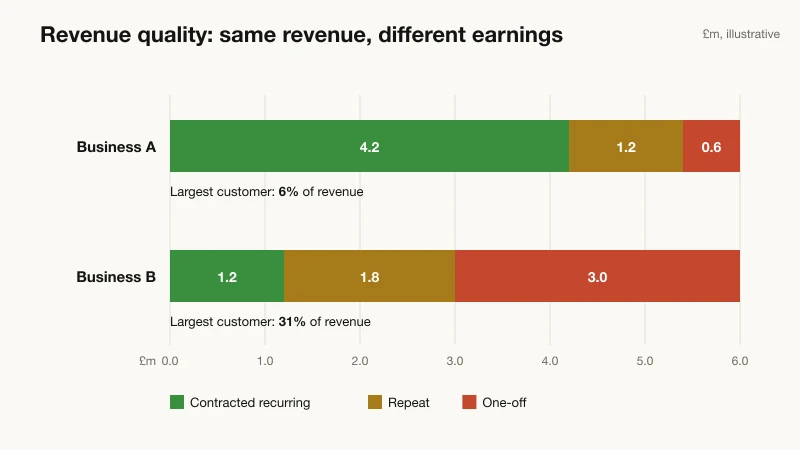
Revenue quality is where the report does most of its work for the multiple. Two businesses with the same EBITDA are not worth the same if one earns it from contracted revenue across many customers and the other from one-off projects with a few large clients. The reviewer splits revenue into recurring revenue, repeat and one-off, and tests each part.
Revenue quality tests in a QoE
Test
What the reviewer looks at
Customer concentration
The share of revenue from the largest customer and the top five or ten, and whether any could leave at short notice
Length, notice periods, renewal history, pricing clauses and any change-of-control clause that lets a customer walk on a sale
Recognition
Whether revenue falls in the period the service is delivered, which matters most for annual subscriptions billed in advance
Same revenue, different quality of earnings: how a QoE splits revenue by type and flags concentration (£m, illustrative).
★ Key Takeaway
A quality of earnings report does not only ask how much you earn. It asks how much of what you earn a buyer can count on, and the answer to that question sets where in the range your multiple falls.
Net working capital and the peg
The reviewer analyses working capital (broadly trade receivables, stock and prepayments, less trade payables and accruals) month by month, usually over at least two years, to show the normal level the business needs and how it moves with the seasons. That analysis becomes the buyer's starting point for the working capital peg: the level against which working capital at completion is measured under completion accounts, or the level a buyer assumes when it agrees a locked box price. A peg set on a seasonal low, or on a year-end that was managed down, is one of the first things a QoE will correct. How the peg is set, and why a month-specific peg can matter, is covered in locked box vs completion accounts.
Net debt and debt-like items
The price is usually agreed on a cash-free, debt-free basis: an enterprise value from which net debt is deducted to reach the equity price. Beyond bank loans and overdrafts, the QoE looks for items a buyer will argue should also be deducted, pound for pound.
Debt-like items a QoE looks for
Item
Why a buyer deducts it
Lease liabilities
Finance leases and hire purchase are usually treated as debt; other lease liabilities are where EBITDA excludes the rent, as it does after the lease change described below
Tax owed for pre-completion periods
Corporation tax, VAT or PAYE arrears and any time-to-pay arrangement with HMRC are the seller's liabilities
Service the buyer must deliver without receiving the cash; buyers may deduct it in full or at the cost of delivering it, and sellers usually argue it is ordinary working capital
Provisions and pension deficits
Dilapidations, onerous contracts, disputes and any defined benefit deficit
Cash conversion and proof of cash
Cash conversion compares operating cash flow with EBITDA for each period. Profit that consistently turns into cash is easier to underwrite than profit sitting in rising debtors or stock. A proof of cash goes further: it reconciles the revenue and costs in the ledger to the money that went through the bank, the most direct test that reported revenue is real. Every gap needs an explanation.
Pro forma and run-rate claims
Sellers often present earnings that have not yet happened: the full-year effect of a new contract, a price increase, a cost saving or a closed loss-making line. The reviewer tests each against evidence. A contract that is signed, started and delivering at a known margin is usually accepted. Savings not yet made, price rises not yet billed and contracts not yet signed are usually rejected, or moved into an earn-out. Our glossary entry on pro forma financial statements explains the term.
Accounting policies
The last area asks whether the accounting policies present the earnings fairly and consistently. Three come up most often in UK SMEs.
Accounting policies a QoE tests
Policy
What the reviewer checks
Revenue recognition
Whether revenue is taken in the period it is earned, particularly on long contracts and annual subscriptions
Capitalised development costs
A policy choice under FRS 102 and a requirement under IAS 38 when the criteria are met. Either way the cost moves below EBITDA, so buyers usually treat recurring development spend as an operating cost
Leases
For periods beginning on or after 1 January 2026, the amended FRS 102 takes most rent out of EBITDA, so the earnings history stops being like for like
Each can change EBITDA with no change in cash. The reviewer puts every year on the same footing and checks that leases are treated the same way in EBITDA and in net debt; the mechanics are in our normalised EBITDA guide.
QoE vs normalised EBITDA
The two are often confused because they arrive together. Normalised EBITDA is the number; the quality of earnings report is the diligence document that tests it. The QoE rebuilds the seller's figure, accepts or rejects each adjustment, and then goes further: revenue quality, working capital, net debt and cash conversion are not part of normalised EBITDA, but each can move the price.
ℹ Note
A strong normalised EBITDA bridge is the best preparation for a QoE, because it is the first thing the reviewer reads. It is not a substitute for one. A buyer's advisers will produce their own view of the number whatever you present.
Sell-side vs buy-side quality of earnings
A buy-side QoE is commissioned by the buyer, usually after heads of terms are signed, and is scoped around the buyer's own concerns and its lenders' requirements. A sell-side QoE is commissioned by the seller before going to market, so that the findings are known, explained or fixed before any buyer sees them, and every bidder works from the same tested numbers.
Sell-side vs buy-side QoE compared
Sell-side QoE
Buy-side QoE
Commissioned and paid for by
The seller
The buyer
When
Before marketing, so it can inform the information memorandum
After heads of terms, during exclusivity
Scope set by
The seller and its corporate finance adviser, broad enough for every bidder
The buyer, focused on its concerns and its financing
Who can rely on it
Bidders read it; the winning buyer and its lenders are often given reliance on terms the accounting firm sets
The buyer and its lenders
What it protects
The price and the timetable
The buyer: price, contract protection and financing
Effect on the buyer's own work
Narrows it to a confirmatory review and any gaps
The buyer's main financial diligence
A sell-side review rarely stops the buyer doing its own work; it changes the starting point. Adjustments already tested by an independent firm are harder to dispute, findings arrive before exclusivity rather than after it, and the seller decides how each issue is explained. Its cost is incurred whether or not the sale completes, the main argument against commissioning one too early.
✔ Example
A seller's own review finds that £90,000 of costs presented as one-off legal fees recur in each of the last three years. Found before marketing, the adjustment is dropped from the bridge and the asking price is set on the lower figure. Found by the buyer's advisers during exclusivity, the same £90,000 becomes a price reduction of £450,000 at an illustrative 5.0x, plus a question over every other adjustment in the bridge.
When an SME should commission a sell-side QoE
The usual moment is after the last full year's accounts are closed and before the information memorandum goes to buyers, so the review covers a complete recent year and its findings shape your asking price. If the process runs for months, buyers will expect the year-to-date figures refreshed. Start preparing well before, because a review can only test evidence that already exists.
Scope is the main decision. A full vendor financial due diligence report is addressed to buyers, can carry reliance, and suits a competitive process, private equity buyers or acquisition finance. A vendor assist has an adviser prepare the financial information and databook without a report addressed to buyers. A red-flag review is for the seller only, to find problems while they can still be fixed; for a small, simple business sold to one trade buyer, it may be all that is needed. Costs vary with the size of the business, the number of entities, the state of the records and the scope, so ask two or three firms to quote on the same scope. Our FAQ on the cost to sell a business puts diligence among the other costs.
1. Close the year and reconcile the management accounts
Monthly management accounts should reconcile to the statutory accounts for every year in scope.
2. Build your own normalised EBITDA bridge
Every adjustment, in both directions, with the evidence attached. The reviewer will start here.
3. Prepare the revenue analysis
Revenue by customer, contract, product and month for at least two years, with churn and cohort data and the contracts behind your largest customers.
4. Prepare monthly working capital and net debt schedules
At least 24 month-ends, with every lease, tax balance, deferred income balance and provision listed.
5. Choose the scope and the firm
Full report, vendor assist or red-flag review; agree the reliance terms before the work starts if buyers and lenders are to rely on it.
6. Fix what it finds before you go to market
Drop adjustments that fail, put related-party arrangements on market terms, and prepare the explanation for anything you cannot fix.
Quality of earnings vs audit vs vendor due diligence
Owners whose accounts are audited sometimes assume the audit already answers the buyer's questions. It does not, because it asks a different one. An audit confirms that the statutory accounts give a true and fair view; a QoE asks what the business sustainably earns and how dependable those earnings are. Vendor due diligence is wider again: the QoE analysis is usually its financial section.
Quality of earnings vs audit vs vendor due diligence
Statutory audit
Quality of earnings
Vendor due diligence (VDD)
The question
Do the accounts give a true and fair view?
Are the earnings real, recurring and backed by cash?
What will a buyer find, across every workstream?
Required?
By the Companies Act 2006, unless the company qualifies for an exemption (most small private companies can)
No; commissioned for a transaction
No; commissioned by the seller
Commissioned by
The company
The buyer or the seller
The seller
Standard
ISAs (UK)
No prescribed standard; scope set in the engagement letter
Scope set for each workstream
Period
The financial year, as filed
Usually two to three years plus the year to date, by month
As the QoE, plus the other workstreams
Output
An opinion on the financial statements
Analysis, adjusted figures and findings; no opinion
A set of reports: financial (including the QoE analysis), tax, and often legal and commercial
Who can rely on it
The company's members, as a body
The client; others only by reliance letter
Usually the buyer and its lenders, by reliance letter on agreed terms
What buyers do with QoE findings
A finding in a quality of earnings report moves into the deal in one of five places: the headline price, the equity bridge from enterprise value to the price for the shares, the completion mechanism, the protection in the sale and purchase agreement, or the timing of payment. The worked example follows one illustrative business through all five.
The business in the worked example
Fact
Detail
Business
A UK B2B software and services company, sold by its founder to a private equity buyer
Seller's normalised EBITDA
£2,000,000, including a £120,000 pro forma adjustment for a price increase announced but not yet billed
Multiple
An illustrative 5.0x, so a headline enterprise value of £10,000,000 on a cash-free, debt-free basis
Balance sheet
No bank debt and no surplus cash; £400,000 of deferred revenue on annual contracts billed in advance
Working capital
The seller proposes a £900,000 peg from the year-end balance sheet, about the level it expects to deliver at completion; the monthly average over the last twelve months, the level the business needs to trade normally, is £1,100,000
Customers
The largest customer is 28% of revenue, on a rolling contract with 90 days' notice
Contractors
Four long-standing contractors working as employees in practice, a possible £150,000 PAYE and National Insurance exposure
Where each QoE finding lands
Finding
Where it lands
Effect on the seller (£000)
Pro forma price increase rejected: not yet billed
Price chip: £120k of EBITDA × 5.0
(600)
Deferred revenue treated as debt-like
Equity bridge: deducted pound for pound
(400)
Peg set at the £1.1m twelve-month average, not £0.9m
Completion mechanics: £200k less at the true-up than the seller expected
(200)
Equity price after the QoE
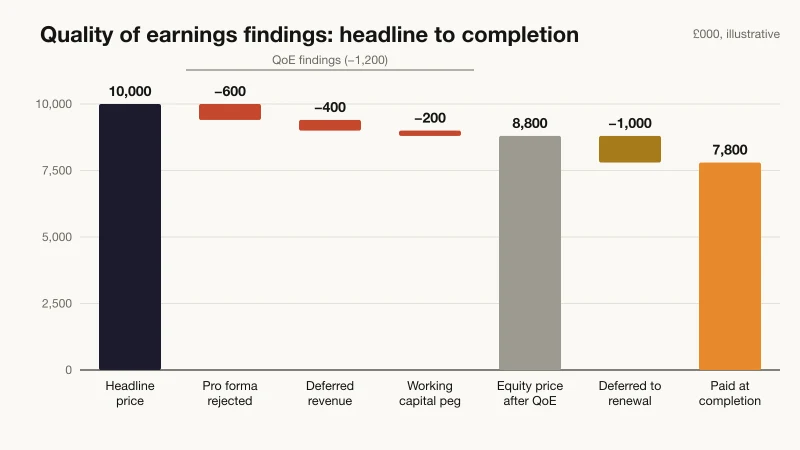
10,000 − 600 − 400 − 200
8,800
Largest customer at 28% on 90 days' notice
Structure: £1.0m deferred, paid if the customer renews for two years
1,000 of the 8,800 deferred
Contractor employment tax exposure
Specific indemnity, outside the W&I policy
No price change; £ for £ if it crystallises
How three QoE findings and one structural change move a £10.0m headline price (£000, illustrative).
Each finding is ordinary. Together they move £1.2m off the price, defer another £1.0m and add an indemnity, with nothing going wrong in the business.
How buyers use QoE findings
Where it lands
How a finding gets there
Price chips
A rejected adjustment reduces EBITDA and the buyer applies its multiple to the reduction, so an adjustment that fails the evidence costs the multiple times its value: £600,000 for £120,000 at 5.0x
Completion mechanics
The working capital and net debt analysis sets the buyer's position on the definitions of cash, debt, debt-like items and the peg, and on whether it trusts the accounts enough to accept a locked box
Specific indemnities
A known exposure, such as a tax risk, a dispute or a historic employment issue, is covered by a specific indemnity: the seller pays pound for pound if it crystallises, often secured by an escrow or a retention from the price
W&I exclusions
Warranty and indemnity (W&I) insurance does not cover matters the buyer knew about before signing, which includes anything found in diligence, so a finding moves into a specific indemnity or the price. Underwriters also read the diligence reports and may exclude the accounts warranties where the financial diligence was thin
Deferred consideration
Where the risk is that earnings will not continue, rather than that they were never there, part of the price moves into an earn-out or a deferred payment tied to the outcome
⚠ Warning
The cost of a finding depends on when it is found. The same issue found by your own review before marketing is a lower asking price you set yourself. Found by the buyer during exclusivity, it is a renegotiation, at a point when you have stopped talking to other bidders.
How intangible evidence affects quality of earnings
Most of the questions a quality of earnings report asks about revenue are questions about intangible assets. Whether revenue will recur depends on the customer relationships and contracts behind it. Whether it survives the sale depends on change-of-control clauses, on who owns the software and know-how that deliver the service, and on whether the relationships sit with the founder or with the team.
QoE questions and the intangible evidence that answers them
QoE question
The intangible asset behind it
Evidence that answers it
Will this revenue recur?
Customer contracts and relationships
Signed contracts, renewal history, cohort retention
Is it concentrated?
Customer relationships
Revenue by customer, relationship owners, notice periods
Will it survive the sale?
Contracts, intellectual property
Change-of-control and assignment clauses, title to software and brands
Does it depend on the owner?
People and organisational know-how
Who holds each key relationship, documented processes
Is the margin sustainable?
Software, processes, supplier terms
Development spend by year, ownership of code, supplier contracts
A seller who can answer these questions with documents shortens the review and narrows the findings. A seller who cannot leaves the reviewer to describe the revenue as "at risk", and that phrase finds its way into the price. The buyer's wider intangible workstream, which tests title, transferability and key-person risk, is covered in our guide to intangible asset due diligence.
★ Key Takeaway
Revenue quality is evidence about intangible assets. The contracts, renewal records and relationship maps that prove your revenue will continue are the same evidence that supports your multiple, and they can be assembled long before any reviewer asks.
Keep the three sets of figures separate
A quality of earnings review works from the accounts as filed and the management accounts that reconcile to them. Any figure you put in front of a reviewer should say which set it belongs to.
ℹ Note
Opagio keeps three sets of figures separate and never mixes them. Reported is the accounts as filed: the fact, and the starting point of every QoE. Accounting-eligible shows what the accounting standards would let the accounts show. Management is a non-statutory model, useful for running the business and for explaining where value sits, but never presented as reportable or auditable, and never as the earnings a buyer is asked to pay a multiple for. A data room that mixes them invites the reviewer to discount all of them.
Assemble the evidence a QoE will test
In Opagio Intangibles, the Opagio Value Drivers Register™ records your intangible assets across Opagio 12, including your customer relationships, with the supporting evidence, such as contracts and renewal records, attached to each one. The Normalised P&L holds every earnings adjustment with its direction, amount, period, narrative and linked documents, and draws the bridge from reported to normalised EBITDA. Opagio does not perform a quality of earnings review, an audit or vendor due diligence; it organises the evidence the accountants who do will test. See how Opagio prepares a business for sale.
Frequently Asked Questions
What is a quality of earnings report?
A quality of earnings report is an accountant's analysis of whether a company's historical earnings are real, recurring and backed by cash. It rebuilds normalised EBITDA, tests each adjustment against evidence, and reports on revenue quality, working capital, net debt, cash conversion and accounting policies. It is prepared for a transaction and gives no audit opinion.
What is the difference between a quality of earnings report and an audit?
An audit gives an opinion on whether the statutory accounts give a true and fair view, under ISAs (UK), for one financial year. A quality of earnings report asks what the business sustainably earns, works month by month over two to three years plus the year to date, adjusts the figures, and reports findings rather than an opinion. An audited company can still have a weak quality of earnings.
What is a sell-side quality of earnings report?
A sell-side quality of earnings report is commissioned and paid for by the seller before going to market, usually as part of vendor due diligence. It lets the seller find and fix or explain issues before buyers see them, gives every bidder the same tested numbers, and often carries reliance for the winning buyer and its lenders.
What is the difference between QoE and normalised EBITDA?
Normalised EBITDA is a figure: reported EBITDA adjusted to the sustainable earnings a buyer would inherit, and the number its multiple is applied to. A quality of earnings report is the diligence document that tests that figure, and goes further into revenue quality, working capital, net debt and cash conversion.
How long does a quality of earnings review take?
It depends on the size of the business, the number of entities and above all the state of the records. Reconciled monthly management accounts, a prepared bridge and organised revenue data make a review far faster than one where the reviewer must rebuild the numbers first. Ask the firm for a timetable against your scope.
Who pays for a quality of earnings report?
Whoever commissions it. The buyer pays for a buy-side QoE as part of its due diligence. The seller pays for a sell-side QoE whether or not the sale completes, which is why it is usually commissioned shortly before going to market.
Next steps
The quality of earnings report is where the price a buyer offered meets the evidence behind it. Prepare what the reviewer will ask for before anyone asks, and decide early whether your own review should go first.
Tony Hillier is Chairman of Opagio with 30 years of experience in structured finance, M&A advisory, and asset valuation, including executive board roles at NM Rothschild & Sons and GEC Finance. Meet the team.
Share:
TH
Tony Hillier — Chairman, Co-Founder
MA, Balliol College, University of Oxford | Harvard Business School MBA with Distinction
Normalised EBITDA is the profit a buyer multiplies. Here is every common adjustment and which way it goes, the 2026 FRS 102 lease change, and a worked EBITDA bridge from £1.5m reported to £1.2m normalised.
Selling a business follows a defined path — preparation, teaser and IM under NDA, heads of terms, diligence, the SPA, then completion. Here is what happens at each stage, and where the price is won or lost.
Business Asset Disposal Relief taxes qualifying gains at 18% from 6 April 2026 on up to £1m over a lifetime, against 24%. The conditions, the worked figures and the checks to make with an adviser before a sale.
Private equity firms are acquiring AI-enabled targets at record rates, but traditional due diligence frameworks miss critical AI-specific risks. This article provides a comprehensive AI due diligence methodology covering technical, commercial, regulatory, and talent dimensions.
Get the latest insights on intangible asset growth and productivity delivered to your inbox.
We use essential cookies to make our website work. We'd also like to use analytics cookies to improve your experience. You can manage your preferences at any time.
Cookie Policy