Our Data Processing Agreement changes on 2 November 2026.
Version 3.0 changes what it says about how our AI service providers handle the data we send them. There is no new sub-processor.
Read what is changing
Our Privacy Policy changes on 9 November 2026.
Version 5.1 updates how we use information about your use of Opagio and our emails, how we handle enquiries, and the service providers that help us.
Read what is changing
Business Asset Disposal Relief: CGT When Selling a Business
By Tony Hillier· 2026-10-12business asset disposal reliefBADRcapital gains taxselling a business ukentrepreneurs reliefshare saleearn-outexit planning
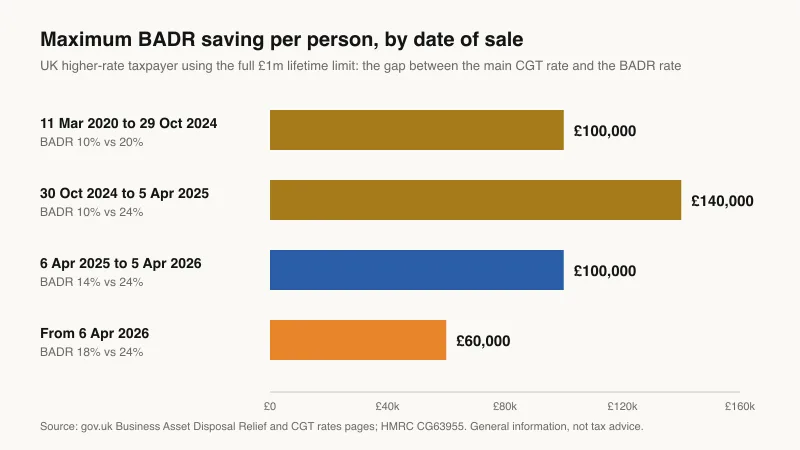
Business Asset Disposal Relief (BADR) is the UK capital gains tax relief that lowers the tax on your gain when you sell all or part of a trading business, or shares in your own trading company, provided you have met its conditions for the two years before the sale. Qualifying gains are taxed at 18% for disposals on or after 6 April 2026 (14% from 6 April 2025 to 5 April 2026, and 10% on or before 5 April 2025), on up to £1 million of gains over your lifetime, against a higher rate of capital gains tax of 24%. For a higher-rate taxpayer that makes the relief worth at most £60,000 per person on a sale today: valuable, and worth checking early, but rarely a reason to restructure a deal on its own.
Last reviewed: October 2026. General information on UK tax rules for disposals from 6 April 2026, not tax advice. Sources: GOV.UK, HMRC's Capital Gains Manual (CG63950 onwards), helpsheet HS275 and the Taxation of Chargeable Gains Act 1992 (TCGA), sections 169H to 169S.
18%BADR rate on qualifying gains from 6 April 2026 (14% in 2025/26)
£1mlifetime limit on gains that qualify, per individual
2 yearsevery condition must be met throughout the two years before the sale
This guide is for owners of UK trading companies, and their co-founders, who expect to sell within the next year or two and want to know three things: what the relief is worth now, which tests they must pass, and what to check with an adviser while there is still time to act on the answer. It covers the business asset disposal relief rate by date of sale, the conditions, worked capital gains tax examples, how the relief interacts with earn-outs, employee ownership trusts and liquidations, and a pre-sale checklist.
Business asset disposal relief rate, by date of sale
BADR was called Entrepreneurs' Relief until Finance Act 2020 renamed it with effect from 6 April 2020. Its rate stayed at 10% from 23 June 2010 to 5 April 2025. The Autumn Budget 2024 raised the main capital gains tax (CGT) rates to 18% and 24% from 30 October 2024 and then raised the BADR rate in two steps: 14% for the 2025/26 tax year and 18% from 6 April 2026 (HMRC CG63955; TCGA s169N(3)).
BADR and main CGT rates by date of disposal
Date of disposal
BADR rate
Main CGT rate for a higher-rate taxpayer
Most BADR can save per person (on £1m)
11 March 2020 to 29 October 2024
10%
20%
£100,000
30 October 2024 to 5 April 2025
10%
24%
£140,000
6 April 2025 to 5 April 2026
14%
24%
£100,000
From 6 April 2026
18%
24%
£60,000
The most BADR can save a UK higher-rate taxpayer with the full £1m limit available: the gap between the main CGT rate and the BADR rate. Sources: GOV.UK; HMRC CG63955.
Two points follow from the table. First, from 6 April 2026 the BADR rate equals the 18% basic rate of CGT, so the relief only helps on gains that would otherwise be taxed at 24%. Gains that qualify for BADR use up any unused basic rate band first (GOV.UK, "Work out your tax"), so a seller with little other income saves slightly less than £60,000.
Second, the date that sets the rate is the date of disposal, and for a sale under contract that is when the contract becomes unconditional, not the day the money arrives (TCGA s28). Exchanging and completing on different days matters if they straddle 6 April.
ℹ Note
Anti-forestalling rules in Finance Act 2025 stop sellers locking in an old rate through a contract signed early. Where a contract entered into before 6 April 2025 completes on or after 6 April 2026, the rate is the one for the completion date, unless the contract was commercial and had no tax-timing purpose (HMRC CG10250). Elections that trigger a gain on a share exchange are caught by a parallel rule (CG10251).
Business asset disposal relief conditions
BADR applies only to a "material disposal of business assets" by an individual, or by the trustees of certain settlements; companies cannot claim it. Each route into the relief has a two-year test, which was one year for disposals before 6 April 2019 (HS275). The routes an owner is most likely to use are below.
The routes to BADR and their two-year tests
What you sell
Main conditions
Where the rule is
All or part of your business, as a sole trader or partner
You owned the business throughout the two years before the sale. It must be the whole business or an identifiable part of it, not just some assets of a continuing business
TCGA s169I(3); CG63975
Assets of a business that has ceased
You owned the business for the two years up to cessation, the assets were in use when it ceased, and you sell within three years of cessation
s169I(4); CG63975
Shares in your personal trading company
Throughout the two years before the sale: the company is your personal company, it is a trading company or the holding company of a trading group, and you are an officer or employee
s169I(6); CG63975
Shares in a company that has stopped trading
The share conditions were met for the two years up to the date trading status ended, and you sell within three years of that date
s169I(7); CG63975
Shares from an Enterprise Management Incentive (EMI) option
The option was granted at least two years before the sale; for those two years the company was trading and you were an officer or employee. No 5% test
s169I(7A) to (7R); CG64052
An asset you own personally that the business uses, such as its premises (an "associated disposal")
Sold alongside a disposal of at least 5% of the company's shares or of the partnership, as part of withdrawing from the business; used in the business for the two years before the sale and owned for at least three years. Relief can be restricted if the business paid you rent
s169K, s169P; CG63996
The personal company test: 5% of shares, votes and economic rights
For shares, the company must be your "personal company" throughout the two years. You must hold at least 5% of the ordinary share capital, and that holding must give you at least 5% of the voting rights. Since 29 October 2018 you also need an economic interest: either at least 5% of the profits available for distribution and at least 5% of the assets on a winding up, or at least 5% of the proceeds if the whole of the ordinary share capital were sold (TCGA s169S(3); HMRC CG64050).
The test is applied to share classes, not headcount. Ordinary share capital means all issued share capital except fixed-rate preference shares, measured by nominal value, so growth shares, alphabet shares and investor preferences can leave an owner with 5% of the votes but less than 5% of the economic rights. Shares held jointly are split by value: spouses holding 100% equally are each treated as holding 50% (CG64050).
If a new share issue, such as a funding round, takes you below 5%, you can elect to be treated as selling and reacquiring your shares just before the issue. That crystallises a gain that qualifies for BADR, and you can elect to defer paying the tax until you sell (TCGA s169SB to s169SH; GOV.UK).
Officer or employee
You must be a director, company secretary or employee of the company, or of another company in its trading group, throughout the two years. HMRC states that "there are no specific requirements regarding either working hours or the level of remuneration" (CG64110). The test still catches owners out: an owner who steps down from the board a year before the sale, or a spouse who holds shares but has no role, fails it on their shares.
Trading company, and the question of non-trading activities
The company must be a trading company, or the holding company of a trading group, meaning its activities do not include "to a substantial extent" activities other than trading (TCGA s165A, applied by s169S(5)). HMRC weighs the indicators together: non-trading income, the asset base, expenses and staff time, and the company's history (CG64090).
HMRC's manual adds a working practice: where neither the level of non-trading income nor the asset base suggests the non-trading element exceeds 20%, a case is unlikely to warrant more detailed review (CG64090). Treat that 20% figure with care. It is HMRC practice rather than law, it is not a safe harbour, and the Upper Tribunal in Allam [2021] UKUT 0291 (TCC) looked at all the indicators, not one ratio. Surplus cash held well beyond working needs, an investment property and loans to connected parties are the usual reasons a company's status is questioned.
★ Key Takeaway
Every BADR condition looks back two years from the date of sale. A shareholding below 5% of the economic rights, a resignation from the board or a large cash balance cannot be put right in the month before completion. Each can usually be checked, and sometimes addressed with advice, a year or two ahead.
Capital gains tax when selling a business: worked examples
The examples below use 2026/27 rates and assume a seller who pays income tax at the higher rate, has no other gains in the year and has made no earlier BADR claims. The £3,000 annual exempt amount is set against the gains taxed at 24%, as GOV.UK allows. Costs of sale, which reduce the gain, are left out to keep the arithmetic visible.
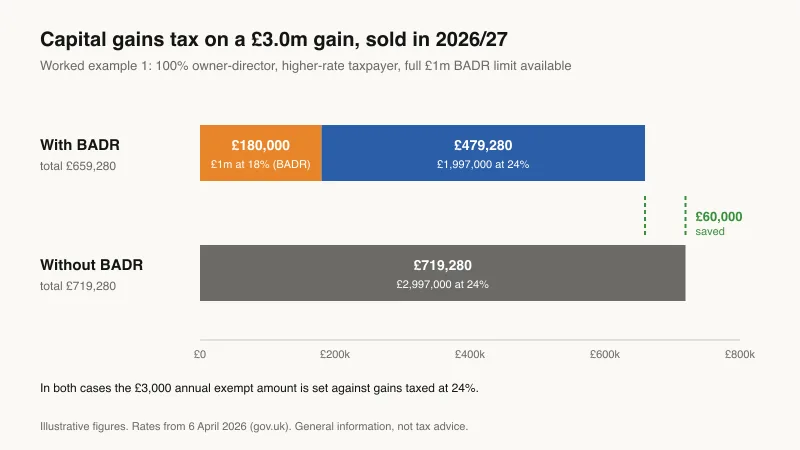
Example 1: an owner-director sells her company for £3.2 million
Step
Amount
Sale price for 100% of the shares
£3,200,000
Less: base cost of the shares
(£200,000)
Gain
£3,000,000
First £1,000,000 at the BADR rate of 18%
£180,000
Remaining £2,000,000, less the £3,000 annual exempt amount, so £1,997,000 at 24%
£479,280
Capital gains tax with BADR
£659,280
Capital gains tax without BADR: £2,997,000 at 24%
£719,280
Saving from BADR
£60,000
The effective rate on the £3.0m gain is 22.0% with the relief and 24.0% without it. Had the contract become unconditional between 6 April 2025 and 5 April 2026, the first £1m would have been taxed at 14%: £140,000 plus the same £479,280, a total of £619,280, which is £40,000 less than the same sale in 2026/27.
Worked example 1: capital gains tax on a £3.0m gain with and without business asset disposal relief, 2026/27 rates. Illustrative figures.
Example 2: a couple who each own half of the company
Two spouses each own 50% of a trading company and have both been directors for more than two years. They sell for £4,000,000. Their shares were subscribed at nominal value, so the base cost is negligible and is ignored here.
Spouse A
Spouse B
Couple
Gain
£2,000,000
£2,000,000
£4,000,000
£1,000,000 at the BADR rate of 18%
£180,000
£180,000
£360,000
£1,000,000 less £3,000 exempt amount, so £997,000 at 24%
£239,280
£239,280
£478,560
Capital gains tax
£419,280
£419,280
£838,560
Spouses and civil partners are separate individuals: each has a £1m lifetime limit and an annual exempt amount, provided each meets the conditions personally (HMRC CG63970). If spouse B had held shares but no office or employment, B's whole gain after the exempt amount would be taxed at 24%, so B would pay £479,280 and the couple £898,560, which is £60,000 more. Had spouse A owned all the shares, the bill would be £180,000 plus £2,997,000 at 24% (£719,280), so £899,280: the qualifying couple pays £60,720 less, a second £1m band (£60,000) and a second exempt amount (£720).
ℹ Note
A spouse who receives shares shortly before a sale does not inherit the giver's history. They must meet the personal company and officer or employee tests themselves for the two years before the sale, so any change to who holds shares, or who holds a role, needs to be made early and on advice.
How BADR interacts with the rest of the deal
The relief does not sit on its own. How the sale is structured and how the price is paid decide whether, when and on how much of the gain BADR can be claimed.
Share sale or asset sale
On a share sale you claim BADR personally on the gain on your shares. On an asset sale it is the company that sells and pays corporation tax on its gain, and BADR does not apply to that. You may be able to claim it later, when you extract the proceeds as capital distributions in a liquidation (see below), but the route has two layers of tax. We compare the two structures, including warranties and stamp duty, in share sale vs asset sale in the UK. Sole traders and partners sell the business assets themselves and can claim BADR on those gains, although goodwill sold to a close company in which they and connected persons hold 5% or more does not qualify (TCGA s169LA; HS275).
Earn-outs, deferred consideration and paper consideration
Deferred consideration whose amount is fixed at completion is brought into your gain at completion, even though it is paid later (TCGA s48), so BADR applies to it within the £1m limit. An earn-out whose amount depends on future performance is different. You are treated as receiving the cash plus a right to future payments, valued at completion and taxed as part of the sale. Each later payment is a disposal of that right, and HMRC states that it "will not be eligible for any relief which was due (or claimed) on the disposal of the original asset" (CG14970). We set out the wider tax and drafting points in how earn-outs work in a business sale.
✔ Example
An owner sells for £2.0m in cash plus an earn-out right valued at £500,000 at completion, with a nil base cost. The gain in the year of sale is £2.5m: £1m at 18% (£180,000) plus £1,497,000 at 24% after the exempt amount (£359,280), so £539,280, payable on £2.0m of cash. Two years later the earn-out pays £800,000. The gain on the right is £300,000; after that year's £3,000 exempt amount, £297,000 is taxed at 24%, which is £71,280, with no BADR.
When the price is paid in shares or loan notes of the buyer, the share exchange rules usually treat the new securities as the same asset as your old shares, so no gain arises at completion (TCGA s127 and s135). The difficulty is that by the time you sell the new shares, the buyer is unlikely to be your personal company. An election under TCGA s169Q disapplies that treatment so a gain arises at the exchange and BADR can be claimed on it; it covers all of the shares exchanged or none (CG64155). Where the buyer's vendor loan notes are qualifying corporate bonds (QCBs), a separate election under s169R brings the frozen gain into charge at the exchange for the same purpose (CG64161). Both elections share the BADR claim deadline.
Selling to an employee ownership trust
For disposals to the trustees of an employee ownership trust (EOT) on or after 26 November 2025, 50% of the gain is chargeable and the other 50% is held over against the trustees' base cost. BADR and Investors' Relief are not available where EOT relief is claimed, so the chargeable half is taxed at the main rates (GOV.UK policy paper, Budget 2025; HMRC CG67801). On a £5m gain, a higher-rate taxpayer would pay £599,280 through an EOT against £1,139,280 on a trade sale with BADR, each after the annual exempt amount. The comparison leaves out timing: an EOT usually pays much of the price in instalments out of future profits, which affects when the cash arrives to meet the tax. We compare an EOT with a trade sale and other business exit strategies.
Investors' Relief
Investors' Relief is the external investor's equivalent. It applies to newly issued shares in an unlisted trading company, subscribed for on or after 17 March 2016 and held for at least three years, and it is not usually available if you or someone connected with you is an officer or employee. It has the same rates as BADR (14% for 2025/26 and 18% from 6 April 2026) and its own lifetime limit, reduced from £10m to £1m for disposals on or after 30 October 2024 (HMRC HS308). Most owner-managers will claim BADR rather than Investors' Relief.
Closing the company: members' voluntary liquidation
An owner who closes a solvent company rather than selling it receives capital distributions in a members' voluntary liquidation (MVL). These are capital gains, and BADR can apply where the share conditions were met for the two years up to the end of trading and the distribution is made within three years of it (TCGA s169I(7)). A targeted anti-avoidance rule taxes a winding-up distribution as income instead where you held at least 5%, the company was a close company, you or a connected person carry on a similar trade or activity within two years of the distribution, and avoiding income tax was a main purpose (Income Tax (Trading and Other Income) Act 2005, s396B). Anyone planning to start a similar business after an MVL should take advice first.
Claiming the relief, and the deadline
BADR is not automatic. You claim it in your Self Assessment tax return, or on the HS275 claim form, by the first anniversary of the 31 January following the tax year of the sale (TCGA s169M(3)). For a sale between 6 April 2026 and 5 April 2027 that is 31 January 2029; for a 2025/26 sale it is 31 January 2028 (GOV.UK). A claim can be amended or revoked within that time, and earlier claims, including those made as Entrepreneurs' Relief, count towards the £1m lifetime limit (HS275; CG63970). There is no limit on how many claims you make within it. For a plain-English summary, see what is Business Asset Disposal Relief, and for the short definition, the BADR glossary entry.
Selling a business: tax implications to check before a sale
Because the tests look back two years, the checks below are most useful 12 to 24 months before a sale, the window our 24-month exit planning guide works through. They are prompts for a conversation with your tax adviser, not steps to take on your own.
Pre-sale BADR checklist
Area
What to check with your adviser
Why it matters
Structure
Share sale or asset sale; whether a holding company sits above the trading company
Decides whether you claim on your shares or the company pays tax first
Shareholding
Each seller's ordinary shares, votes and economic rights against the 5% tests, for the full two years; the effect of any planned share issue
The personal company test; the dilution election
Role
Each selling shareholder, including a spouse, has held an office or employment for two years
The officer or employee test
Non-trading activity
Surplus cash, investment property, loans to connected parties
Trading status under CG64090
Assets you own personally
Property or IP the company uses, and any rent it pays you
Associated disposal relief, and its restriction
Lifetime limit
Earlier BADR or Entrepreneurs' Relief claims
How much of the £1m remains
Form of the price
Cash, fixed deferred consideration, an earn-out, shares or loan notes
When the gain arises and whether BADR reaches it
Timing
When the contract will become unconditional, and in which tax year
The rate, and the claim deadline
⚠ Warning
This checklist is general information on UK tax rules, not tax advice, and every point turns on your own facts. Speak to a tax adviser before you agree heads of terms, and before you change a shareholding, a role or the company's assets for tax reasons. Changes made mainly to obtain a relief can attract anti-avoidance rules.
The tax is calculated on the price, and the price is set by what a buyer believes about the business. The sale and purchase agreement will also carry tax warranties and a tax covenant, so a clean, well-documented company helps on both counts.
Where Opagio fits
Opagio does not give tax advice or calculate your tax. We help owners build the evidence a buyer prices: Opagio Intangibles maps your intangible assets in the Opagio Value Drivers Register™ and restates your earnings in a Normalised P&L, so the value behind the price is documented before diligence starts. Start with the free Quick Assessment, or see how Opagio supports exit readiness.
Frequently asked questions about business asset disposal relief
What is the current business asset disposal relief rate?
For disposals on or after 6 April 2026 the rate is 18%, on up to £1m of qualifying gains over your lifetime. It was 14% for disposals from 6 April 2025 to 5 April 2026 and 10% before that. Gains above the limit are taxed at the main rates, 24% for a higher-rate taxpayer.
Can I claim business asset disposal relief more than once?
Yes. There is no limit on the number of claims, but the total of qualifying gains across all of them is capped at £1m per person. Earlier claims, including those made under the old name of Entrepreneurs' Relief, count towards the cap.
Does my spouse get their own £1 million limit?
Yes, if they meet the conditions themselves. Each spouse or civil partner must hold at least 5% of the shares, votes and economic rights and be an officer or employee for the two years before the sale (HMRC CG63970).
Do EMI shares qualify for business asset disposal relief?
They can, without the 5% test. The option must have been granted at least two years before the sale, and for those two years the company must have been trading and you must have been an officer or employee (CG64052).
Does business asset disposal relief apply to an earn-out?
It applies to the gain at completion, which includes the value placed on the earn-out right. Later gains on the right do not qualify (CG14970). Where the earn-out or price is paid in the buyer's shares or loan notes, elections under s169Q or s169R can bring the gain forward so the relief can be claimed.
How do I claim business asset disposal relief, and by when?
In your Self Assessment tax return, or on the HS275 claim form, by the first anniversary of the 31 January after the tax year of the sale. For a sale in the 2026/27 tax year, that is 31 January 2029.
A buyer's diligence is designed to find the weaknesses you left too late to fix. This is the owner's checklist for getting a business ready to sell — and ready to survive that scrutiny.
Vendor due diligence is diligence the seller commissions on its own business so every bidder starts from the same verified reports. What a VDD report contains, how reliance works, how it meets warranties and W&I, and the intangibles section buyers test hardest.
Exit planning is the work that sets your sale price. Most owners start three months before they go to market; the ones who get the best price start twenty-four. Here is the plan, window by window.
Get the latest insights on intangible asset growth and productivity delivered to your inbox.
We use essential cookies to make our website work. We'd also like to use analytics cookies to improve your experience. You can manage your preferences at any time.
Cookie Policy