Our Data Processing Agreement changes on 2 November 2026.
Version 3.0 changes what it says about how our AI service providers handle the data we send them. There is no new sub-processor.
Read what is changing
Our Privacy Policy changes on 9 November 2026.
Version 5.1 updates how we use information about your use of Opagio and our emails, how we handle enquiries, and the service providers that help us.
Read what is changing
Management Incentive Plan (MIP) Guide: Sweet Equity, Ratchets, Tax
By Mark Hillier· 2026-10-12management incentive planMIPsweet equityratchetprivate equityenvy ratioEMIselling a business ukintangible assets
A management incentive plan (MIP) gives the managers of a private equity-backed company a small slice of the ordinary shares, bought cheaply because the private equity fund puts most of its money in as loan notes or preference shares that are repaid first. If the business is sold for well above what it cost, that slice, known as sweet equity, can be worth ten times or more what the managers paid; if it is not, it can be worth nothing. What a MIP pays you is decided by three things: the exit value above the fund's preferred return, the leaver terms if you go early, and whether the shares are taxed as capital or as income.
This guide is for UK owner-managers selling to private equity who will stay and reinvest, and for managers who have been offered sweet equity in a buyout. It explains how a private equity MIP is built, works one through to an exit with figures that reconcile, compares the alternatives, and sets out the tax in outline. For a short definition, see our MIP glossary entry.
Last reviewed 12 October 2026. UK law and HMRC guidance as at that date. General information, not tax, legal or investment advice.
10% to 20%of the ordinary equity is commonly set aside for management in a UK buyout
14 daysto make a joint section 431 election after acquiring restricted shares
18%Business Asset Disposal Relief rate from 6 April 2026, against 24% higher-rate CGT
How a private equity management incentive plan works
In a buyout, a private equity fund (the sponsor) buys a company through a new holding company, funded by bank debt and the sponsor's own money. The management team invests alongside it. The MIP is the set of shares, rights and rules that decide what the managers put in, what they own, and what they take out when the business is sold, usually three to seven years later in a trade sale or a secondary buyout.
The institutional strip
The sponsor does not invest only in ordinary shares. Most of its money goes in as shareholder loan notes or preference shares carrying a fixed return, often in the range of 8% to 12% a year, that rolls up rather than being paid in cash. Together with the small amount it invests in ordinary shares, this package is called the institutional strip. Loan notes and preference shares rank ahead of the ordinary shares, so on an exit the sponsor's preferred capital and its accrued return are paid before any ordinary shareholder receives anything.
Sweet equity
Because so much of the sponsor's money sits in the preferred layer, the ordinary shares are a small, highly geared slice of the capital structure. Managers buy ordinary shares at the same price per share as the sponsor, but they buy no loan notes or only a few, so for a small cheque they own a meaningful percentage of the ordinary equity. That is sweet equity. Its value depends on the exit equity value clearing the preferred layer: every pound above it is shared among the ordinary shareholders, and nothing below it is.
The envy ratio
The envy ratio measures how much better the managers' terms are than the sponsor's. It compares the price each pays for one per cent of the ordinary equity, counting the sponsor's whole strip:
📚 Definition
Envy ratio = (sponsor's total investment ÷ sponsor's share of the ordinary equity) ÷ (management's investment ÷ management's share of the ordinary equity). An envy ratio of 9x means the sponsor pays nine times as much as management for each percentage point of the ordinary shares.
Sponsors and managers negotiate it directly. A higher ratio makes the plan more valuable to managers but means the sponsor needs a larger exit to earn its target return. It is also a check on affordability: the managers' cheque should be meaningful to them, which is why sponsors often ask outgoing owners who are staying on to roll over part of their sale proceeds.
The management pool
The sweet equity is usually set at 10% to 20% of the ordinary shares, sometimes more in smaller deals with a few key people. Not all of it is issued on day one. Part is held back as an unallocated pool for future hires and promotions, either kept by the sponsor (warehoused) or held in an employee benefit trust, and issued later at the market value at that time. The later the issue, the higher the price per share, so early participants usually get the best terms.
A buyout capital structure at entry
Layer
Who provides it
Ranks
Return
Senior debt
Bank or private credit fund
First
Interest paid in cash; amortises
Loan notes or preference shares
Sponsor (part of the institutional strip)
Ahead of ordinary shares
Fixed coupon, usually rolled up to exit
Ordinary shares: sponsor
Sponsor (rest of the strip)
Last, with management
Share of value after all preferred claims
Ordinary shares: sweet equity
Management
Last, with the sponsor
Share of value after all preferred claims
★ Key Takeaway
Sweet equity is a geared claim on the last slice of exit value. The fund's loan notes and their rolled-up coupon act as a hurdle: managers are paid only from value created above it, which is why a modest change in the exit price moves a MIP's value a great deal.
Leaver provisions: good, bad and intermediate leavers
Managers usually own their shares outright from the day they buy them. What vests over time is the price they receive if they leave before the exit. The articles of association and an investment agreement oblige a leaver to sell their shares, often to the company, to an employee benefit trust or to new managers, at a price that depends on why and when they leave.
Leaver categories and what they are paid
Leaver category
Typical triggers
Typical price for the shares
Good leaver
Death, serious ill health, retirement by agreement, redundancy, dismissal without cause; often any case the board designates
Market value, or the higher of cost and market value
Bad leaver
Dismissal for cause, breach of restrictive covenants, often resignation within an early period
The lower of cost and market value, sometimes nominal value
Intermediate leaver
Anyone who is neither, typically a resignation after the early period
Market value for the vested proportion; the lower of cost and market value for the rest
The trend in recent UK deals has been away from all-or-nothing definitions. Bad leaver is increasingly confined to misconduct and early resignation, and the intermediate leaver category, with time-based vesting over three to five years, has become common. A leaver's market value may also be discounted for a minority holding unless the articles say otherwise, so the definition of "market value" in the articles matters as much as the category.
⚠ Warning
Read the leaver terms before you sign, with the same care as the price. A broad bad leaver definition can turn several years of value creation into a refund of your original cheque. Negotiate the triggers, the vesting schedule, who decides good leaver status, and how market value is set. Leaver terms also make the shares "restricted securities" for tax, which is why the section 431 election below matters.
Two other rights shape the exit. Drag-along rights let the sponsor require managers to sell on the same terms when it sells; tag-along rights let managers sell alongside it. Between them, they make the MIP pay out on the sponsor's timetable, not the managers'.
Vesting and ratchets: a worked example
The figures below are illustrative. They show how the exit value flows through the capital structure to the sweet equity, and what a ratchet adds.
Entry: a £60m buyout
A sponsor buys a business with £7.5m of normalised EBITDA at 8.0 times, an enterprise value of £60.0m. It is funded by £21.0m of senior debt, £34.0m of sponsor loan notes at 10% a year (rolled up, simple interest for clarity), and £5.0m of ordinary shares at £1 each. Management subscribes £0.75m for 750,000 shares (15%); the sponsor subscribes £4.25m for 4,250,000 shares (85%). The sponsor's institutional strip is £38.25m.
Entry funding and ownership of the ordinary shares
Entry funding
£m
Share of ordinary equity
Senior debt
21.00
Sponsor loan notes
34.00
Sponsor ordinary shares
4.25
85%
Management ordinary shares (sweet equity)
0.75
15%
Total (enterprise value)
60.00
100%
The envy ratio is 9.0x: the sponsor pays £38.25m ÷ 85% = £45.0m for the whole of the ordinary equity on its terms, against management's £0.75m ÷ 15% = £5.0m.
Exit after five years: the waterfall
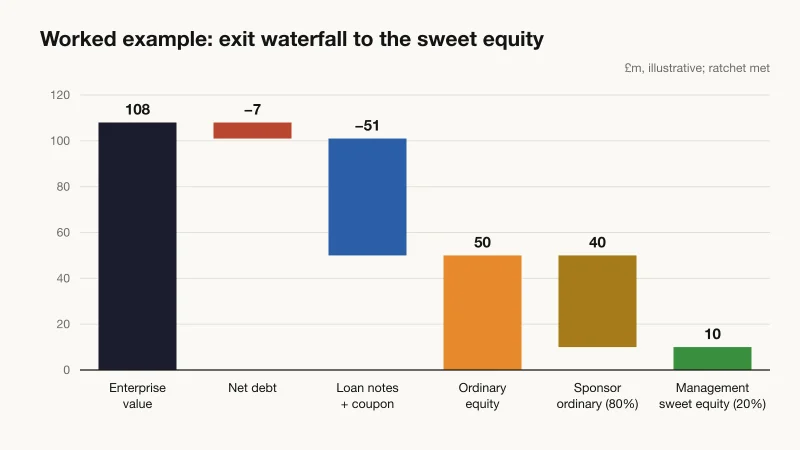
The business grows EBITDA to £12.0m and is sold at 9.0 times, an enterprise value of £108.0m. Net debt at exit is £7.0m. The loan notes have accrued five years of 10% coupon, £17.0m, so £51.0m is due to the sponsor before the ordinary shares receive anything.
Exit waterfall: from enterprise value to the sweet equity
Step
£m
Enterprise value (£12.0m EBITDA × 9.0)
108.0
Less net debt
(7.0)
Equity value
101.0
Less loan notes: principal
(34.0)
Less loan notes: rolled-up coupon (5 × £3.4m)
(17.0)
Ordinary equity
50.0
The worked example's exit waterfall, in £m. Illustrative figures; the management bar assumes the ratchet is met.
Management's share with and without a ratchet
A waterfall distribution like this one can include a ratchet: a term that increases management's share of the ordinary equity if the sponsor's return clears a target. Here, management's share rises from 15% to 20% if the sponsor still earns at least 2.25 times its money (its MOIC) after the ratchet. Sponsors also set ratchets on an IRRhurdle rate, or on both.
Exit proceeds with and without the ratchet
Without a ratchet
With the ratchet
Management share of the ordinary equity
15%
20%
Management proceeds
£7.5m
£10.0m
Management money multiple (on £0.75m)
10.0x
13.3x
Sponsor proceeds (loan notes £51.0m plus ordinary)
£93.5m
£91.0m
Sponsor money multiple (on £38.25m)
2.44x
2.38x
Ratchet test (sponsor at least 2.25x after the ratchet)
Not applicable
Met
The ratchet moves £2.5m of value from the sponsor to management. Both columns reconcile to the same £101.0m of equity value: £51.0m of loan notes plus £50.0m of ordinary shares.
✔ Example
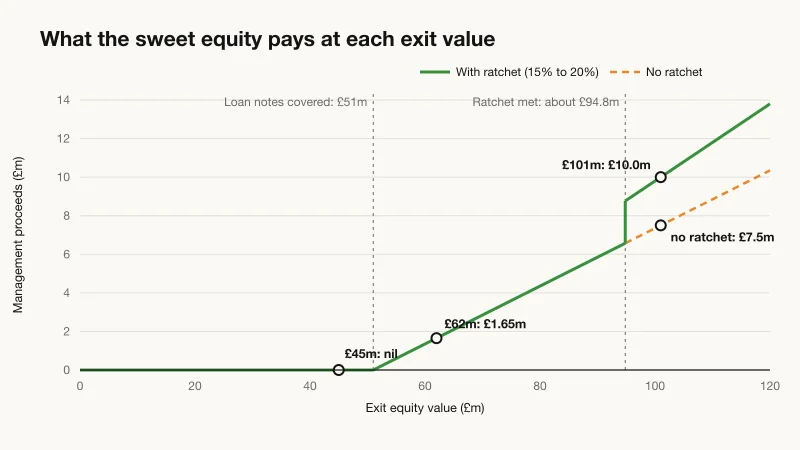
The same plan at three exit values. At an equity value of £45.0m the loan notes are £6.0m short, the ordinary shares are worth nothing and management receives nothing. At £62.0m the ordinary shares are worth £11.0m, management's 15% is £1.65m, and the sponsor's 1.58x misses the ratchet. At £101.0m management receives £10.0m. The ratchet starts to pay at an equity value of about £94.8m, the point at which the sponsor's £51.0m plus 80% of the ordinary equity reaches 2.25 times £38.25m.
Management's proceeds by exit equity value in the worked example, with the loan-note hurdle at £51m and the ratchet step at about £94.8m. Illustrative figures.
The chart shows the two features that define sweet equity: a flat line at zero until the loan notes are covered, then a steep slope. It also shows the cliff a single-step ratchet creates. Just below £94.8m management holds 15%; just above, 20%. Some plans use a sliding scale between two hurdles to avoid that cliff, which reduces the incentive to argue over the last pound of the price.
ℹ Note
How a ratchet is built changes its tax treatment. Under the 2003 memorandum of understanding between HMRC and the BVCA, HMRC's safe harbour covers ratchets that depend on the company's performance or the sponsor's return, exist when the sponsor invests, and where managers pay a price reflecting their maximum entitlement. In practice that means managers subscribe for the larger stake (here, £1.0m for 20%) and give part of it up if the hurdle is missed, or pay a premium. A ratchet that dilutes the sponsor in management's favour without that premium can leave part of the value taxed as employment income at the start. Management's exit proceeds above are the same either way; only the entry price, and so the money multiples, would change.
Alternatives to a MIP: growth shares, EMI, CSOP and phantom plans
Sweet equity is the standard structure in a sponsor-led buyout, but it is not the only one. The choice usually turns on whether the company qualifies for a tax-advantaged scheme, how much the managers can invest, and whether the plan has to reach beyond a small senior team.
Management incentive alternatives compared (UK)
Plan
What the manager gets
Who can use it
Tax in outline
Fit in a private equity buyout
Sweet equity MIP
Ordinary shares bought at market value, behind the sponsor's strip
Any company
Income tax on any shortfall against unrestricted market value at acquisition; exit gain usually capital gains
The standard structure
Growth shares
A share class that participates only in value above a hurdle, often set at or above today's equity value
Any company
As sweet equity; the hurdle keeps the value at issue low, but it must be supportable
Common in founder-led companies and for later joiners
EMI options
Options over ordinary shares, up to £250,000 per employee at grant
Independent trading companies with gross assets of £120m or less and fewer than 500 full-time equivalent employees (from 6 April 2026)
No income tax or NICs on exercise if the exercise price is at least market value at grant; capital gains on sale
Usually unavailable once a fund controls the company
CSOP options
Options up to £60,000 per employee
Companies not under the control of another company, unless listed
No income tax or NICs if exercised 3 to 10 years after grant, or in certain leaver and exit cases
Often unavailable for the same reason, and small
Phantom plan or exit bonus
A cash payment tied to the exit value
Any company
Income tax and NICs as earnings; usually deductible for the company
Used for the wider team, or where shares are impractical
EMI options and the independence test
Enterprise Management Incentive options are usually the most tax-efficient route for UK employees. From 6 April 2026 the limits rose: a company can qualify with gross assets of up to £120m (previously £30m) and fewer than 500 full-time equivalent employees (previously 250), with up to £6m of unexercised options in total and an exercise period of up to 15 years. The individual limit stays at £250,000, and the employee must work at least 25 hours a week, or 75% of their working time, for the company.
Size, however, is rarely what rules EMI out after a buyout. The company must be independent: not a 51% subsidiary of another company and not under another company's control. HMRC's guidance is that where a limited partnership controls the company and its general partner is a company, as in most private equity fund structures, the general partner controls the company and the test fails. EMI therefore mostly matters before the deal: options granted at least two years before a sale can be exercised on the exit with capital gains treatment and access to Business Asset Disposal Relief.
Growth shares and phantom plans
Growth shares do the same job as sweet equity without a separate preferred layer. Because the class shares only in value above a hurdle, its market value at issue is low, so managers can buy a meaningful stake for a modest sum. The weak point is valuation: the price must reflect the unrestricted market value, and HMRC can challenge it later, so a documented valuation at issue is essential.
Phantom plans pay cash by reference to the exit value or share price. They are simple and flexible and need no share issue, but the payment is taxed as employment income with National Insurance on both sides, so the manager keeps far less of each pound than with shares taxed as capital.
How a MIP is taxed in the UK (general information, not tax advice)
This section outlines the UK rules as at 12 October 2026. MIP tax depends on the precise share rights, the price paid and the timing, so take advice before you invest, and before the exit.
Restricted securities and the section 431 election
Shares that managers acquire because of their employment are employment-related securities under Part 7 of the Income Tax (Earnings and Pensions) Act 2003 (ITEPA 2003). Leaver provisions that can force a sale below market value make them restricted securities under Chapter 2. Without an election, part of the later growth in value can be taxed as employment income when the restrictions lift or the shares are sold.
The usual answer is a joint election by the employer and the manager under section 431, made within 14 days of acquiring the shares on HMRC's approved form. It taxes the shares on their unrestricted market value at acquisition, ignoring the restrictions, and takes later Chapter 2 charges out of play. Where managers pay the full unrestricted market value, the election costs nothing at acquisition, which is why it is signed as a matter of course at completion.
Paying unrestricted market value at acquisition
If managers pay less than the unrestricted market value of their shares, the shortfall is employment income. Valuing sweet equity is hard, which is why the Inland Revenue (now HMRC) and the British Private Equity and Venture Capital Association (BVCA) agreed a memorandum of understanding in July 2003 (published in HMRC's Employment Related Securities Manual at ERSM30520). HMRC accepts that managers have paid unrestricted market value where the conditions below are met.
The 2003 BVCA memorandum's conditions, in outline
Condition
What it means in practice
Managers' shares are ordinary shares
The sweet equity sits in the ordinary capital, behind all debt and preferred capital
The sponsor's preferred capital is on commercial terms
The return on its loan notes or preference shares is at least the rate on the most expensive finance from lenders who hold no ordinary shares, adjusted for tax deductibility
Same price, same time
Managers pay no less per share than the sponsor for shares with the same economic rights, and buy when the sponsor does
No special rights
The managers' shares carry no rights that other ordinary shareholders lack
Full pay elsewhere
Managers are fully paid through salary and bonus under separate service contracts
In November 2025, HMRC's Employment Related Securities Bulletin 61 confirmed that sweet equity with no or limited voting rights, compared with the sponsor's strip shares, can still fall within the memorandum if the other conditions are met. Ratchets have their own conditions, summarised in the note in the worked example.
When exit proceeds can be taxed as income
A MIP that meets these conditions, with a section 431 election, normally produces a capital gain on exit. The risk of employment-income treatment comes from departures from that pattern: a price below unrestricted market value at the start; a ratchet that shifts value to managers without the structure the memorandum describes; rights added or varied later that other ordinary shareholders do not receive; returns linked to an individual's own performance; or proceeds that are in substance a bonus rather than a return on shares. Where income tax applies and the shares are readily convertible assets, PAYE and National Insurance can also apply.
⚠ Warning
The memorandum is a safe harbour, not a rule of law. HMRC is not bound by it where there are material departures from the structure it describes, or where avoiding tax is a main or significant purpose. Changes made during the hold, such as a new share class for a new hire, a refinancing, or a partial exit, need the same tax review as the original plan.
Business Asset Disposal Relief for management shareholders
On a sale, gains on shares are taxed at the capital gains tax rates: 24% for a higher-rate taxpayer, after a £3,000 annual exempt amount. Business Asset Disposal Relief (BADR) reduces the rate to 18% for disposals from 6 April 2026 (14% from 6 April 2025 to 5 April 2026), on up to £1m of qualifying gains in a lifetime. For shares, for at least two years before the sale you must be an employee or officer of the company or its group, the company must be a trading company or the holding company of a trading group, and the company must be your personal company. That means you hold at least 5% of the ordinary share capital and 5% of the voting rights, and are entitled to at least 5% of either the distributable profits and the assets on a winding up, or the proceeds of a sale of the company.
Most managers other than the chief executive fall short of the 5% tests, because the sponsor's ordinary shares count in the total, and non-voting sweet equity fails the voting test. The exception is shares acquired by exercising EMI options: they qualify without the 5% tests if the option was granted at least two years before the sale and the other conditions are met. Our FAQ on what Business Asset Disposal Relief is covers the relief in general terms.
Why MIP value depends on intangible value creation
In the worked example, the loan notes and net debt are fixed by the time of the exit. Every change in enterprise value therefore falls on the ordinary shares. One turn of the exit multiple on £12.0m of EBITDA is £12.0m of value, and management's 15% of it is £1.8m, almost a quarter of their £7.5m. Sweet equity is, in effect, a geared bet on the multiple a buyer will pay.
That multiple is set by how a buyer judges the durability and transferability of the earnings, and most of what drives that judgement is intangible. A buyer will pay more where customer relationships are contracted and diversified, where the team runs the business without depending on one or two people, where processes are documented, and where customers would find it costly to switch. In the Opagio 12 framework those are Customer Capital, Human Capital, Organisational Capital and Switching Costs & Lock-In. A sponsor's value creation plan usually targets them, and key person risk is the discount a buyer applies when the plan has not worked.
Opagio 12 value drivers that move a private equity exit multiple
Opagio 12 driver
What the next buyer tests
What the management team can evidence during the hold
Customer Capital
Retention, concentration, contract terms and change-of-control clauses
Cohort retention, contract register, revenue by customer
Human Capital
Depth beyond the founder and the leadership team
Succession cover, retention of key staff, documented roles
Organisational Capital
Whether the business runs on systems rather than individuals
Process documentation, management information, scalability
Switching Costs & Lock-In
How hard it is for customers to leave
Integration depth, contract length, churn after price rises
Brand & Reputation
Pricing power and demand that does not rely on sales effort
Price realisation, inbound share of pipeline, reviews
★ Key Takeaway
For a manager holding sweet equity, the intangible assets are not an accounting topic. They are the main lever on the exit multiple, and the exit multiple is the main lever on what the MIP pays.
Opagio Intangibles builds a Value Drivers Register of the named intangible assets in your business across the Opagio 12 value drivers, with the evidence for each. The Asset Valuator values individual assets using standard asset-level methods, including relief from royalty, MPEEM and with-and-without, and the company valuation workspace brings DCF, trading comparables and a growth bridge together for the business as a whole. Growth Plan tracks KPIs, targets and the valuation trajectory from your own data, so the team can see which assets are moving the price during the hold. Start with the free Quick Assessment, or see how Opagio supports exit readiness.
Frequently asked questions about management incentive plans
What is a management incentive plan?
A management incentive plan is the arrangement through which the managers of a private equity-backed company own part of its ordinary shares, usually 10% to 20%, bought at a low price because the fund's money sits mostly in loan notes or preference shares ranking ahead of them. The managers are paid on the exit, from the value above the fund's preferred return.
How much equity do managers get in a MIP?
The management pool is commonly 10% to 20% of the ordinary shares, sometimes more in smaller deals, with part held back for future hires. The chief executive typically holds the largest single allocation. What matters more than the percentage is the size of the preferred layer ahead of it, and the envy ratio.
What is sweet equity?
Sweet equity is the ordinary shares managers buy in a buyout. They pay the same price per share as the fund, but because the fund invests most of its money as loan notes or preference shares, a small investment buys a meaningful share of the ordinary equity, and of any growth above the fund's preferred return.
What is a ratchet in a management incentive plan?
A ratchet changes management's share of the ordinary equity according to the fund's return or the company's performance, for example from 15% to 20% if the fund makes at least 2.25 times its money. For HMRC's safe harbour, managers normally pay for the maximum stake and give part back if the target is missed.
Can a private equity-backed company grant EMI options?
Usually not. EMI requires the company to be independent of other companies, and HMRC treats a company controlled by a fund's limited partnership with a corporate general partner as controlled by that general partner. Size is less often the barrier since 6 April 2026, when the limits rose to £120m of gross assets and 500 employees.
Are MIP gains taxed as income or capital gains?
Usually as capital gains, at 24% for a higher-rate taxpayer or 18% where Business Asset Disposal Relief applies, if the managers paid unrestricted market value, made a section 431 election, and the plan follows the BVCA memorandum. Departures from that pattern can turn part of the gain into employment income. Take advice on your own facts.
Normalised EBITDA is the profit a buyer multiplies. Here is every common adjustment and which way it goes, the 2026 FRS 102 lease change, and a worked EBITDA bridge from £1.5m reported to £1.2m normalised.
A quality of earnings report tests whether the profit you are selling is real, recurring and backed by cash. What a QoE covers, when to commission a sell-side review, how it differs from an audit, and how its findings move the price.
Business Asset Disposal Relief taxes qualifying gains at 18% from 6 April 2026 on up to £1m over a lifetime, against 24%. The conditions, the worked figures and the checks to make with an adviser before a sale.
Get the latest insights on intangible asset growth and productivity delivered to your inbox.
We use essential cookies to make our website work. We'd also like to use analytics cookies to improve your experience. You can manage your preferences at any time.
Cookie Policy