Brand Valuation: Methods, a Worked Example and Brand Equity vs Brand Value
By Ivan Gowan· 2026-03-16brand valuationbrand valuation methodsbrand equity vs brand valuebrand equityrelief from royaltyintangible asset valuationbrand valuebrand as intangible asset
Brand valuation is the process of putting a financial value on a brand, most often as the present value of the royalties its owner avoids by owning the brand rather than licensing it (the relief from royalty method). Valuers work to ISO 10668 and IVS 210 and choose between income, market and cost approaches; the result is used in acquisitions, licensing, transfer pricing, disputes and lending. In the UK, a brand reaches the balance sheet only when it is bought: one built in-house is never recognised under FRS 102 or IAS 38.
Last reviewed: October 2026. Written for UK businesses and their advisers; accounting references are FRS 102 with IFRS alongside. General information, not valuation, accounting or tax advice.
A brand is often the most valuable single intangible asset a consumer-facing company owns, and the one its accounts are least able to show. Under IAS 38 and FRS 102 Section 18, an internally generated brand cannot be recognised at all; it appears only when someone buys it. That leaves an owner with a gap. The asset that commands the price premium and keeps customers coming back is invisible in the statutory figures, so the first time it is valued is often in the buyer's purchase price allocation, on the buyer's assumptions. A brand valuation closes that gap with a number you can defend.
3valuation approaches recognised by IVS 210 and ISO 10668: income, market and cost
£7.6mfair value of the worked example's brand, on £20m of Year 1 revenue
64%of the value before TAB sits in the terminal value, after Year 5
★ Key Takeaway
Brand valuation answers a financial question: what would a buyer or licensee pay for the right to use this brand? Brand equity, the strength of the brand in customers' minds, is what drives that answer, but it is not the answer itself. A defensible valuation shows how one feeds the other.
Brand Equity vs Brand Value
The two terms are used interchangeably in boardrooms and marketing plans, and the confusion costs money in negotiations. They measure different things, on different scales, for different audiences.
Brand equity is consumer-based, or marketing, equity: the effect the brand has on how customers think and behave. David Aaker's model (Managing Brand Equity, 1991) breaks it into brand loyalty, brand awareness, perceived quality and brand associations, plus other proprietary brand assets such as trade marks. Kevin Lane Keller's customer-based brand equity model (Journal of Marketing, 1993) defines it as the differential effect that knowledge of the brand has on a customer's response to its marketing, with awareness and brand image (the associations a customer holds) as the two components. Brand equity is measured with surveys, tracking studies, Net Promoter Score, retention and observed price premiums.
Brand value is the monetary value of the brand as an asset: what it is worth, in pounds, to an owner, a buyer or a licensee. It is set by valuation standards. ISO 10668 sets the requirements for monetary brand valuation, including the legal, behavioural and financial analysis a valuer must carry out. ISO 20671-1 sets the principles for brand evaluation, the structured assessment of brand strength that sits between the marketing measures and the money. IVS 210, the International Valuation Standards Council's standard for intangible assets, governs the valuation itself when the brand is valued for financial reporting, transactions or lending.
Brand equity and brand value compared
Brand equity
Brand value
What it measures
The brand's effect on customer awareness, associations, perceived quality and loyalty
The brand's worth as an asset, in money
Unit
Scores, indices, survey results, retention and premium data
Pounds (a point value or a range)
Main frameworks
Aaker (1991); Keller (1993)
ISO 10668; IVS 210; ISO 20671-1 for the strength assessment that feeds it
Who uses it
Marketing teams, brand managers, boards tracking brand health
What would someone pay to own or license this brand?
Can it be negative?
Yes: associations can deter customers
The asset is not valued below nil, but damaged equity lowers it, sometimes to nil
How the two connect
Brand equity is an input; brand value is the output. A valuer translates the evidence of equity into the assumptions that drive the number.
From brand equity evidence to valuation inputs
Valuation input
Brand equity evidence
Effect on brand value
Royalty rate
Awareness and loyalty against competitors
A stronger brand supports a rate towards the top of the comparable licence range
Discount rate
Repeat purchase, retention, low churn
Less volatile branded cash flows support a lower brand-specific risk premium
Useful life and growth
Heritage, durable associations
Support a longer life and a terminal value; a recent or faddish brand does not
Price premium
Customers paying more than for a generic equivalent
Direct evidence for the premium profit method and a cross-check on the royalty rate
ℹ Note
ISO 10668 requires a behavioural analysis for exactly this reason: the valuer must explain how customers' perceptions of the brand translate into the cash flows being valued. A valuation that never mentions awareness, loyalty or price premium has skipped a step the standard expects.
For the other kinds of IP and the methods that suit them, see IP valuation methods.
When You Need a Brand Valuation
Brand valuations are required, or valuable, in several specific contexts. The purpose decides the basis of value (fair value, market value or a value to a specific owner), and the basis decides assumptions such as the tax amortisation benefit.
Recognise the brand as an identifiable intangible at fair value
Acquirer, auditor
Exit planning
Show the buyer what the brand is worth before its PPA decides
Seller, adviser
Licensing and franchising
Set arm's-length royalty rates
Licensor, licensee
Transfer pricing
Justify intercompany charges for brand use
HMRC and other tax authorities
Litigation and disputes
Quantify damages from infringement or passing off
Courts, experts
Lending and securitisation
Support the brand as collateral
Lender
Insolvency
Realise the brand in a distressed sale
Administrator
Strategic planning
Assess the return on brand investment
Board, marketing director
Brand Valuation Methods
IVS 210 recognises three approaches for intangible assets: income, market and cost. ISO 10668 uses the same three for brands. Within the income approach, both standards name several methods, and relief from royalty is the one used most often for brands, because licensing data gives it an observable anchor.
Brand valuation methods at a glance
Method
Approach
How it values the brand
Where it is named
When to use it
Relief from royalty
Income
Present value of the after-tax royalties avoided by owning the brand
IVS 210; ISO 10668 ("royalty relief")
Default for brands with comparable licensing evidence
Premium profit / price premium
Income
Present value of the extra profit from a higher price (or greater volume) than an unbranded equivalent
IVS 210 (premium profit); ISO 10668 (price premium, volume premium)
Consumer goods with credible generic or own-label comparators
With-and-without
Income
Difference between business cash flows with the brand and without it
IVS 210 (grouped with premium profit)
Where the loss of the brand can be modelled across the whole business
Multi-period excess earnings (MPEEM)
Income
Residual cash flows after charges for every other contributing asset
IVS 210 (excess earnings); ISO 10668
Only where the brand is the primary asset of the business
Cost approach
Cost
Cost to recreate or replace the brand, less obsolescence
IVS 210 (replacement and reproduction cost); ISO 10668
Cross-check or floor; newly launched brands with no income history
Market approach
Market
Prices paid for comparable brands
IVS 210; ISO 10668
Rarely: comparable, disclosed brand sales are scarce
Method 1: Relief from royalty
The relief from royalty method values the brand as the royalties its owner does not have to pay. If the business did not own the brand, it would have to license it from a third party; owning it relieves the business of that cost. The value is the present value of those avoided royalties, after tax.
Forecast branded revenue
Identify the revenue earned under the brand. For a single-brand company this may be total revenue; for a portfolio, segment by brand and exclude revenue the brand does not drive.
Select the royalty rate
Benchmark the royalty rate against comparable brand licences, then position the brand within the range using the brand equity evidence.
Deduct tax on the royalty saved
A royalty would be tax-deductible to the licensee, so the saving is taxed: multiply by one minus the tax rate (25% UK main rate of corporation tax).
Discount to present value
Discount the after-tax royalties at a brand-specific rate over the brand's useful life, with a terminal value where the life is indefinite.
Add the tax amortisation benefit where the basis requires it
In a fair-value valuation, add the TAB where a market participant buying the brand on its own could deduct its amortisation for tax.
Worked example: relief from royalty for a UK consumer brand
A UK consumer brand has a board forecast of branded revenue of £20.0m in Year 1, rising to £26.0m in Year 5.
Worked example inputs
Input
Assumption
Basis
Royalty rate
4%
Within the illustrative 3-8% range for consumer packaged goods brands (below), positioned on the brand's strength
Tax rate
25%
UK main rate of corporation tax
Discount rate
12%
Brand-specific rate, reconciled to the business's cost of capital
Discounting
Year end
Keeps the arithmetic easy to follow; mid-year discounting would give a higher value
Growth after Year 5
2% a year, indefinitely
Long-term growth for the terminal value
Relief from royalty calculation (£000; present values to the nearest £1,000)
Year
Branded revenue
Royalty at 4%
After tax at 25%
Discount factor at 12%
Present value
1
20,000
800
600
0.8929
536
2
22,000
880
660
0.7972
526
3
24,000
960
720
0.7118
512
4
25,000
1,000
750
0.6355
477
5
26,000
1,040
780
0.5674
443
Years 1 to 5
2,494
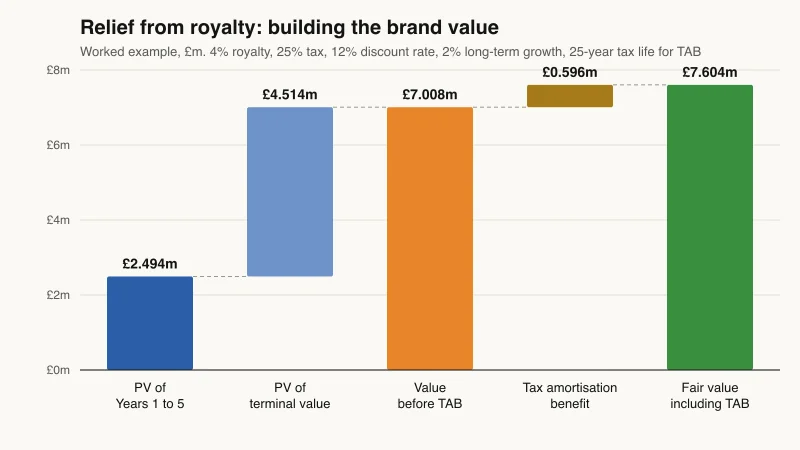
The terminal value captures everything after Year 5. The Year 6 after-tax royalty is £780,000 × 1.02 = £795,600. Divided by the discount rate less growth (12% − 2% = 10%), that gives a terminal value of £7,956,000 at the end of Year 5, worth £7,956,000 × 0.5674 = £4,514,000 today.
From royalty savings to fair value (£000)
Component
Calculation
Value
Present value of Years 1 to 5
Sum of the table above
2,494
Present value of the terminal value
7,956 × 0.5674
4,514
Value before TAB
2,494 + 4,514
7,008
Tax amortisation benefit
7,008 × (1.0851 − 1)
596
Fair value including TAB
7,008 × 1.0851
7,604
The TAB factor of 1.0851 comes from three assumptions: a 25% tax rate, a 12% discount rate and a 25-year tax life (the 4% a year fixed-rate writing-down election in section 730 of the Corporation Tax Act 2009, the usual route to relief for a brand that is not amortised in the accounts). The present value of £1 a year for 25 years at 12% is 7.8431, so the factor is 1 ÷ (1 − 25% ÷ 25 × 7.8431) = 1 ÷ 0.92157 = 1.0851.
Relief from royalty worked example: the terminal value contributes 64% of the brand's value before the tax amortisation benefit.
✔ Example
On these assumptions the brand is worth about £7.0m before the tax amortisation benefit and £7.6m at fair value including it. Move the royalty rate from 4% to 5% and every royalty, and so every present value and the TAB, rises by a quarter: the fair value becomes about £9.5m. The royalty rate and the terminal value carry most of the answer, which is why both need the most evidence.
The tax amortisation benefit is a valuation assumption
The TAB is the present value of the tax deductions a buyer would get by amortising the brand. It belongs in a fair-value measurement, such as the brand's value in a purchase price allocation under IFRS 3 or FRS 102 Section 19, because fair value assumes a hypothetical sale of the brand on its own to a market participant. Where that market participant could deduct the brand's amortisation for tax, the price it would pay includes the value of those deductions, whatever the structure of the actual deal.
The TAB does not mean the actual acquirer gets any tax relief. After a UK share purchase, the brand recognised in the consolidated PPA usually has no tax base and attracts no relief; the PPA records a deferred tax liability instead (see the purchase price allocation guide). For other purposes, such as a licensing negotiation, a dispute or an owner's planning figure, many valuers report the value before TAB. Whether to include it, and on what tax life, should be stated as an assumption; the TAB vs amortisation benefit comparison sets out the mechanics.
⚠ Warning
The fair value including TAB is not a measure of tax relief anyone will receive. A PPA does not create tax relief; the structure of the deal does. Take tax advice on structure before signing.
Industry royalty rate ranges
The ranges below are illustrative only, not benchmarks drawn from a named dataset. They are not a substitute for a comparable licence set: a defensible rate cites specific agreements and explains where the brand sits within the range.
Indicative brand royalty rates by sector
Industry
Indicative brand royalty rate
Luxury goods and fashion
8-15%
Consumer packaged goods
3-8%
Food and beverage
3-6%
Pharmaceuticals (OTC)
3-8%
Hospitality and hotels
4-8%
Technology and software
2-5%
E-commerce and retail
2-5%
Automotive
2-5%
Financial services
1-3%
Professional services
1-3%
Method 2: Premium profit (price premium)
The premium profit method values a brand by the extra profit it earns over an equivalent unbranded product. ISO 10668 splits this into a price premium method (the branded product sells for more) and a volume premium method (it sells in greater quantity at the same price). The present value of that premium, after tax and after any extra costs of supporting the brand, is the brand's value.
It works well where a credible generic comparator exists: branded cereals against own-label, branded over-the-counter medicines against generics. It is hard to apply to B2B brands or sectors without unbranded equivalents, and the comparator must be genuinely equivalent apart from the brand, or the premium measures something else, such as distribution or product quality.
Method 3: With-and-without
The with-and-without method values the brand by modelling the whole business twice: once as it is, and once as if the brand did not exist, with lower prices, lower volumes or higher marketing spend while a replacement is built. The difference in present value is the brand's value. IVS 210 treats it alongside the premium profit method, since both compare a business with the asset against one without.
It is more often used for non-compete agreements and for assets whose loss can be modelled directly. For a brand, the hard part is building a credible "without" scenario: how far prices would fall, how many customers would leave and how long recovery would take are all judgements.
Method 4: Cost approach
The cost approach estimates what it would cost to recreate the brand (reproduction cost) or to build one of equivalent utility (replacement cost): design, trade mark registration, launch advertising and the time to build awareness, adjusted for obsolescence.
It usually understates an established brand's value, because spending does not equal brand equity: two campaigns of the same cost can build very different brands. Both IVS 210 and ISO 10668 treat it as a method for when the income and market approaches cannot be applied reliably, such as a recently launched brand with no income history, or as a cross-check.
Method 5: Market approach
The market approach values the brand by reference to prices paid for comparable brands. In principle it is the most direct evidence; in practice it is rare, because brand sales are seldom disclosed in enough detail, and no two brands are alike. It is most useful as a cross-check, for example by comparing the implied royalty rate or a value-to-revenue multiple against disclosed brand transactions.
★ Key Takeaway
Use relief from royalty as the primary method where licensing evidence exists, and cross-check it with a second method: the price premium where generic comparators exist, the cost approach for a young brand, or a disclosed transaction where one is available. A brand valuation that rests on one method and one royalty rate is the easiest to challenge.
Brand Strength Assessment
Whatever method is used, the valuer must assess the brand's strength, which is where brand equity evidence enters the valuation. Strength affects the royalty rate (stronger brands support higher rates within the range) and the discount rate (stronger brands carry less risk).
Brand strength factors
Factor
Strong brand
Weak brand
Awareness
High unaided recall
Prompted recognition only
Loyalty
High repeat purchase rate, low churn
Significant switching behaviour
Pricing power
Commands a premium against competitors
Price-competitive, no premium
Geographic reach
Multi-market presence
Single market
Legal protection
Registered trade marks, active enforcement
Unregistered or weak protection
Consistency
Unified identity and messaging
Fragmented or inconsistent
Heritage
Established history and reputation
Recent entrant
Digital presence
Strong search, social and content authority
Limited digital footprint
ℹ Note
Brand strength is not purely subjective. It can be evidenced through customer surveys (awareness tracking, Net Promoter Score), market data (price premium analysis, market share trends) and financial metrics (revenue stability, customer retention). ISO 20671-1 gives a structure for that assessment; what matters to a buyer is that each claim about strength has a record behind it.
Accounting Recognition: When a Brand Reaches the Balance Sheet
Brand value and the balance sheet are different questions. A brand can be worth millions and carried at nil, and the rules turn on how the brand came into the business, not on what it is worth.
Internally generated brands are never recognised
IAS 38.63 prohibits recognising internally generated brands, mastheads, publishing titles, customer lists and items similar in substance; paragraph 64 gives the reason: the spending on them cannot be distinguished from the cost of developing the business as a whole. Under UK GAAP, FRS 102 Section 18 reaches the same result: paragraph 18.8C(a) lists internally generated brands, logos, publishing titles, customer lists and similar items among the things an entity may not recognise as intangible assets. The marketing spend that built the brand is expensed as incurred.
Acquired brands are recognised in the purchase price allocation
When a business is acquired, the buyer allocates the price across the identifiable assets acquired, and a brand is usually one of them. The tests differ between frameworks.
Separable or arising from contractual or legal rights (either is enough)
Separable and arising from contractual or other legal rights (both required)
Policy option
None
An entity may choose to recognise intangibles that meet only one of the two criteria, applied to every intangible in the same class
Useful life
Finite or indefinite
Always finite; no more than 10 years where no reliable estimate can be made
Subsequent measurement
Amortised if finite; annual impairment test under IAS 36 if indefinite
Amortised over the useful life; tested for impairment where there is an indication
Where the test is not met
Value stays in goodwill
Value stays in goodwill
A registered trade mark usually satisfies both FRS 102 criteria: it arises from a legal right and can be sold or licensed separately from the business. An unregistered brand, relying on goodwill and the law of passing off, is harder to separate, and without the policy choice its value may stay in goodwill.
UK trade mark registration as evidence
Registration with the UK Intellectual Property Office (UKIPO) is the strongest single piece of evidence behind a UK brand valuation. A registration lasts ten years and can be renewed indefinitely, and the register records the owner, the mark, the classes of goods and services and the dates. That record does several jobs at once.
What a UKIPO trade mark registration evidences
Question
What the registration shows
Ownership
The company, not a founder or an agency, owns the mark: buyers check this in due diligence
Scope
The classes define what the brand protects, and so which revenue the valuation can attribute to it
Recognition
The legal right that supports the contractual-legal criterion under FRS 102 and IFRS 3
Royalty logic
A registered mark is a licensable right, which is what the relief from royalty method assumes
Useful life
Indefinite renewal supports a long or indefinite life, subject to the brand's commercial durability
There is also a tax pointer, as general information only. In a UK trade and assets purchase, a registered trade mark is generally within the corporate intangibles rules in Part 8 of the Corporation Tax Act 2009, while an unregistered trade mark or sign is one of the "relevant assets", alongside goodwill, whose relief is restricted (section 879A, which replaced section 816A from April 2019). Registration therefore matters to a buyer's tax position in an asset deal as well as to the valuation.
✔ Example
An owner preparing for a sale finds that the company's main brand was registered by the founder personally in 2014, and that two newer product names were never registered. Before the sale, the founder assigns the registration to the company and the company files the two new marks. Each is now a separable, contractually protected asset the buyer can identify and value, rather than an argument about goodwill.
Brand Valuation in M&A
In a business combination, the acquired brand is measured at fair value in the purchase price allocation, usually by relief from royalty, and often with a TAB as described above. Under IFRS, the classification of its useful life then drives the post-acquisition accounting.
Brand tied to a specific contract, product or market window, or planned for retirement
Indefinite life
Not amortised; annual impairment test under IAS 36
Established brands with no foreseeable limit on the period of economic benefit
⚠ Warning
Classifying a brand as having an indefinite life avoids amortisation under IFRS but requires an annual impairment test. If the brand's performance deteriorates, the charge can be large. Indefinite life is not available under FRS 102, where every intangible is amortised, so a UK GAAP group and its IFRS parent may account for the same brand differently.
Brand Valuation in Transfer Pricing
When a brand is used across jurisdictions, typically through intercompany licences, transfer pricing rules require the royalty rate to be set at arm's length. HMRC and other tax authorities scrutinise brand royalty charges, particularly where royalties flow from higher-tax to lower-tax jurisdictions.
The OECD Transfer Pricing Guidelines require the royalty to reflect the functions performed, assets used and risks assumed by each entity. A relief from royalty valuation provides a foundation for that analysis, but the transfer pricing rate must also consider the factors below.
Factors beyond the valuation model
Factor
Why it matters
The brand owner's ongoing investment
Maintaining and developing the brand supports the owner's share of the return
Local marketing contributions by the licensee
May justify a lower royalty in that market
The DEMPE functions
Development, enhancement, maintenance, protection and exploitation must be mapped to the entities that perform them
Transfer pricing documentation requirements
Requirement
Purpose
Comparability analysis
Benchmarking the royalty rate against comparable arm's-length transactions
Functional analysis
Documenting which entity performs which DEMPE functions
Economic analysis
Supporting the royalty rate with a brand valuation model
Consistency
Applying the rate consistently across jurisdictions
✔ Example
A UK consumer goods company licenses its brand to subsidiaries in 12 countries. A tax authority challenges the 5% royalty rate as excessive for lower-income markets. The company's defence rests on a relief from royalty valuation, a comparability analysis of third-party licensing agreements and a functional analysis showing that the UK parent performs the brand development and protection functions.
Common Mistakes in Brand Valuation
Having worked with brands across consumer goods, technology, financial services and professional services, I see these errors consistently.
Common brand valuation mistakes
Mistake
What goes wrong
Using generic royalty rates
A luxury fashion brand and an industrial B2B brand cannot share a rate, yet sector averages are often applied without positioning the brand within the range
Ignoring brand-specific risk
The discount rate for a century-old brand should differ from that for a five-year-old digital brand; one cost of capital for both ignores the difference
Double-counting with customer relationships
If the brand drives acquisition and retention and customer relationships are valued separately, the two must be calibrated so the same cash flows are not counted twice
Where asset identification is superficial, brand value is left in the goodwill residual, understating identified intangibles and overstating goodwill in the acquirer's accounts
Treating the TAB as tax relief
Including a TAB in a fair value is a market-participant assumption; it does not mean the actual buyer will receive any deduction
Ignoring negative brand equity
Brands involved in scandal, recall or regulatory action can carry associations that reduce, rather than add to, enterprise value
Brand Valuation for SMEs and Owners Preparing to Sell
Brand valuation is not only for multinationals. Owner-managed businesses with strong brands in their niche, whether local, sector-specific or digital, often hold brand value well above anything on their balance sheet.
The most common reason is a sale. A buyer will value the brand in its PPA; valuing it first, with the evidence in order, lets you argue the price from the same numbers. The how to value a business guide shows where the brand fits in the whole-company valuation.
Other SME brand valuation contexts
Context
Why a brand value helps
Fundraising
Evidence of brand value supports the equity story
Licensing and partnerships
Co-branding and licence negotiations need a defensible royalty and value
Lending
Some lenders will take a registered brand as part of the security package, against a valuation prepared to a recognised standard
Value the brand before the buyer does
Opagio Intangibles identifies and evidences your intangible assets across Opagio 12, including Brand & Reputation, and records them in the Opagio Value Drivers Register. Its Asset Valuator runs relief from royalty on your own revenue forecast, with a TAB toggle, mid-year discounting and sensitivity analysis, alongside the with-and-without, cost and market approaches. See how Opagio helps owners prepare for a sale, or see the product in detail.
Frequently Asked Questions
What is the difference between brand equity and brand value?
Brand equity is the brand's effect on customers: awareness, associations, perceived quality and loyalty, measured with surveys, retention and price premium data (the Aaker and Keller models). Brand value is the brand's worth as an asset in money, measured under ISO 10668 and IVS 210. Equity is an input to the valuation; value is the output.
What is the most common brand valuation method?
Relief from royalty. It values the brand as the present value of the after-tax royalties the owner avoids by owning rather than licensing it. It is preferred because royalty rates can be benchmarked against real licence agreements, which gives auditors and tax authorities observable evidence.
Can I put my brand on the balance sheet?
Not if you built it. IAS 38.63 and FRS 102 paragraph 18.8C(a) prohibit recognising internally generated brands. A brand is recognised only when acquired, separately or in a business combination; under FRS 102 an acquired brand is recognised separately from goodwill when it is both separable and arises from legal rights, unless the entity has chosen the policy option to recognise those meeting only one criterion.
Does the tax amortisation benefit mean the buyer gets tax relief?
No. The TAB is an assumption in a fair-value measurement: it reflects the deductions a market participant buying the brand on its own could claim. It does not depend on how the actual deal is structured. After a UK share purchase, the acquired brand usually carries no tax relief, and a deferred tax liability is recognised instead.
How does a UK trade mark registration affect a brand valuation?
A UKIPO registration proves the company owns the mark, defines which goods and services it covers, and gives a licensable legal right. That supports the royalty logic of relief from royalty, the recognition criteria in a purchase price allocation, and a long useful life, since registrations can be renewed every ten years indefinitely.
Ivan Gowan is the Founder and CEO of Opagio. With 25 years of experience in financial technology, including senior roles at IG Group where brand was central to competitive positioning, he brings a practitioner's lens to intangible asset measurement and strategy. Meet the team.
Royalty rate benchmarking turns comparable licences into a defensible rate. The steps, the sources, the interquartile range, the cross-checks that replaced the 25% rule, and a worked example from eight comparables to a relief from royalty value.
A practical guide to valuing trademarks and service marks as intangible assets under IFRS 3. Covers the Relief-from-Royalty method, key inputs, common pitfalls, and how trademarks create enterprise value.
A practical decision framework for choosing between the Relief from Royalty (RFR) and Multi-Period Excess Earnings Method (MPEEM) when valuing intangible assets in purchase price allocations and standalone valuations.
We use essential cookies to make our website work. We'd also like to use analytics cookies to improve your experience. You can manage your preferences at any time.
Cookie Policy