Patent Valuation: Methods, a Worked Example and What a Patent Is Worth
By Ivan Gowan· 2026-03-16patent valuationpatent valuation methodsIP valuationrelief from royaltyincome approachintellectual propertypatent licensingUKIPOintangible asset valuation
Patent valuation estimates the cash advantage that a patent's exclusive rights give its owner over the protected life that remains. Most valuers use relief from royalty: the after-tax royalties the owner avoids paying, discounted to today. Because a patent lasts at most 20 years from filing, the value stops at expiry; unlike a brand, there is no terminal value.
Last reviewed: October 2026. Reflects UKIPO renewal fees as published on gov.uk, IAS 38, FRS 102 Section 18 and the International Valuation Standards. General information, not tax or legal advice.
Patents are among the easiest intangible assets to identify: they are registered, numbered and published. Valuing them is harder. Legal existence is the starting point; the value depends on the market the claims cover, how hard they are to design around, and how many years of protection are left. This guide sets out what drives patent value, the four valuation methods, and a relief-from-royalty calculation on a UK patent that you can reproduce line by line.
£748kworked example: a UK patent with nine years left, before any tax amortisation benefit
20 yrsmaximum UK patent term from filing, renewed yearly from the fourth anniversary
£0terminal value after expiry: the protected cash flows end with the patent
★ Key Takeaway
A patent is worth the economic benefit its exclusivity protects, for as long as it lasts. The cost of obtaining it, the novelty of the invention and the number of claims do not set the value. Protected revenue, a defensible royalty rate and the remaining life do.
How Much Is a Patent Worth?
There is no price list. The same patent can carry different values for a licence negotiation, an acquisition, a loan or a tax filing, because the premise of value differs: fair value for financial reporting, market value for a transaction, an orderly-disposal value for a lender. Within any one premise, six drivers do most of the work.
Patent value drivers
Driver
What the valuer asks
Effect on value
Remaining life
How many years until the 20-year term ends, and are renewals paid?
Sets the length of the cash flow; nothing is counted after expiry
Claim breadth
Do the independent claims cover the commercial product, or a narrow variant?
Broad claims raise the protected revenue and the royalty rate
Enforceability and validity
Has the patent survived examination cleanly, and is any challenge pending?
A credible validity risk raises the discount rate or cuts the life
Can the owner sell the product without infringing someone else's patent?
A blocking third-party patent can make the owner's own patent worth little
The market
How large is the revenue the claims cover, and is it growing?
The royalty base: value scales with it
Licensing evidence
Has anyone paid, or offered to pay, for a licence?
Actual royalties are the best evidence of a rate and of demand
Cost to obtain is not on the list. Applying for a UK patent costs at least £405 in Intellectual Property Office fees, and attorney fees usually add several thousand pounds (gov.uk). Neither figure tells you what the patent is worth: a patent that protects nothing anyone wants to buy is worth little, however much it cost.
ℹ Note
Market-wide figures for "average patent value" or "typical royalty rates by industry" are widely quoted but rarely sourced to a dataset you can inspect. This guide does not use them. Royalty rates should come from comparable licences, selected and adjusted for the patent in front of you, as set out in our guide to royalty rate selection.
For how patents fit alongside trade marks, copyright and know-how, see our guide to IP valuation.
Patent Valuation Methods
The International Valuation Standards recognise three approaches to valuing intangible assets: income, market and cost (IVS 210, Intangible Assets). For patents, the income approach splits in two in practice, which gives the four methods below.
What it would cost to recreate the invention and the right
Early-stage or defensive patents with no income to measure
Relief from royalty
The relief-from-royalty method asks what the owner would pay a third party to use the patented technology if it did not own it. Multiply the protected revenue by an arm's-length royalty rate, deduct tax, and discount the result over the remaining life. It is the most widely used method for patents because its inputs can be evidenced from licence agreements, and auditors and lenders are familiar with it. The worked example below uses it.
Income approach: incremental cash flow
The income approach can also measure the patent's benefit directly: the price premium it allows, or the cost it saves, compared with a business that does not have it. IVS 210 calls the comparison of the two scenarios the with-and-without (or premium profit) method. It suits process patents that cut manufacturing cost, where no one would license the technology on a revenue royalty, and defensive patents whose value lies in keeping a competitor out.
✔ Example
A pharmaceutical company's formulation patent has eight years left. The product sells £30M a year at a 65% gross margin; without the patent, generic competition would bring the margin to 25% on the same revenue. The incremental profit is 40% of £30M, or £12M a year before tax and £9M after UK corporation tax at 25%. Discounted at 16% with end-of-year timing, eight years of £9M is worth 9 × 4.3436 = £39.1M. The same arithmetic before tax gives £52.1M, which is why a pre-tax figure overstates the value.
Market approach: comparable licences and transactions
The market approach looks at what comparable rights sold or licensed for. For patents, true comparables are scarce: each patent is unique by definition, and sale prices are rarely published. Royalty rates from comparable licences are the market evidence most valuers use, which is why the market approach usually feeds relief from royalty rather than standing on its own. Commercial databases such as ktMINE, RoyaltyStat and RoyaltySource collect licence terms; each comparable needs adjusting for exclusivity, territory, the stage of the technology and the remaining life.
Cost approach: reproduction and replacement cost
The cost approach values the patent at what it would cost to recreate. Reproduction cost rebuilds the same invention; replacement cost buys an equivalent capability, both less obsolescence. It almost always understates a commercially successful patent and overstates a failed one, because the cost of inventing something bears no fixed relationship to what it earns. Use it as a floor, or where no income can yet be attributed.
Early-stage patents: real options and Monte Carlo
A patent with no revenue yet is an option on future commercialisation. Some valuers model it that way, using real options analysis, or simulate many outcomes with a Monte Carlo model, or weight a small number of scenarios (no launch, modest launch, strong launch) by their probability. These are refinements within the income approach, not separate approaches. They depend on inputs that are hard to evidence, such as volatility and the probability of technical and commercial success, so they are best used to frame a range alongside a probability-weighted cash flow rather than to produce a single number.
ℹ Note
A defensible patent valuation rarely rests on one method. The usual pattern is relief from royalty as the lead, the incremental cash flow or market evidence as a cross-check, and the cost approach as a floor. Our sibling guide on how to value a patent works through method selection by purpose, with an MPEEM example and the UK lending lens.
A Worked Patent Valuation Calculation (Relief from Royalty)
If you searched for a patent valuation calculator, this section is the calculation such a tool performs. Every figure is illustrative, and every line reconciles, so you can rebuild it in a spreadsheet with the inputs below.
The patent and the inputs
A UK engineering company owns a granted GB patent on a sensor assembly. The application was filed on 1 January 2016, so the 20-year term ends on 31 December 2035. The valuation date is 31 December 2026, which leaves nine years of protection (2027 to 2035).
Input
Value
Basis
Protected revenue
£4.0M in 2027, rising to £4.6M by 2030, then flat
Sales of products that practise the claims
Protected share of revenue
100% to 2030, then 90%, 80%, 70%, 60% and 50%
An obsolescence curve: competitors design around the claims and the product moves to a new generation
Royalty rate
5% of protected revenue
Comparable licences, adjusted for this patent's claim strength (illustrative)
Tax rate
25%
UK corporation tax main rate
Discount rate
15%
12% weighted average cost of capital plus a 3% premium for technology and obsolescence risk
Timing
Mid-year discounting
Royalties accrue through each year
Terminal value
None
The patent expires on 31 December 2035
Relief from royalty schedule (£000)
Year
Revenue
Protected share
Royalty base
Royalty at 5%
After tax at 25%
Discount factor
Present value
2027
4,000
100%
4,000
200.00
150.00
0.9325
140
2028
4,200
100%
4,200
210.00
157.50
0.8109
128
2029
4,400
100%
4,400
220.00
165.00
0.7051
116
2030
4,600
100%
4,600
230.00
172.50
0.6131
106
2031
4,600
90%
4,140
207.00
155.25
0.5332
83
2032
4,600
80%
3,680
184.00
138.00
0.4636
64
2033
4,600
70%
3,220
161.00
120.75
0.4031
49
2034
4,600
60%
2,760
138.00
103.50
0.3506
36
2035
4,600
50%
2,300
115.00
86.25
0.3048
26
Total
40,200
33,300
1,665.00
1,248.75
748
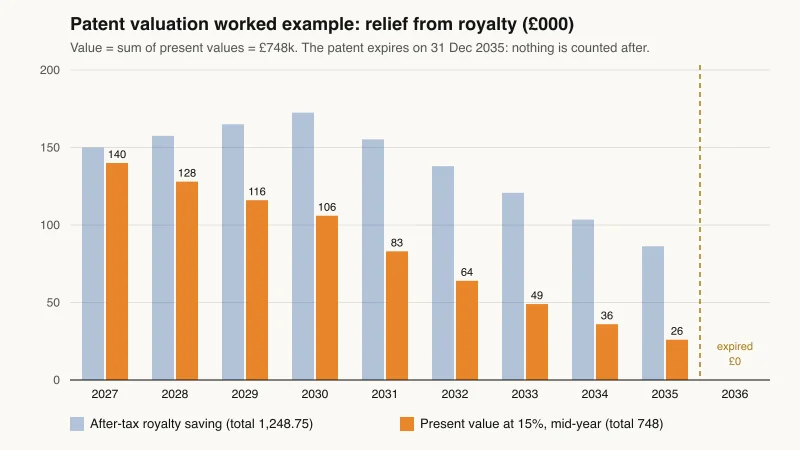
The royalty base of £33.3M produces £1,665k of royalties; tax at 25% takes £416.25k, leaving £1,248.75k after tax. Discounted at 15% from the middle of each year, that is worth £748k at 31 December 2026 (140 + 128 + 116 + 106 + 83 + 64 + 49 + 36 + 26). The discount factor for year n is 1 ÷ 1.15^(n − 0.5); for 2027 that is 1 ÷ 1.15^0.5 = 0.9325.
The worked relief-from-royalty schedule (£000): after-tax royalty savings against their present value at 15%. The patent value is the sum of the present values, £748k, and nothing is counted after expiry.
Why there is no terminal value
A brand valuation by relief from royalty usually ends with a terminal value, because a registered trade mark can be renewed indefinitely and the brand can earn royalties beyond any forecast period. A patent cannot. The UK term is at most 20 years from filing (Patents Act 1977, section 25), after which anyone may practise the invention. The only extension is a supplementary protection certificate, of up to five years, for some medicinal and plant protection products. The value therefore stops at expiry, and often earlier: the technological obsolescence curve above takes the protected share down to 50% by the final year.
✔ Example
Without the obsolescence curve, counting the full £4.6M of revenue as protected to the last day of the term, the same inputs give £844k. The curve removes £96k, which is the valuer's judgement that the claims will protect less of the revenue as the product ages. A buyer will test that curve as hard as the royalty rate.
The tax amortisation benefit: a fair-value assumption
The £748k is the value before any tax amortisation benefit (TAB). Valuers commonly add a TAB to income-approach fair values, because fair value assumes a hypothetical sale of the patent on its own to a market participant, who could then amortise the price for tax. The calculation below uses a nine-year tax life to match the remaining term.
TAB calculation for the worked example
Step
Calculation
Result
Annuity factor at 15% over nine years
(1 − 1.15^−9) ÷ 0.15
4.7716
TAB factor
25% ÷ 9 × 4.7716
13.25%
Value including the TAB
£748k ÷ (1 − 0.1325)
£862k
TAB
£862k − £748k
£114k
The TAB is an assumption inside the fair value, not a tax outcome for any actual buyer. Whether a buyer gets relief depends on the deal structure. In a UK share purchase, the patent stays inside the company with its existing tax position, and the step-up recognised on consolidation gets no tax relief. Whether to include a TAB, and on what tax life, is a judgement the auditor will expect to see explained; our purchase price allocation guide sets out the same framing for a whole acquisition.
Sensitivity: which input moves the number
The grid below reruns the schedule with the royalty rate and the discount rate moved either side of the base case; everything else is unchanged.
Value before TAB at different royalty and discount rates (£000)
Royalty rate
Discount rate 13%
Discount rate 15%
Discount rate 17%
4%
634
598
566
5%
793
748
707
6%
951
897
848
A one-point change in the royalty rate moves the value by a fifth, because the value is proportional to the rate. A two-point change in the discount rate moves it by 5% to 6%, because the life is short. The royalty rate is therefore where the evidence matters most.
ℹ Note
UK renewal fees for years 12 to 20 of this patent total £4,950 on the current gov.uk schedule. That is under 1% of the value, so the example leaves it out; on a low-value patent, or a portfolio of hundreds, a valuer would deduct renewal and maintenance costs from the royalty savings.
Patent Strength Assessment
The drivers table above says what moves value. In diligence, a buyer or lender turns them into a strength assessment of each patent.
Strong and weak patents compared
Factor
Strong patent
Weak patent
Claim breadth
Broad independent claims covering the core concept
Narrow claims that are easy to design around
Prior art
Clean search, clear novelty
Crowded field, marginal novelty
Jurisdictions
Granted in the markets where the product sells
One jurisdiction only
Prosecution history
Granted without narrowing amendments
Claims cut back during examination
Remaining life
Ten or more years
Under five years
Enforceability
No challenge pending
Opposition, revocation action or validity doubts
Market coverage
Covers the dominant product configuration
Covers a niche or declining configuration
Design-around difficulty
No practical non-infringing alternative
Competitors can engineer around it cheaply
⚠ Warning
A patent with broad claims, a long remaining life and no practical design-around in a large market can be worth many times a narrow patent in a declining market with two years left, even when the two cost the same to obtain. The legal right is the starting point; the economics decide the value.
Patents on the Balance Sheet: IAS 38 and FRS 102
A patent's value and its carrying amount in the accounts are different numbers, and for most home-grown patents the carrying amount is small or nil.
How patents reach the balance sheet
Route
IFRS (IAS 38, IFRS 3)
UK GAAP (FRS 102)
Bought separately
Recognised at cost (IAS 38.24 and 38.25)
Recognised at cost (Section 18)
Acquired in a business combination
Recognised at fair value, separately from goodwill (IFRS 3)
Recognised separately from goodwill (Section 19); a patent is both separable and a legal right
Developed in-house
Only the development costs that meet the six criteria in IAS 38.57; capitalisation is required when they are met
Only development costs, if the entity chooses a capitalisation policy (FRS 102 18.8H and 18.8K)
Two points follow. First, an internally generated patent never goes on the balance sheet at its value: only qualifying development costs are capitalised, and research costs are expensed (IAS 38.54). Fees to register the legal right can form part of the cost of a capitalised development asset (IAS 38.66). Second, the useful life of a patent cannot exceed its remaining legal term, although it may be shorter if the technology will be superseded first (IAS 38.94). Our guide to development costs under IAS 38 covers the capitalisation tests, and the useful life entry covers the life judgement.
Patent Valuation in the UK
Four UK-specific points affect the inputs.
UKIPO grant and term
A GB patent is granted by the UK Intellectual Property Office and lasts up to 20 years from filing. A European patent validated in the UK runs on the same basis. A UK patent gives no protection abroad, so the protected revenue is only the revenue in territories where a patent is in force.
Renewal fees
The first renewal falls due on the fourth anniversary of filing, covering the fifth year, and then every year. Fees rise from £90 for the fifth year to £810 for the twentieth (gov.uk). A patent whose renewal lapses stops protecting anything, so a valuer checks the renewal record before modelling any life.
The Patent Box
The Patent Box can apply a lower rate of Corporation Tax to profits from patented inventions, subject to conditions (gov.uk). It can affect the after-tax cash flows a patent supports. Whether it applies is a question for your tax adviser; our FAQ on the UK Patent Box rules is a starting point.
IP audit first
Before valuing anything, confirm what you own: granted patents and applications, assignments from employees and contractors, licences in and out, and renewal status. An intangible asset audit does this, and an intellectual property audit is the step lenders and buyers expect.
Patent Valuation in Specific Contexts
The purpose of the valuation sets the premise of value, and the premise changes the number for the same patent.
Fair value under IFRS 3, usually relief from royalty
Amortised over the shorter of the remaining legal life and the expected economic life, from the acquisition date
Licensing negotiation
The range between the licensee's benefit and the licensor's own-use value
The licensee will pay no more than the patent saves it over designing around or doing without; the licensor will accept no less than it could earn by exploiting the patent itself
Litigation (UK)
Damages or an account of the infringer's profits, at the claimant's election (Patents Act 1977, section 61)
Damages cover lost profits on sales the claimant would have made, and a reasonable royalty on infringing sales it would not; the royalty evidence is the same as for relief from royalty
Transfer pricing
Arm's length price for intra-group transfers and licences
The OECD Transfer Pricing Guidelines' DEMPE framework (development, enhancement, maintenance, protection, exploitation) allocates returns to the group entities that perform those functions; HMRC applies the arm's length principle
Most companies own portfolios rather than single patents, and a portfolio is valued differently from the sum of its parts.
Portfolio effects on value
Effect
Why it matters
Cluster value
Patents covering different aspects of one technology are worth more together, because together they are harder to design around
Standard-essential patents
Patents essential to a standard such as 5G or Wi-Fi carry FRAND licensing commitments, which constrain the rate but make royalties more predictable
Blocking patents
A patent that stops a competitor entering a market can be worth more than its direct income suggests
Expiring patents
Value only the remaining protected cash flows, with no terminal value
Portfolio segmentation approach
For large portfolios, individual valuation of every patent is impractical. Valuers typically segment by technology or product line, value the most important patents individually, value the rest by segment, and check the total against any observable portfolio transactions. The relief-from-royalty calculation is the same; the royalty base is the revenue of the segment rather than of a single product.
Trends Affecting Patent Value
AI-assisted inventions: in the UK an inventor must be a natural person (Thaler v Comptroller-General, Supreme Court, 2023). Where AI contributes to an invention, the record of human inventorship matters to whether a patent is granted and who owns it, and so to value.
The Unified Patent Court: since June 2023 a single court can rule on European patents across participating EU states, which changes enforcement economics there. The UK is not part of it; the UK part of a European patent is enforced in the UK courts.
Standards and FRAND: disputes over global FRAND rates, several decided in the UK courts, shape the royalty evidence for standard-essential portfolios.
Frequently Asked Questions
How much is a patent worth?
A patent is worth the present value of the cash advantage its exclusivity protects over its remaining life. That depends on the revenue the claims cover, a defensible royalty rate, the years left, and the risk that the patent is challenged or designed around. In the worked example above, a UK patent protecting £4.0M to £4.6M of annual revenue with nine years left is worth £748k by relief from royalty, before any tax amortisation benefit.
What are the main patent valuation methods?
Relief from royalty and incremental cash flow (both income approach), comparable licences and transactions (market approach), and reproduction or replacement cost (cost approach), as recognised by IVS 210. Relief from royalty is the usual lead method; the others serve as cross-checks or a floor.
Is there a patent valuation calculator?
A patent valuation calculator performs the relief-from-royalty arithmetic in the worked example: royalty base × royalty rate, less tax, discounted over the remaining life. You can reproduce it in a spreadsheet with the inputs table above. The inputs carry the risk, especially the royalty rate and the obsolescence curve, so a number from any calculator is only as good as the evidence behind them.
Does a patent have a terminal value?
No. A UK patent lasts at most 20 years from filing, so the protected cash flows end at expiry and nothing is counted after it. A supplementary protection certificate can extend protection for some medicinal and plant protection products by up to five years; that extension is modelled explicitly, not as a perpetuity.
Can I put an internally generated patent on my balance sheet?
Not at its value. Under IAS 38 you capitalise the development costs that meet the six criteria in paragraph 57, and under FRS 102 only if you choose a capitalisation policy (18.8H). Research costs are expensed. A patent's value reaches the accounts only when the patent is acquired: at cost when it is bought on its own, or at fair value in the buyer's consolidated accounts after a business combination.
Next Steps
Value the patent in context: the Asset Valuator in Opagio Intangibles values intangible assets with relief from royalty, MPEEM, with-and-without, replacement cost, the cost approach, greenfield and the market approach, with sensitivity analysis and a TAB toggle where they apply. Book a demo of Opagio Intangibles to see it run across a patent portfolio, or see how Opagio supports growing companies preparing for a round or an exit.
Learn the method: the Valuation Methods programme covers relief from royalty and the other methods with worked examples.
Ivan Gowan is the Founder and CEO of Opagio. With 25 years in financial technology, he has direct experience building and protecting technology IP across regulated financial markets. He leads Opagio's mission to make intangible assets, including intellectual property, visible, measurable and actionable. Meet the team.
See how Opagio Intangibles values your full asset portfolio
Opagio Intangibles runs RFR, MPEEM, With & Without and Cost across every intangible asset you own — the evidence base that survives Fair Value scrutiny.
The Patent Box taxes profits attributable to qualifying patents at 10%, through an additional deduction in the corporation tax computation. Who qualifies, the steps that decide the relevant IP profits, and a worked example.
Brand valuation turns a brand's market strength into a defensible number. This guide separates brand equity from brand value, works a relief from royalty example through to the pound, compares the other methods against IVS 210 and ISO 10668, and explains when a brand is recognised in the accounts.
How to value databases and data assets as intangible assets. Covers the three standard valuation approaches, the unique characteristics that make data assets different from other intangibles, and practical considerations for data-rich businesses.
Get the latest insights on intangible asset growth and productivity delivered to your inbox.
We use essential cookies to make our website work. We'd also like to use analytics cookies to improve your experience. You can manage your preferences at any time.
Cookie Policy