Our Data Processing Agreement changes on 2 November 2026.
Version 3.0 changes what it says about how our AI service providers handle the data we send them. There is no new sub-processor.
Read what is changing
Our Privacy Policy changes on 9 November 2026.
Version 5.1 updates how we use information about your use of Opagio and our emails, how we handle enquiries, and the service providers that help us.
Read what is changing
Patent Box Explained: UK Rate, Rules and Calculation
By Tony Hillier· 2026-10-12patent boxpatent box reliefpatent box ukpatent box ratecorporation taxpatentsR&D fractionintellectual property
The Patent Box is a UK corporation tax relief that charges profits attributable to qualifying patents, and a few similar rights, at 10% instead of the main rate of 25%. It works through an additional deduction in the company's tax computation, sized so that the "relevant IP profits" end up taxed at 10%; the rest of the company's profits are taxed as normal. Because several steps cut those relevant IP profits down before the rate applies, the effective rate on a patent-led company's total profits is usually well above 10%, and the relief only applies if the company elects into it.
Last reviewed: October 2026. General information on UK corporation tax rules for accounting periods beginning on or after 1 April 2023, not tax advice. Sources: GOV.UK Patent Box guidance, HMRC's Corporate Intangibles Research and Development Manual (CIRD200000 onwards) and the Corporation Tax Act 2010 (CTA 2010), Part 8A, sections 357A to 357GE.
10%rate on relevant IP profits, against a 25% main rate since 1 April 2023
× 1.3uplift in the R&D fraction, which ties the relief to your own development spend
2 yearsafter the end of the accounting period, broadly, to elect in
This guide is for founders and finance leads of UK scale-ups that hold patents, or have applications pending, and earn product or licence income from them. It covers how the Patent Box rate is delivered, why "a 10% effective rate" is a simplification, who qualifies, the calculation steps with a worked example, the election, how the relief differs from R&D tax relief, and the records that make a claim straightforward.
How the Patent Box rate works
The relief has been available since 1 April 2013 and reached the full 10% rate on 1 April 2017, after a phased introduction (HMRC CIRD201010). A company elects in under CTA 2010 s357A(1). Its relevant IP profits are not taxed at a separate rate on the return; instead, a "Patent Box deduction" is subtracted from the profits of the trade, and the reduced profit is taxed at the company's normal rate (s357A(2)).
The Patent Box deduction formula
For accounting periods beginning on or after 1 April 2023 the deduction is (s357A(3); CIRD201020):
Term
Meaning
Deduction
RP × (AR − IPR) ÷ AR
RP
The relevant IP profits of the trade, after the steps described below
AR
The "applicable rate": the 19% small profits rate where the company's profits are charged at that rate, otherwise the main rate, 25%
IPR
The special IP rate, 10% (s357A(4))
For a company paying the main rate, the deduction is 60% of relevant IP profits: (25% − 10%) ÷ 25%. Taxing what remains at 25% gives exactly 10% on those profits. For a company on the 19% small profits rate the deduction is 9/19 of relevant IP profits (CIRD201020). Before 1 April 2023 the formula used the main rate (MR) in place of AR; Finance (No. 2) Act 2023 made the change so that small companies also reach 10%. A company in the marginal relief band (profits between £50,000 and £250,000) uses the main rate as AR, so its result is close to, but not exactly, 10%.
★ Key Takeaway
The Patent Box applies a 10% rate to profits attributable to qualifying IP, via an additional deduction. It is not a 10% rate on a company's profits, or even on all the profit from a patented product.
Why "a 10% effective rate" is a simplification
The 10% figure is accurate for one number only: the relevant IP profits. Six features of the regime decide how large that number is, and whether the company gets the relief at all.
What narrows the Patent Box to relevant IP profits
Feature
What it does
Where the rule is
Streaming
Only income that is relevant IP income counts, divided into sub-streams by patent, product or process; finance income is excluded
s357BF Steps 1 and 2; CIRD275200
Routine return
10% of certain "routine" costs (staff, premises, plant, capital allowances, some services) is taken out, as the profit any business would make without the patent
s357BJ, s357BJA; CIRD220430
Marketing assets return
Profit earned by brands, trade marks and customer information is taken out; a small claims option replaces this with a flat 25% for smaller claims
s357BK, s357BN; CIRD220470 to CIRD220490
R&D fraction
Relevant IP profits are scaled by the share of development spending the company did itself or subcontracted to unconnected parties, so bought-in IP and connected-party R&D dilute the relief
s357BLA; CIRD274100
Election
Nothing happens unless the company elects in, and the election covers all its trades
s357A(1), s357G
The applicable rate
The deduction depends on whether the company pays 25%, 19% or marginal relief
s357A(3); CIRD201020
The R&D fraction, often called the nexus fraction, came in with the OECD's work on preferential IP regimes. It applies to new entrants and new IP from 1 July 2016, and to every company for accounting periods beginning on or after 1 July 2021, when the transitional protection for the old rules ended (s357A(6) and (11); CIRD200120).
Who qualifies for patent box relief
A company needs to be a qualifying company, which turns on holding qualifying IP rights, and it needs relevant IP income from those rights. Only companies within the charge to UK corporation tax can use the regime.
The qualifying company
A company is a qualifying company for an accounting period if, at any time in it, it holds qualifying IP rights or an exclusive licence over them (Condition A), or it receives income from rights it held earlier while it was qualifying and elected in (Condition B). A company in a group must also meet the active ownership condition (s357B; CIRD210100). An exclusive licence must give rights to the exclusion of everyone else, including the licensor, in at least one country or territory, and the right to sue for infringement or to receive most of the damages (s357BA).
Qualifying IP rights
The right must be one the regime applies to, and the company must meet the development condition for it (s357B(4)).
Rights the UK Patent Box applies to
Right
Notes
Source
UK patents
Granted under the Patents Act 1977
s357BB(1)(a)
European patents
Granted under the European Patent Convention
s357BB(1)(b)
Patents of specified EEA states
Austria, Bulgaria, Czechia, Denmark, Estonia, Finland, Germany, Hungary, Poland, Portugal, Romania, Slovakia and Sweden
s357BB(1)(c); SI 2013/420; CIRD210160
Supplementary protection certificates
For medicinal and plant protection products, UK and EU
s357BB(1)(d), s357BBA; CIRD210170
Plant breeders' and plant variety rights
Plant Varieties Act 1997 and Community plant variety rights
s357BB(1)(e), s357BBA; CIRD210175
Regulatory marketing or data protection
Human and veterinary medicines and plant protection products, treated as a right held by the marketing authorisation holder
s357BB(3) to (6), s357BBA; CIRD210170
Trade marks, copyright, registered designs, know-how and unpatented software are not on the list. A patent granted only in a country outside the list, such as the United States, is not a qualifying right on its own. For what a patent protects and how it sits among other intellectual property, see the glossary.
The development condition
The company, or a member of its group, must have carried out "qualifying development": creating or significantly contributing to the invention, or doing a significant amount of work to develop it, or a product or process that incorporates it (s357BC, s357BD). It can come before or after the company acquired the right. Buying a fully developed patent and selling the product, negotiating licences or defending the patent does not count, and nor does funding development that is wholly outsourced (CIRD210190).
Groups: active ownership
Where the development was done by another group company, the company holding the rights must show active ownership: for all or almost all of its qualifying rights it must make the plans and decisions on developing or exploiting them, or have developed them itself (s357BE). HMRC gives deciding where to keep protection, whether to grant licences and which products go to market as examples of management activity, and says that a central IP board is likely to satisfy the test where the Patent Box company's directors sit on it and take an active part in its decisions (CIRD210210). The condition does not apply to a company outside a group.
Relevant IP income
Relevant IP income falls under five heads: sales of patented items, items that incorporate them and spare parts designed for them; licence fees and royalties for the rights; proceeds of selling a right or an exclusive licence; infringement income; and other damages, insurance or compensation (s357BH). Where a company exploits a patent without selling a patented item, for example through a patented manufacturing process or a service delivered with a patented tool, it can elect to treat a notional royalty, set on arm's-length transfer pricing principles, as relevant IP income (s357BHA).
Patent Box calculation: the steps and a worked example
HMRC describes four stages: identify the profit from relevant IP income, remove a routine return, remove a marketing assets return, and apply the R&D fraction (CIRD220100). The legislation sets them out as eight steps (s357BF(2); CIRD275200).
1
Stream the income. Split the trade's credits, excluding finance income, into relevant IP income and standard income.
2
Divide into sub-streams. By individual patent where reasonably practicable, otherwise by product or process.
3
Allocate the costs. Spread the trade's debits, excluding finance costs and R&D additional deductions, across the streams on a just and reasonable basis.
4
Deduct costs and the routine return. Take off each sub-stream's costs and 10% of its routine deductions. What remains is the qualifying residual profit (QRP).
5
Deduct the marketing assets return, or the small claims figure if the company has elected for small claims treatment.
6
Apply the R&D fraction to each sub-stream.
7
Add the sub-streams together to give the relevant IP profits.
8
Add any pre-grant profits, if the company has elected for them in the period a patent is granted (s357BM).
The routine return, the marketing assets return and the small claims option
Routine deductions are capital allowances, premises costs, staff and externally provided workers, plant and machinery, and certain professional and other services (s357BJA). R&D spending that attracts an R&D deduction or credit is not a routine deduction (s357BJB). The routine return is 10% of the routine deductions allocated to each sub-stream.
The marketing assets return is the notional royalty the company would pay for its brands, trade marks and customer information, less any marketing royalty it actually pays. It is nil if the difference is under 10% of the QRP, which HMRC says is more likely where customers buy on technical specification rather than brand (CIRD220490). A single-trade company with QRP up to £1 million can instead elect for small claims treatment, which takes 25% of the QRP as the small claims figure and carries no more than £1 million forward to the R&D fraction. A company with QRP up to £3 million (less where group companies are also in the Patent Box) can use it only if it has not calculated without it in the previous four years (s357BN, s357BNB; CIRD220470, CIRD220480).
The R&D fraction
The R&D fraction for each sub-stream is the lower of 1 and (s357BLA; CIRD274200):
(D + S1) × 1.3 ÷ (D + S1 + S2 + A)
where D is in-house R&D spending on the relevant IP, S1 is R&D subcontracted to unconnected parties, S2 is R&D subcontracted to connected parties, and A is the cost of acquiring the qualifying rights or exclusive licences. The figures are cumulative from 1 July 2016 (or an earlier elected date, at most 20 years back) to the end of the period (s357BLF). The 1.3 uplift lets connected-party R&D and acquisition costs reach 30% of the company's own qualifying spending before the fraction falls below 1; a company with no relevant R&D or acquisition spending has a fraction of nil (CIRD274100).
✔ Example
The worked example below is illustrative. A UK scale-up makes patented flow sensors and sells them under its own brand to installers and facilities managers. For its 12-month accounting period to 31 December 2026 it has income of £10.0 million, of which £8.0 million is sensor sales (relevant IP income, one product sub-stream) and £2.0 million is unpatented servicing. Its costs are £7.0 million, of which £5.5 million is allocated to the sensors. It has no associated companies and pays the 25% main rate. Finance items and R&D relief are ignored for simplicity.
Worked example: from sensor profit to relevant IP profits
Step
Calculation
Amount
Steps 1 to 4: sensor sub-stream profit
£8,000,000 income − £5,500,000 costs
£2,500,000
Step 4: routine return
10% × £4,000,000 routine deductions in the sub-stream (the other £1,500,000 is materials and bought-in components, which are not routine deductions)
(£400,000)
Qualifying residual profit
£2,100,000
Step 5: marketing assets return
Notional marketing royalty 4% × £8,000,000 = £320,000; no actual marketing royalty; £320,000 is more than 10% of QRP (£210,000), so it is deducted
(£320,000)
After Step 5
£1,780,000
Step 6: R&D fraction
Cumulative since 1 July 2016: D £1,350,000 + S1 £150,000 = £1,500,000; S2 nil; A £1,000,000 (an exclusive licence bought in); (£1,500,000 × 1.3) ÷ £2,500,000 = 0.78
× 0.78
Relevant IP profits (RP)
£1,780,000 × 0.78
£1,388,400
Worked example: the Patent Box deduction and the tax
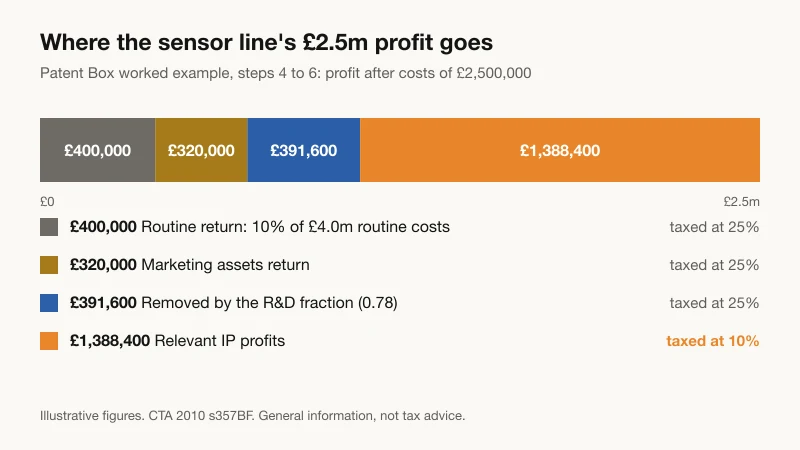
Where the sensor line's £2.5m profit goes in the worked example: just over half becomes relevant IP profits. Illustrative figures; CTA 2010 s357BF.
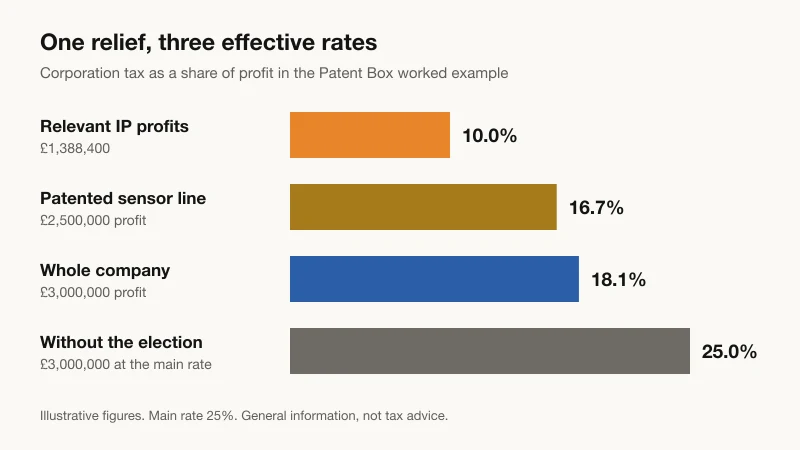
Of the £2.5 million the patented sensors earned, £1,388,400 is taxed at 10%. The other £1,111,600 (the routine return, the marketing return and the £391,600 removed by the R&D fraction) is taxed at 25%. The tax on the sensor line is therefore £138,840 plus £277,900, or £416,740: an effective rate of 16.7%. Add the servicing profit of £500,000 at 25% (£125,000) and the company pays £541,740 on £3.0 million, an effective rate of 18.1%.
The same relief, measured on three different bases. Illustrative figures; main rate 25%. General information, not tax advice.
Had the company developed the licensed technology in-house for the same £1.0 million, its R&D fraction would have been capped at 1, its relevant IP profits would have been £1,780,000 and its saving £58,740 higher (£391,600 × 15%). Because the fraction is cumulative and recalculated each year, further in-house development gradually reduces the effect of an acquisition.
Electing into the Patent Box, and revoking
The election is made by written notice to HMRC, either in the computations sent with the Company Tax Return or separately. There is no special form of words and no box on the return; a computation that includes a Patent Box deduction is taken as an election if that is clearly the intention (CIRD260100; GOV.UK).
The notice must name the first accounting period it applies to, and be given by the last day on which the return for that period could be amended. In practice that is 12 months after the filing date, or two years after the end of a 12-month accounting period (s357G(3); GOV.UK). For a period ending 31 December 2026 the deadline is 31 December 2028. The election then applies to every trade of the company and to every later period until revoked (s357G(4), (5)), so a company cannot elect patent by patent. HMRC treats it as an election, not an annual claim, so there is no late election.
ℹ Note
A company can elect before it is a qualifying company, for example while a patent application is pending. If it does, and the patent is later granted, it can elect under s357BM to bring into the period of grant the extra relief for earlier elected periods, going back to the later of the filing date and six years before the grant (CIRD220540). If the calculation for a period produces a relevant IP loss, there is no deduction; the loss is set against the relevant IP profits of the company's other trades, then of other group members, and then carried forward, while ordinary trading losses are relieved as usual (s357EA to s357EC; CIRD240100).
A company can revoke its election by notice within the same time limit. An election made after a revocation cannot apply to any accounting period beginning within five years after the end of the first period the revocation covers (s357GA(5)). HMRC explains the bar as stopping companies moving in and out to leave relevant IP losses outside the regime (CIRD260110).
Patent Box UK vs R&D tax relief
The two reliefs reward different things and often apply to the same company. R&D tax relief rewards qualifying spending on research and development as it is incurred, whether or not it produces a patent; for accounting periods beginning on or after 1 April 2024 most companies claim it under the merged scheme (GOV.UK). The Patent Box rewards profits, later, and only from qualifying IP.
As the spending is incurred, including in loss-making years
When the IP earns profits
Needs a patent
No
Yes, or another qualifying right
How it is given
A deduction or credit claimed for each period
An additional deduction that brings relevant IP profits to 10%
How you enter
A claim for each period
A standing election, revocable with a five-year bar
How they interact
Spending that attracts R&D relief is not a routine deduction, and R&D additional deductions are excluded from the Patent Box streams (s357BI, s357BJB)
The same R&D spending forms the R&D fraction, whether or not it was in an R&D claim (CIRD274200)
Neither relief decides how development costs are shown in the accounts. Whether they are capitalised as an intangible asset or expensed is an accounting question under IAS 38 or FRS 102, covered in our guide to R&D capitalisation under IAS 38.
Keeping IP records that support a Patent Box claim
The computation is only as good as the records behind it. HMRC expects a company to show how its R&D spending was tracked to each R&D fraction, at least in the first period, and to explain any later change of method (CIRD272000, CIRD272100). Because the fraction is cumulative from 1 July 2016, records started late are hard to rebuild.
Records to keep for a Patent Box computation
Record
Why it matters
A register of granted rights and applications: number, jurisdiction, grant and expiry dates, renewal status
Shows which rights qualify and when; supports the pre-grant election
Which products and processes use each right
Supports the income streams and sub-streams
Licences in and out, with their exclusivity terms
Tests exclusive licences and identifies acquisition costs (A)
R&D spending by right or product since 1 July 2016, split in-house, unconnected and connected
The R&D fraction (D, S1 and S2)
Marketing spend, brands and any marketing royalties paid
Supports the marketing assets return, or the case that it is nil
Board or IP committee minutes on development and exploitation
Group companies' active ownership condition
An inventory of this kind is the core of an intellectual property audit, and the same records support a patent valuation when an investor, lender or buyer asks what the portfolio is worth. Where a notional royalty or notional marketing royalty is needed, the royalty rate must be set on arm's-length principles under the OECD transfer pricing guidelines (s357BHA(6), s357BKA(6)), usually with specialist support.
⚠ Warning
This guide is general information on UK tax rules, not tax advice, and every step turns on a company's own facts. Speak to a tax adviser before electing into the Patent Box, before choosing how to stream income or apportion costs, and before restructuring how IP is held or licensed within a group. The regime has anti-avoidance rules (CTA 2010 Part 8A, Chapter 6).
Where Opagio fits
Opagio does not give tax advice, prepare Patent Box computations or estimate Patent Box savings. We help companies see and document their intangible assets: Opagio Intangibles records them, patents among them, in the Opagio Value Drivers Register™, an inventory your tax adviser and your board can work from. Start with the free Quick Assessment, or see how Opagio supports growth companies.
Frequently asked questions about the Patent Box
What is the Patent Box rate?
The rate is 10% on relevant IP profits, against the 25% main rate. It is delivered as an additional deduction: for a company paying 25%, 60% of its relevant IP profits. The effective rate on the company's total profits is higher, because only the relevant IP profits get the 10% rate.
Does the Patent Box apply to software?
Only where the income is attributable to a qualifying right the company holds, such as a patent covering an invention the software implements. Copyright and unpatented software do not qualify, and nor do trade marks or know-how.
Can a company claim R&D tax relief and the Patent Box?
Yes. R&D relief rewards the spending; the Patent Box rewards the later profits. The R&D spending also feeds the R&D fraction, which is often the reason a company needs to keep good R&D records long after its claim is made.
What if the patent has not been granted yet?
A company can elect in while the application is pending. When the patent is granted, it can elect to add the relevant IP profits it would have had in earlier elected periods, back to the later of the filing date and six years before grant, to the period of grant (s357BM).
How long do I have to elect into the Patent Box?
Until the last day the return for the first period could be amended, which in practice is two years after the end of a 12-month accounting period. For a period ending 31 December 2026, that is 31 December 2028. There is no late election.
Can a company leave the Patent Box and come back?
It can revoke the election, but it cannot elect back in for any period beginning within five years after the end of the first period the revocation covers (s357GA).
Intellectual property creates the legal protection for your innovation and differentiation. This lesson teaches you how to identify IP assets worth protecting, measure their strategic value, and communicate that value to investors.
Patent valuation in practice: what drives how much a patent is worth, the four methods valuers use under IVS 210, and a relief-from-royalty calculation that reconciles line by line over a UK patent's remaining legal life, with no terminal value after expiry.
Solar technology IP is no longer a niche of crystalline silicon patents. The value wedge in 2026 sits across perovskite tandems, BIPV glazing, agrivoltaics, smart-tracker control, and storage integration. A practitioner view of where IP carries value and how to size it.
We use essential cookies to make our website work. We'd also like to use analytics cookies to improve your experience. You can manage your preferences at any time.
Cookie Policy