Our Data Processing Agreement changes on 2 November 2026.
Version 3.0 changes what it says about how our AI service providers handle the data we send them. There is no new sub-processor.
Read what is changing
Our Privacy Policy changes on 9 November 2026.
Version 5.1 updates how we use information about your use of Opagio and our emails, how we handle enquiries, and the service providers that help us.
Read what is changing
Non-Dilutive Funding in the UK: Grants, Loans and Schemes Compared
By Tony Hillier· 2026-10-12non-dilutive fundingventure debtrevenue based financingasset based lendingcash flow lendingIP-backed lendingGrowth Guarantee SchemeInnovate UK grantsinvoice financeintangible assets
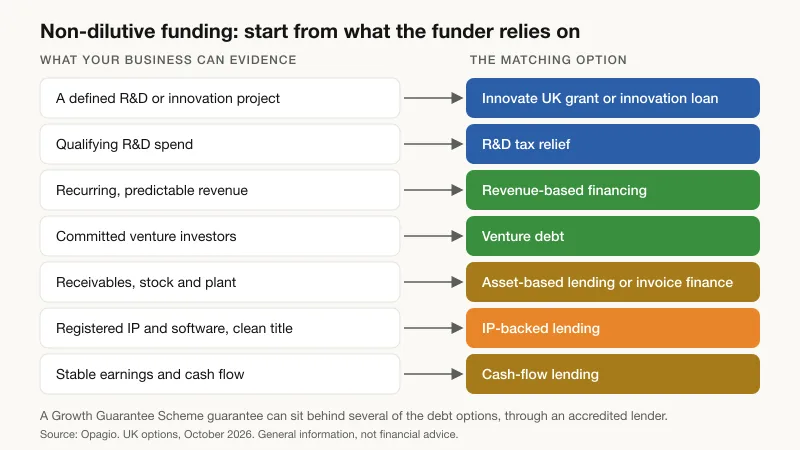
Non-dilutive funding is money a company raises without issuing new shares, so existing shareholders keep their percentage of the business. In the UK it comes from nine main sources: Innovate UK grants, R&D tax relief, revenue-based financing, venture debt, asset-based lending, cash-flow lending, IP-backed lending, invoice finance, and lending backed by the British Business Bank's guarantee schemes. The way to choose between them is to ask what each funder relies on to get its money back (a project, a tax credit, your revenue, your assets, your intellectual property or your cash flow) and to match that to what your business can evidence.
Last reviewed 12 October 2026. Written for UK companies. General information, not financial, legal or tax advice; scheme and lender terms change, so confirm them with the provider.
70%government guarantee to the lender on Growth Guarantee Scheme loans of up to £2m (HM Treasury, July 2026)
50%maximum NatWest advance against the independently valued IP, from £250,000 (England and Wales, since January 2024)
£500mof British Business Bank ENABLE Guarantee capacity allocated to lending to IP-rich firms (HM Treasury, July 2026)
★ Key Takeaway
Non-dilutive funding is not free capital. It swaps dilution for other costs: interest, fees, a share of revenue, warrants, security, covenants or co-funding. The right choice is the option whose costs your business can carry, given what a funder can rely on.
What Non-Dilutive Funding Is, and What It Is Not
Every equity round creates new shares, and every new share reduces the percentage held by everyone else. That reduction is dilution. Non-dilutive funding avoids it: the company receives cash in the form of a grant, a tax credit, a loan or an advance against future revenue, and the share register stays as it was.
What it does not avoid is cost. A grant may require the business to fund part of the project itself, and it is paid against claims for eligible costs. A loan charges interest and fees, often takes security and usually comes with covenants. Revenue-based financing takes a share of every pound of sales until a fixed total has been repaid. Venture debt sits between the two worlds: it is debt, but lenders commonly take warrants, so it carries a small amount of dilution of its own.
The useful comparison is therefore not "dilutive or non-dilutive" but "what does each source cost, and what must the business show to get it". In structured finance the question a lender asks first is always the same: what will repay me, and what can I fall back on if that fails? The answers differ across the nine options, which is why the same company can be a strong candidate for one and ineligible for another.
UK Non-Dilutive Funding Options Compared
The table sets out the nine options side by side. It describes what drives the cost of each rather than quoting rates, because pricing depends on the lender, the borrower and the market at the time, and published "typical" figures date quickly.
Non-dilutive funding options in the UK: use, security, cost drivers and covenants
Option
Typical use
Security
Cost drivers
Covenants and conditions
Suits
Innovate UK grants and innovation loans
A defined R&D or innovation project
None for grants; loans per competition terms
The share of project costs the business funds itself; bid time; reporting
Competition scope, project milestones, claims against eligible costs
Businesses with a fundable project that fits an open competition
R&D tax relief
Recovering part of qualifying R&D spend
None
Claim preparation; HMRC enquiry risk
HMRC qualifying-cost rules
Companies doing qualifying R&D in the UK
Revenue-based financing
Marketing, inventory, sales hires
Underwritten on the revenue stream; providers often also take a debenture or other security
The repayment cap; the revenue share; how fast revenue repays it
Revenue reporting; minimum revenue levels
Recurring or predictable revenue with good gross margins
Venture debt
Extending runway between equity rounds
Usually a debenture over the company's assets, including IP
Interest, fees and warrants
Information covenants; sometimes minimum cash; investor support
Venture-backed companies with committed investors
Asset-based lending
Working capital against the balance sheet
Receivables, stock, plant and sometimes property
Interest, facility and monitoring fees, field examinations
A borrowing base recalculated regularly; reserves
Businesses with substantial receivables and stock
Cash-flow lending
Growth, acquisitions, refinancing
A debenture; personal guarantees in smaller deals
Interest and fees, priced on leverage and risk
Leverage and interest or debt service cover tests
Profitable companies with stable EBITDA
IP-backed lending
Growth capital where tangible security is thin
A charge over registered IP and software
Interest, fees and an independent IP valuation
Serviceability from cash flow; the IP kept in force and revalued
Term loans, overdrafts, asset finance, invoice finance and ABL, through an accredited lender
As the lender requires
The lender's pricing, with part of its risk guaranteed
The scheme's eligibility rules plus the lender's own
Viable SMEs a lender would otherwise decline or limit
ℹ Note
"Cost drivers" means what moves the price, not a price. Where this article gives a figure, it is a published scheme or lender term with its source, or an input labelled illustrative in the worked example.
Grants and R&D Tax Relief
Innovate UK, the UK's innovation agency and part of UK Research and Innovation (UKRI), funds business-led innovation. According to its own guidance, it supports businesses through grant funding, loans and procurements, and publishes funding competitions on the Innovation Funding Service. Each competition sets its own scope and criteria. The funding rate a business receives depends on its size and type and its role in the project, and collaborative projects need at least two grant-claiming partners, none of which may account for more than 70% of eligible costs.
Two features matter for planning. First, a grant pays for a project, not for general working capital, so it rarely solves a runway problem on its own. Second, where the funding rate is below 100% of eligible costs, the business funds the remainder itself, so a grant often has to be paired with another source. Innovate UK also runs innovation loans: loans for SMEs to carry out late-stage R&D with a clear route to commercialisation, awarded through loan competitions.
R&D tax relief needs a guide of its own, so this is the outline only. HMRC's merged R&D expenditure credit (RDEC) scheme and enhanced R&D intensive support (ERIS) replaced the old RDEC and SME schemes for accounting periods beginning on or after 1 April 2024. The relief reduces tax or, in some cases, produces a payable credit; it does not dilute anyone. For the rules, read HMRC's guidance on the merged scheme and ERIS, and for how R&D spend relates to the intangible assets it creates, see how R&D tax credits relate to intangible assets. For why capitalising development costs does not change the claim, see R&D tax relief vs capitalisation.
⚠ Warning
Grant terms, competition windows and tax relief rules change. Treat this section as orientation, take advice on any tax claim, and check the live competition or HMRC guidance before you plan around a figure.
Revenue-Based Financing and Venture Debt
Revenue based financing (RBF) gives the company an advance that it repays as a fixed percentage of its revenue until it has paid back an agreed total, the repayment cap. Repayments rise and fall with sales, and there is no equity. The cost is set by three things: the cap, the revenue share, and how quickly the business's revenue repays the advance. Because the cap is a fixed total, faster repayment means a higher effective annual cost. RBF suits companies with recurring, predictable revenue and margins that can absorb the revenue share. Our guides cover revenue-based financing for intangible-heavy businesses and revenue-based financing against equity.
Venture debt is term debt lent to venture-backed companies, usually alongside or shortly after an equity round, to extend runway. The lender relies heavily on the strength of the company's investors and their capacity to fund the next round, rather than on profits the company does not yet make. Its cost has three parts: interest, fees, and warrants giving the lender the right to buy shares later. Warrants are why venture debt is better described as low-dilution than non-dilutive.
The main risk with venture debt is timing. If the next round slips, the loan still has to be serviced, and covenants or a material adverse change clause may give the lender rights at the worst moment. Size it to what the business could repay if the round took longer than planned, not to the most a lender will offer.
Asset-Based Lending, Cash-Flow Lending and Invoice Finance
Asset based lending (ABL) lends against a borrowing base: eligible receivables, stock and sometimes plant and property, each multiplied by an advance rate, less ineligible items and reserves. The facility moves with the assets, so it is recalculated regularly and the lender monitors the collateral closely, including through field examinations. Our answer on how a borrowing base works sets out the mechanics, and traditional ABL against intangible ABL compares the two collateral pools.
Cash flow lending sizes the loan on the business's earnings and its capacity to service debt, rather than on the liquidation value of particular assets. The lender tests leverage and cover, commonly using a debt service coverage ratio, and sets covenants on both. It suits profitable companies with stable EBITDA; it is hard to obtain for a loss-making business however valuable its technology.
Invoice finance advances cash against unpaid customer invoices. In factoring, the funder usually runs collections and customers know about it; in invoice discounting, the business keeps credit control and the arrangement is often confidential. The cost depends on the volume funded, the quality and concentration of the customers, and the service level.
✔ Example
A software company whose customers are invoiced and pay quarterly in advance may find invoice finance of limited use, because its customers pay before the work is delivered. A manufacturer with 60-day terms and creditworthy customers may find it the cheapest working capital available. The same product suits one business and not the other because of what sits on each balance sheet.
IP-Backed Lending
For companies whose value sits mainly in patents, software, trade marks and other intellectual property, IP-backed lending is now offered under published programmes by two banks in the NatWest Group. NatWest has offered it in England and Wales since January 2024, lending from £250,000 up to 50% of the value of the company's IP as assessed by an independent valuer. The Royal Bank of Scotland launched IP-backed lending in Scotland in June 2026. A lender still expects such a loan to be repaid from trading cash flow; the IP is the security if that fails.
Policy has moved the same way. On 13 July 2026 HM Treasury announced that the British Business Bank had allocated £500 million of the capacity in its ENABLE Guarantee programme to lending to SMEs and scaling firms rich in intellectual property. Our answer on the NatWest High Growth IP Loan covers that programme's eligibility in more detail.
★ Key Takeaway
"Up to 50%" applies to the lender's valuation of the IP, not to what the IP is worth to you, and the loan is the lower of that limit and the debt your cash flow can service. Clean title and a credible valuation decide whether you reach the limit at all.
Government-Backed Schemes: the Growth Guarantee Scheme and ENABLE
The Growth Guarantee Scheme (GGS) is administered by the British Business Bank on behalf of the Secretary of State for Business and Trade. It gives an accredited lender a 70% government guarantee on commercial loans to SMEs of up to £2 million, which reduces the lender's credit risk and can turn a decline into an approval. The guarantee is given to the lender, not to the business. The GOV.UK entry for the scheme (published 29 June 2026) lists term loans, overdrafts, asset finance, invoice finance and asset-based lending facilities as products it can support.
Growth Guarantee Scheme terms (GOV.UK and HM Treasury, read 12 October 2026)
Point
Published position
Guarantee
70%, given by the government to the lender
Maximum facility
Up to £2 million per business group
Products
Term loans, overdrafts, asset finance, invoice finance and asset-based lending
Turnover limit
Not over £45 million (GOV.UK, 29 June 2026); HM Treasury announced an increase to £54 million on 13 July 2026
Maximum term
HM Treasury announced an increase from six to 10 years for loans of up to £1.1 million on 13 July 2026
Other conditions
Trading in the UK; more than 50% of turnover from trading activity; viable; not a business in difficulty
How to apply
Through an accredited lender, not the British Business Bank directly
⚠ Warning
The July 2026 changes were announced as part of an expansion of the scheme. Ask the lender which terms apply to your facility on the date you apply, and confirm the current position on the British Business Bank's scheme page.
ENABLE Guarantees work at a different level. HM Treasury's July 2026 announcement describes the £500 million as capacity within the British Business Bank's ENABLE Guarantee programme, allocated to lending to IP-rich SMEs and scaling firms. As a guarantee programme it supports lenders, so a business would reach it through a lender rather than by applying to the British Business Bank.
How Intangible Assets Change What You Can Raise
Many UK scale-ups hold more of their value in software, data, brands, customer relationships and know-how than in property or stock. That shapes which of the nine options are open to them. The table shows the effect option by option.
How intangible assets affect access to each option
Option
What the intangibles do
Innovate UK grants
The project usually creates new IP; a clear plan for owning and exploiting it strengthens the application
R&D tax relief
Qualifying R&D spend is often the cost of building intangible assets the accounts do not show
Revenue-based financing
Recurring revenue from software and customer relationships is the collateral in substance
Venture debt
The lender usually takes security over all assets, including IP, but relies more on the investors
Asset-based lending
Intangibles are usually outside the borrowing base, so intangible-heavy firms qualify for less
Cash-flow lending
Intangibles drive the earnings the lender sizes against, but are rarely valued separately
IP-backed lending
Registered IP and software become direct security, if title is clean and value is evidenced
Invoice finance
Largely indifferent to intangibles; the customers' credit quality decides
Government-backed lending
The Growth Guarantee Scheme backs the lender, not a valuation of the intangibles; ENABLE capacity is aimed at lending to IP-rich firms
The practical consequence is that evidence opens doors. An IP audit confirms what the company owns and fixes title defects before a lender finds them. An independent valuation on the basis the lender uses turns IP into a security value. A maintained register of intangible assets, kept current across the intangible assets lifecycle, means the evidence exists when a funder asks rather than being assembled under deadline.
Start from what a funder can rely on, then shortlist the matching non-dilutive funding options. Source: Opagio.
A Worked Comparison of Total Cost
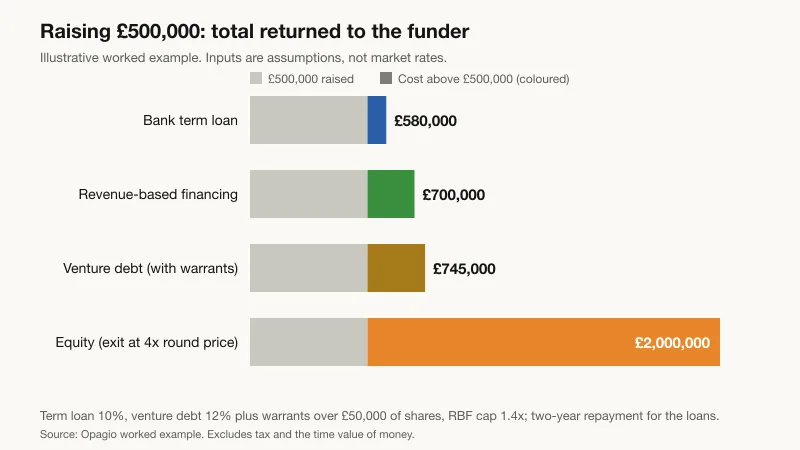
The example below compares four ways to raise the same £500,000. Every input is illustrative, chosen to show how the costs are built, and none is a quote or a market rate. Your own offers will differ.
The company is a UK software business with £3 million of annual revenue (£250,000 a month), raising £500,000 to fund a two-year sales expansion.
Illustrative inputs
Option
Illustrative terms
Bank term loan (cash-flow or IP-backed)
10% a year interest; repaid in two equal annual instalments of £250,000; 1% arrangement fee
Venture debt
12% a year interest; same repayment profile; 1% fee; warrants to buy £50,000 of shares at the round price
Revenue-based financing
Repayment cap of 1.4 times the advance; 8% of monthly revenue
Equity
£500,000 of new shares at the round price
Each debt cost is calculated on the balance outstanding. In year one the full £500,000 is outstanding; after the first instalment, £250,000 remains for year two. For the warrants and the equity, the example assumes the company is later sold at four times the round price per share.
Total cost of raising £500,000 (illustrative)
Option
Interest and fees
Other cost
Total cost above £500,000
Total returned to the funder
Bank term loan
£50,000 + £25,000 interest + £5,000 fee = £80,000
None
£80,000
£580,000
Venture debt
£60,000 + £30,000 interest + £5,000 fee = £95,000
Warrants: shares bought for £50,000, worth £200,000 at exit, a £150,000 gain
£245,000
£745,000
Revenue-based financing
None separately
Cap: £500,000 × 1.4 = £700,000 repaid
£200,000
£700,000
Equity
None
New shares worth £500,000 × 4 = £2,000,000 at exit
£1,500,000
£2,000,000
Three points follow from the arithmetic. At 8% of £250,000, the revenue-based financing repays £20,000 a month and takes 35 months to reach £700,000 if revenue stays flat; if revenue grows it finishes sooner, and its effective annual cost rises. For an IP-backed version of the term loan at a 50% advance, the lender's valuation of the IP would need to be at least £1,000,000 (£500,000 ÷ 50%). And equity is cheaper than the term loan only if the company is eventually sold at less than 1.16 times the round price per share (£580,000 ÷ £500,000), which is a bet against the company's own plan.
Illustrative total returned to each funder for £500,000, from the worked example above. Inputs are assumptions, not market rates. Source: Opagio.
ℹ Note
The example leaves out tax, the time value of money and the value of flexibility. Debt must be serviced whether or not the plan works, while equity shares the downside. That is why the cheapest option on paper is not always the right one; for the trade-off in detail, see IP lending compared with equity and our guide to mezzanine debt and preferred equity.
Choosing Between the Options
Define the need and its timing
A project, working capital, runway to the next round and an acquisition each point to different sources. Write down the amount, the use and when the money must be repaid or replaced.
Take the money that costs least first
Check open Innovate UK competitions and whether your R&D spend qualifies for tax relief. Neither dilutes, and neither needs security.
Size debt to cash flow, then find the security
Work out the repayment your forecast can carry with headroom, then match the security: receivables and stock for ABL or invoice finance, registered IP for IP-backed lending, earnings for cash-flow lending. Ask lenders whether a Growth Guarantee Scheme facility would change their answer.
Use equity for what debt cannot carry
Risk capital for unproven plans is what equity is for. Non-dilutive funding works best alongside it, reducing how much of the company each round has to sell.
ℹ Note
Watch the covenant headroom on any facility, and remember that a lender's loan-to-value ratio applies to its own valuation basis, which is usually more conservative than yours.
Where Opagio Fits
Opagio is not a lender, and it does not arrange or broker finance or apply for grants on a company's behalf. Opagio Intangibles helps a company build the evidence funders ask for: it values each intangible asset with the Asset Valuator's recognised methods, including relief from royalty, MPEEM and with-and-without, and records the results in the Opagio Value Drivers Register™, classified across Opagio 12. That gives a lender's valuer, a grant assessor or an investor one evidenced list of what the company owns. For lender guides, the eligibility checklist and the calculator in one place, start at the Opagio lending hub.
Evidence your intangible assets before you raise
Growing companies use Opagio Intangibles to value their intangible assets and keep the evidence in one register, ready for lenders, investors and buyers. See how it works at Opagio for growing companies, or start with the free Quick Assessment to see where your intangible assets stand today.
Frequently Asked Questions about Non-Dilutive Funding
What is non-dilutive funding?
Non-dilutive funding is capital a company raises without issuing new shares, so existing shareholders keep their percentage ownership. Grants, tax credits, loans, revenue-based financing and invoice finance are all non-dilutive. Venture debt is close to it, but lenders commonly take warrants, which can dilute slightly.
What non-dilutive funding is available in the UK?
The main sources are Innovate UK grants and innovation loans, R&D tax relief, revenue-based financing, venture debt, asset-based lending, cash-flow lending, IP-backed lending (NatWest in England and Wales, the Royal Bank of Scotland in Scotland), invoice finance, and lending supported by the British Business Bank's Growth Guarantee Scheme and ENABLE Guarantees.
Is venture debt non-dilutive?
Mostly. Venture debt is a loan, so it does not require new shares to be issued at drawdown, but lenders usually take warrants giving them the right to buy shares later. If those warrants are exercised, existing shareholders are diluted, though by far less than an equity round of the same size.
Can a company with few tangible assets get non-dilutive funding?
Yes. Grants, R&D tax relief and revenue-based financing do not depend on tangible security, and IP-backed lending treats registered IP and software as security. Asset-based lending and invoice finance are harder, because intangibles usually sit outside the borrowing base. Clean title and an independent valuation widen the options.
Is non-dilutive funding cheaper than equity?
Usually, if the company grows. Debt has a fixed or capped cost, while equity gives away a share of all future value. In our illustrative example, equity costs less than a bank loan only if the company is sold at under 1.16 times the round price. But debt must be repaid even if the plan fails.
Related Reading
Further reading on non-dilutive funding and IP finance
Sources: HM Treasury, press release on small business finance (13 July 2026); GOV.UK, "Growth Guarantee Scheme" (business finance support, 29 June 2026); UKRI, Innovate UK "General guidance" (updated 20 August 2026) and "Funding rules"; HMRC, "Research and Development (R&D) tax relief: the merged R&D expenditure credit scheme and enhanced R&D intensive support" (updated 8 January 2026); NatWest Group press releases of 12 January 2024 and 3 June 2026. All read on 12 October 2026.
About the Author
Tony Hillier is Chairman of Opagio. He holds an MA from Balliol College, Oxford and an MBA with distinction. Tony held executive board positions at NM Rothschild & Sons and GEC Finance, and a non-executive directorship at Financial Security Assurance in New York, where he specialised in structured finance, asset-backed securities and cross-border leasing. Meet the team.
Share:
TH
Tony Hillier — Chairman, Co-Founder
MA, Balliol College, University of Oxford | Harvard Business School MBA with Distinction
The long-form report is the reporting accountant's private report to the directors and the sponsor or Nomad. What it covers, what it asks about intangible assets, the findings it commonly raises and how to prepare.
Financial position and prospects procedures (FPPP) give the directors a reasonable basis for judging the company's position and prospects. What the sponsor or Nomad expects, what the board memorandum covers and how to prepare.
The standard IPO readiness checklist covers governance, controls and legal. This one adds the intangibles and valuation workstreams that the price rests on, with a timeline, a one-page table and how the UK venues compare with Canada, Australia and the US.
How IP-backed lending works in the UK — which assets qualify, valuation methods banks accept, typical loan terms, and how to prepare your application for IP finance.
We use essential cookies to make our website work. We'd also like to use analytics cookies to improve your experience. You can manage your preferences at any time.
Cookie Policy