Board Pack: What to Include, With a Template and Examples
By Mark Hillier· 2026-10-12board packboard pack templateboard pack exampleskpi dashboardwhat to include in a board packboard reportingdirectors dutiesintangible asset kpisprivate equityventure capital
A board pack is the set of papers the directors receive before a board meeting: the agenda, the minutes of the last meeting, the chief executive's report, the financial results and forecast, the KPIs, the risks, and the decisions the board is asked to take. It exists so that the directors arrive informed, spend the meeting on judgement rather than on reading, and leave a record showing what they knew when they decided. A good board pack is short at the front, complete at the back, and built the same way every time.
Last reviewed: October 2026. Written for UK private companies, with references to the Companies Act 2006 and, for listed companies, the UK Corporate Governance Code (FRC, 2024 edition). General information, not legal advice. All KPI values are illustrative.
7standard sections in the board pack template below, from agenda to appendices
s172 and s174the two directors' duties in the Companies Act 2006 that a board pack most directly serves
10 yearsthe minimum period a company must keep minutes of directors' meetings (s248)
This guide is for chief executives, finance directors and founders of UK growth companies backed by venture capital or private equity, who prepare the pack and want the investor directors to trust it. It covers what to include, a template, an example KPI dashboard, how to report the intangible assets that drive value, and how venture-backed and PE-backed boards differ. The intangible asset section of a startup's pack has its own guide, startup board reporting on intangible assets; this page covers the whole pack.
What is a board pack?
The board of directors is collectively responsible for the company. It meets to set direction, approve the things only the board can approve, and hold management to account. The board pack is how management gives the directors the information to do that, and how the directors show they did it with care.
📚 Definition
A board pack (also called board papers or a board book) is the collated set of documents circulated to directors before a board meeting. It usually contains the agenda, the draft minutes of the previous meeting and an action log, management reports, financial information, KPIs, the risk register, papers seeking decisions, and supporting appendices.
Why the board pack matters to directors' duties
Two of the general duties in the Companies Act 2006 bear directly on what a board pack is for. Under section 172, a director must act in the way they consider, in good faith, would be most likely to promote the success of the company for the benefit of its members as a whole. In doing so they must have regard, among other matters, to the likely long-term consequences of a decision, the interests of employees, the need to foster business relationships with suppliers, customers and others, the impact of the company's operations on the community and the environment, the desirability of a reputation for high standards of business conduct, and the need to act fairly between members.
Under section 174, a director must exercise reasonable care, skill and diligence: the care of a reasonably diligent person with the general knowledge, skill and experience that may reasonably be expected of someone carrying out that director's functions in the company, and with the general knowledge, skill and experience the director actually has. A director cannot exercise that care on information they never received, or received too late to read.
The pack serves both duties. It puts the matters section 172 lists in front of the board, and it gives each director a fair chance to apply the care section 174 expects. Companies listed in the equity shares (commercial companies) category, formerly premium listing, also report against the UK Corporate Governance Code on a comply-or-explain basis, and the Code expects the chair to ensure that directors receive accurate, timely and clear information. Companies on AIM name a recognised corporate governance code they follow, often the QCA Corporate Governance Code.
★ Key Takeaway
A board pack is not a report about the company sent to the board. It is the information the directors need to decide and to discharge their duties, and it becomes part of the record of how they did so. Write it for the decisions on the agenda, not for completeness.
What to include in a board pack
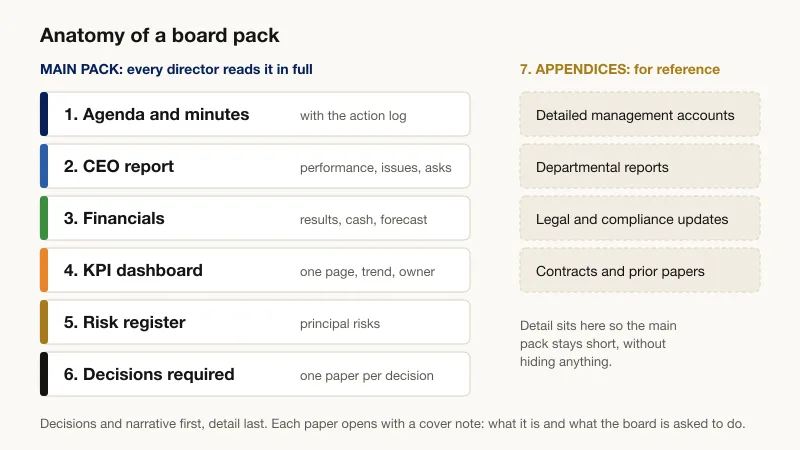
A typical growth-company board pack has seven parts. The order matters: decisions and the narrative come before the detail, so a director who reads only the first third of the pack still knows what the board is being asked to do and why.
Board pack template: contents checklist
Section
What it contains
Prepared by
For decision or information
1. Agenda and minutes
Agenda with timings and the purpose of each item; draft minutes of the last meeting; action log; declarations of interest
Company secretary or chair
Minutes for approval; actions for information
2. CEO report
A short narrative: performance against plan, what changed, the main issues, and what management needs from the board
Chief executive
Information and discussion
3. Financials
P&L against budget and prior year; balance sheet; cash flow and cash position; forecast against budget; covenant tests where there is debt
Finance director
Information; a reforecast may be for approval
4. KPIs and dashboard
One page of agreed KPIs, financial and non-financial, with trend, target, owner and status
Finance director with functional heads
Information and challenge
5. Risk register
The principal risks, owner, likelihood and impact, mitigations, and movement since the last meeting
Chief executive or finance director
Review; changes for approval
6. Decisions required
One paper per decision: the recommendation, options considered, financial effect, risks, and the factors the board must weigh
The executive who owns the proposal
Decision
7. Appendices
Detailed management accounts, functional reports, contracts, legal and compliance updates, previous papers referred to
Various
Reference
The anatomy of a board pack: a main pack every director reads in full, and appendices for reference.
Agenda, minutes and the action log
Each agenda item should state whether it is for decision, discussion or information, and who leads it, so that time goes to the items that need it. The draft minutes of the last meeting follow, for approval, then the action log: what was agreed, who owns it and whether it is done. Under section 248 of the Companies Act 2006, every company must keep minutes of all proceedings at directors' meetings for at least ten years from the date of the meeting. The pack, read with the minutes, is the record of what the board knew.
CEO report
The chief executive's report is the narrative that makes the numbers readable. Two or three pages are usually enough: how the business performed against plan, what changed since the last meeting and why, the issues the chief executive is worried about, and what the executive team needs from the board. It should not restate the financials. A useful test is whether a director who read only the CEO report would know what the meeting must decide.
Financials: P&L, balance sheet, cash flow and forecast
The financial section shows where the company stands and where it is heading. For most growth companies it has four parts.
What the financials section of a board pack contains
Statement
What to show
P&L
The month or quarter and the year to date, against budget and the prior year, with a short commentary on each material variance
Balance sheet
The position at the period end, with movements in working capital and any debt
Cash flow
Cash generated or used in the period and the closing cash position; for a loss-making company, the burn rate and runway
Forecast against budget
The latest view of the full year set against the budget the board approved, so the board sees whether the year is on track, not only whether last month was
Where the company has borrowings, the section also shows each covenant test and the covenant headroom against it, ideally projected forward on the forecast. A reforecast that changes the year materially should come to the board as a decision paper, not appear quietly in the numbers.
ℹ Note
Present the figures on the basis the board approved and the accounts will report. If a pack also shows adjusted figures, such as normalised EBITDA for a lender or a buyer, label them, show the bridge from the reported figure, and keep the definitions the same from one pack to the next.
KPIs and the KPI dashboard
The KPI section is one page that shows, at a glance, whether the business is performing on the measures the board has agreed matter most. A key performance indicator earns its place on the page if it tells the board something the P&L does not, early enough to act on. The dashboard example below shows the structure.
Risk register
The risk register lists the principal risks, who owns each, an assessment of likelihood and impact, the mitigations in place and how each risk has moved since the last meeting. The board does not need the full operational register every time. It needs the principal risks, the movements, and any new risk worth discussing. Many of the risks that matter most to a growth company sit in its intangible assets: a concentrated customer base, key person risk in a small team, an unregistered brand, or know-how held by one engineer.
Decisions required
Each decision gets its own short paper. A standard format helps the board and the minutes: the recommendation in the first line; the background; the options considered and why the others were rejected; the financial effect; the risks; and the matters the directors must weigh under section 172, such as the effect on employees, customers or suppliers. A decision paper that does not state a recommendation is a discussion paper, and should be labelled as one.
Appendices
The appendices hold everything a director may want to check but should not have to read: detailed management accounts, departmental reports, legal and compliance updates, contracts referred to in a decision paper. Putting them at the back keeps the main pack short without hiding anything.
KPI dashboard example
A KPI dashboard works when each line has a definition the board agreed once, a target, an owner, and a trend. The example below is for an illustrative UK software scale-up after its Series A. It mixes financial KPIs with indicators of the intangible assets behind them. Every figure is illustrative.
Example KPI dashboard for a board pack (illustrative scale-up)
The status rule in this example: green when the KPI meets its target; amber when it is short of target but improving or holding steady; red when it is short of target and getting worse.
Four habits make a dashboard like this useful rather than decorative. Keep it to one page. Keep the definitions fixed, and if one has to change, say so and restate the comparative. Show the trend, because a single figure says little about direction. And explain every red or amber line in a sentence, with what is being done about it.
✔ Example
In the dashboard above, logo churn is red, because it has missed its target and is rising, while net revenue retention is amber and improving, because the remaining customers are expanding. A pack that shows only retention by value would hide the fact that more customers are leaving. The CEO report should name the accounts lost, the reason, and whether the cause is the product, the service or the market.
How to report intangible value drivers as KPIs
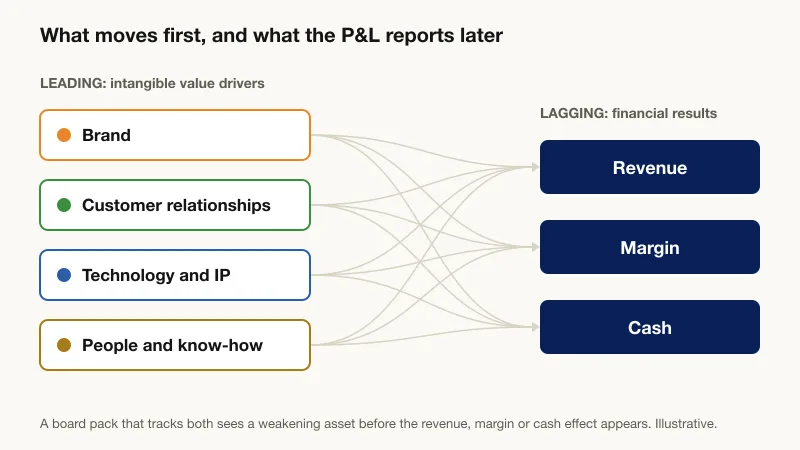
In many growth companies, much of the value an investor pays for sits in assets the balance sheet does not record: the brand, the customer relationships, the technology and other intellectual property, and the people and know-how that run the business. Changes in these assets often show before they reach the financial results. A customer relationship weakens before the renewal is lost; a key engineer leaves before the roadmap slips. A board that sees only the financial results learns about these changes late.
The answer is not a second dashboard. It is a few well-chosen lines on the existing one, each tied to an asset the board recognises, with the evidence behind it held somewhere a director can check.
Intangible value drivers and board KPIs (illustrative)
Value driver
Example KPIs a board might track
What a decline may signal
Evidence behind the KPI
Brand
Share of new customers arriving through direct or organic channels; trade mark registrations in priority markets; customer satisfaction or recommendation measures
Rising acquisition cost; exposure in a new market
Channel analytics; the trade mark schedule; survey method and sample
Patent and design filings and renewals; licences in and out; share of engineering time on new product versus maintenance
A product that is ageing; rights that are not secured
The IP schedule; licence agreements; engineering time records
People and know-how
Regretted staff turnover; critical roles with a named successor; core processes documented and current
Key person dependency; knowledge that leaves with an individual
Organisation chart; succession plan; process documentation and trade secrets controls
Changes in intangible value drivers often show first; the P&L reports the result later. A board pack that tracks both sees change sooner.
Three rules keep these KPIs honest. First, measure what the company can evidence: a KPI with no record behind it is an opinion. Second, report the same KPIs every period; switching to whichever measure looks best this quarter destroys the trend. Third, give each driver an owner on the executive team, so that a decline has someone who answers for it. The Opagio 12 framework groups a company's intangible assets into twelve value drivers, which is a useful check that the dashboard has not left out a material one. Our guide to startup board reporting on intangible assets sets out KPI categories for an early-stage company, and the FAQ on building an intangible asset dashboard for board reporting covers the design.
★ Key Takeaway
Report intangible value drivers on the same page as the financial KPIs, in plain language, with an owner and evidence for each. The board then sees the cause and the effect together, rather than learning about a weakening asset from next year's revenue.
Timing and length
A board pack only helps if the directors have read it. That depends mostly on when it arrives and how long it is.
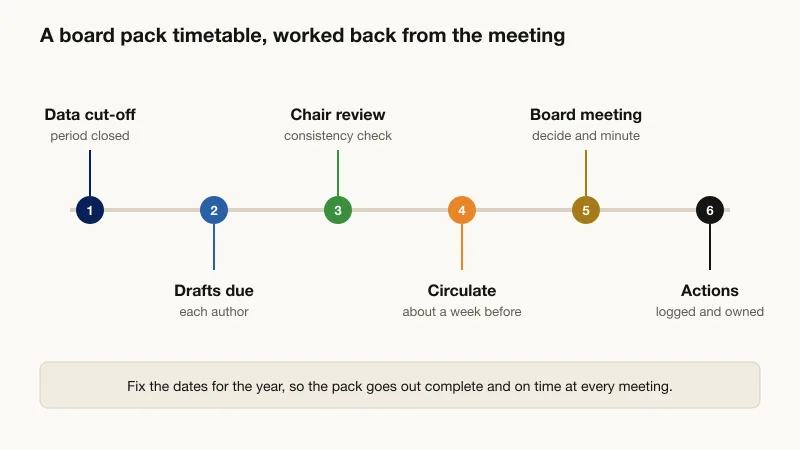
Common practice is to circulate the pack about a week before the meeting, and rarely less than a few working days. A pack that arrives the evening before invites a meeting spent reading, or decisions taken on trust. Set a timetable that works backwards from the meeting: the cut-off for financial information, the date drafts are due from each author, the chair's review, and the circulation date. For a monthly PE-backed board, that timetable is tight, which is why the close process and the pack template need to be fixed rather than rebuilt each month.
A board pack timetable: fix the cut-off, draft, review and circulation dates for the year.
On length, the useful discipline is the split between the main pack and the appendices. The main pack is what every director reads in full: the agenda, the CEO report, a summary of the financials, the dashboard, the principal risks and the decision papers. Everything else goes to the appendices. Each paper in the main pack should open with a short cover note saying what it is, why it is on the agenda and what the board is asked to do.
Four steps to a board pack that arrives on time
1. Fix the calendar
Set the meeting dates for the year, and for each meeting the data cut-off, the deadline for drafts and the circulation date.
2. Agree the template and the KPIs once
Agree the sections, the dashboard lines and their definitions with the chair and the investor directors, and change them only by agreement.
3. Write the decisions first
Draft the decision papers and the CEO report before the detail, so the rest of the pack supports them.
4. Review, then circulate on time
The chair or the finance director reviews the whole pack for consistency, then it goes out on the agreed date, complete.
Startup and VC board vs PE-backed board
The structure of a board pack is much the same whatever the ownership. What changes is how often the board meets, who sits on it, and what dominates the conversation.
How a board pack differs by ownership
Startup and venture-backed board
Often meets quarterly, with an investor update between meetings
Founders, one or more investor directors, sometimes an independent chair
Dominated by growth, product, hiring, burn and runway, and the next round
Information rights and investor consents set in the investment agreement, articles and shareholders' agreement
PE-backed board
Often meets monthly, with management accounts due a set number of working days after month end
Management, investor directors, often a chair appointed with the investor
Dominated by EBITDA against budget, cash, lender covenants and the value creation plan
Information rights, reporting deadlines and consents set in the investment agreement and the facility agreement
On a venture-backed board, the pack has to show progress toward the milestones the next round will be priced on, and how long the cash lasts if they slip. Investor directors read many packs, so a consistent format and a clear CEO report count for a lot. Between meetings, an investor update keeps all shareholders informed; our guide to quarterly investor updates covers that different document.
On a PE-backed board, the investment agreement usually specifies what management must report and when, and the facility agreement adds covenant reporting to the lenders. The pack is built around the budget and the value creation plan agreed at the deal. Management usually holds equity through a management incentive plan, so the pack is also where management and the investor watch the numbers that will decide what that equity is worth at exit. The shareholders' agreement or investment agreement lists the reserved matters that need investor consent, and a decision paper on one of them should say so.
ℹ Note
The contract sets the minimum. Check the investment agreement, the articles, the shareholders' agreement and any facility agreement for the information rights, reporting deadlines and consents that apply to your company. The pack should meet them without anyone having to ask.
Board pack examples: three common mistakes
Weak board packs often fail in one of three ways, each visible to any director who reads them and each cured by a fixed template.
✔ Example
The data dump. A pack of a hundred pages, mostly exported reports, with no CEO narrative and no indication of what matters. Directors either skim it or spend the meeting asking questions the pack could have answered. The fix is the main pack and appendices split, and a cover note on every paper.
✔ Example
The pack with no decisions. Every item is "for information". The board discusses, but the minutes record nothing decided, and actions drift from one meeting to the next. The fix is a decisions section with a recommendation in each paper, and an action log reviewed at the start of each meeting.
✔ Example
The moving definitions. Churn is calculated by value one quarter and by logo the next; "adjusted EBITDA" adds back different items each month. The board cannot see a trend, and trust in the numbers erodes. The fix is a definitions page agreed with the board and a bridge whenever an adjusted figure appears.
Building the board pack from your records
The financial sections of a board pack come from the management accounts. The intangible value driver lines are harder, because the evidence for them is usually spread across contracts, HR files, the IP schedule and people's heads. Building those lines from a maintained record, rather than assembling them for each meeting, is what makes them consistent from one pack to the next.
Bring the intangible value drivers into the board pack
In Opagio Intangibles, the Opagio Value Drivers Register records your intangible assets across Opagio 12, with the evidence for each attached. The Growth Plan holds KPIs and targets for the drivers you choose to track, and co-branded reports present the register and its asset valuations in a form you can include in the board pack as a section or an appendix. Opagio does not produce your management accounts, your forecasts or the board pack as a whole; it keeps the record that the intangible lines of the pack are drawn from. See how Opagio supports growth companies.
The same record serves beyond the boardroom. A buyer, a lender or the next round's investor will ask the questions the board has been asking, and a company that has tracked its intangible assets can answer from history rather than from a hurried data room. For a company preparing to float, the board's information is itself examined: our IPO readiness checklist covers the procedures a reporting accountant reviews, and our guide to how to value a business shows how buyers turn the same evidence into a price.
⚠ Warning
Keep the basis of every figure clear. Opagio keeps three sets of figures separate and never mixes them: Reported is the figures on the company's own accounting policies, as the filed accounts show them, and the default for a board pack's financials; Accounting-eligible shows what the accounting standards would let the accounts show; Management is a non-statutory model, useful for explaining where value sits, but never presented as reportable or auditable. A board pack that draws on more than one should keep each table on a single basis, label it, and never add figures from different bases together.
Frequently Asked Questions
What is a board pack?
A board pack is the set of papers circulated to directors before a board meeting. It usually contains the agenda, the minutes of the last meeting and an action log, the chief executive's report, financial information, a KPI dashboard, the risk register, papers seeking decisions, and appendices. It informs the board's decisions and forms part of the record of them.
What should be included in a board pack?
Seven sections cover most growth companies: agenda and minutes; the CEO report; financials (P&L against budget and prior year, balance sheet, cash flow and forecast against budget); KPIs and a dashboard; the risk register; decisions required, one paper each; and appendices for detail. Put decisions and narrative first and detail last.
How far in advance should a board pack be sent?
Common practice is about a week before the meeting, and rarely less than a few working days, so directors can read it and raise questions before the meeting rather than during it.
How long should a board pack be?
There is no set length. Keep the main pack, which every director reads in full, to the agenda, the CEO report, a financial summary, the dashboard, the principal risks and the decision papers, and put detail in the appendices.
What KPIs should go in a board pack?
The KPIs the board has agreed best show whether the strategy is working: usually revenue growth, margin, cash and runway or covenant headroom, plus a few non-financial indicators such as customer retention, concentration and key-person cover. Each needs a fixed definition, a target, an owner and a trend.
Is a board pack a legal requirement?
There is no statutory requirement for a document called a board pack. However, directors must exercise reasonable care, skill and diligence under section 174 of the Companies Act 2006, and companies must keep minutes of directors' meetings under section 248. Investment and facility agreements often set specific reporting obligations. A good pack is how a board meets these in practice.
What is the difference between a board pack and an investor update?
A board pack goes to the directors before a board meeting and supports decisions the board must take. An investor update goes to shareholders, often monthly, and keeps them informed between meetings; it seeks no decisions. Some content overlaps, but the audience, purpose and level of detail differ.
Next steps
Start with the template: agree the seven sections, the dashboard lines and their definitions with your chair and investor directors, then fix the calendar for the year. Add the intangible value drivers to the dashboard a few lines at a time, choosing those you can evidence.
Mark Hillier is Co-Founder and Chief Commercial Officer of Opagio. With 30+ years advising businesses through growth, scaling and PE exits, he brings a commercial view of what boards and investors need to see. Meet the team.
Most board packs report revenue, burn rate, and runway. They ignore the intangible assets that generate much of the company's value. Adding intangible asset KPIs to board reporting transforms the quality of strategic decisions and the depth of investor engagement.
Venture capital investment decisions are intangible asset decisions. Every VC who writes a cheque is betting on the quality and growth trajectory of a startup's technology, team, IP, customer capital, and brand. Understanding how they evaluate these assets gives founders a strategic advantage.
Series A due diligence has evolved beyond financials and product demos. Sophisticated investors now assess the full intangible asset portfolio — technology defensibility, customer capital quality, IP strength, and team resilience. Understanding what they look for changes how you prepare.
We use essential cookies to make our website work. We'd also like to use analytics cookies to improve your experience. You can manage your preferences at any time.
Cookie Policy