Our Data Processing Agreement changes on 2 November 2026.
Version 3.0 changes what it says about how our AI service providers handle the data we send them. There is no new sub-processor.
Read what is changing
Our Privacy Policy changes on 9 November 2026.
Version 5.1 updates how we use information about your use of Opagio and our emails, how we handle enquiries, and the service providers that help us.
Read what is changing
IPEV Guidelines 2025: What Changed and How Funds Apply Them
By David Stroll· 2026-10-12ipev guidelinesipev guidelines 2025ipev valuation guidelinesfair valueprivate equity valuationventure capital valuationifrs 13asc 820
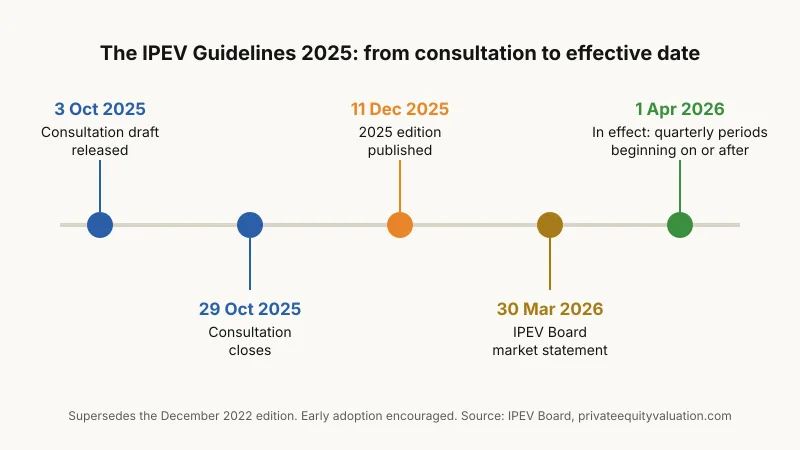
The IPEV Guidelines are the International Private Equity and Venture Capital Valuation Guidelines: best-practice recommendations, published by the IPEV Board, for measuring the fair value of private capital investments in a way that is consistent with IFRS 13 and US GAAP (ASC 820). The current edition is dated December 2025. It supersedes the 2022 edition and is in effect for quarterly reporting periods beginning on or after 1 April 2026, with early adoption encouraged. The Board changed only one of the Guidelines themselves, and only for clarity; the substance of the update sits in the explanatory text and in new application guidance on complex capital structures, SAFEs and ASAs, co-investments and artificial intelligence.
Last reviewed: October 2026, against the December 2025 edition of the Guidelines and the IPEV Board's published notices (privateequityvaluation.com). The Guidelines are international; this page applies to funds reporting under IFRS, US GAAP or a framework with a similar definition of fair value. General information, not valuation or accounting advice.
11 Dec 2025the IPEV Board publishes the 2025 edition of the Guidelines
1 Apr 2026in effect for quarterly reporting periods beginning on or after this date
5investment-level valuation techniques, unchanged from 2022
This page is for partners, principals and finance teams at venture capital and private equity funds who sign off quarterly fair values, and for the portfolio-company finance directors who supply the numbers behind them. It explains what the Guidelines are, the five techniques they set out, how calibration and backtesting work, and exactly what the 2025 edition changed. Every change listed here comes from Appendix 3 of the edition, where the Board sets out its own change list.
What are the IPEV Guidelines?
📚 Definition
The IPEV Valuation Guidelines set out recommendations, intended to represent current best practice, on how private equity and venture capital funds measure the fair value of their investments at each reporting date. They are maintained by the IPEV Board, an independent body created in 2005 whose members include limited partners, general partners and service providers.
The Guidelines are written for the whole range of private capital funds (seed and venture capital, buyouts, growth capital, infrastructure and credit) and for funds of funds valuing their interests in other funds. The IPEV Board's website lists 40 endorsing associations, among them UK Private Capital, Invest Europe, the US National Venture Capital Association, the American Investment Council, the Institutional Limited Partners Association, the Australian Investment Council and the African Private Capital Association. They are a global reference, not a UK or European one.
They are not law, and they are not an accounting standard. The Introduction to the 2025 edition is explicit: "Financial reporting standards do not require that these Valuation Guidelines be followed." It adds that valuers "must conclude for themselves" whether their measurements comply with the relevant standards, and that compliance with IFRS and US GAAP "can be achieved by following these Valuation Guidelines". Where the Guidelines conflict with a law, regulation or accounting standard, the latter takes precedence.
ℹ Note
The IPEV Board does not certify funds, valuers or companies. The Guidelines are applied by the valuer, whether that is a fund's internal valuation team or an external adviser, and the fund's auditor tests the result against the accounting framework the fund reports under.
Fair value under IFRS 13 and ASC 820, as IPEV applies it
The Guidelines start from the accounting definition. Under IFRS 13 and ASC 820, fair value is the price that would be received to sell an asset in an orderly transaction between market participants at the measurement date. It is an exit price, judged from the perspective of market participants, at a specific measurement date. It is not the price in a forced or distressed sale.
For an unquoted investment, the Guidelines ask the valuer to assume the investment is realised at the measurement date, whether or not the company is prepared for sale or its shareholders intend to sell. Because private equity and venture capital value is usually realised by selling or floating the whole company, most of the techniques begin with the enterprise value of the company, adjust it for surplus assets, excess liabilities and other relevant factors, deduct instruments that rank ahead of the fund, and then allocate what is left between the instruments, including the fund's own.
The Guidelines also expect consistency. Fair value should be estimated with the same techniques from one measurement date to the next, unless a change in market conditions or in the investment would change how a market participant prices it, and any change of technique should be documented with its rationale.
The five IPEV valuation techniques
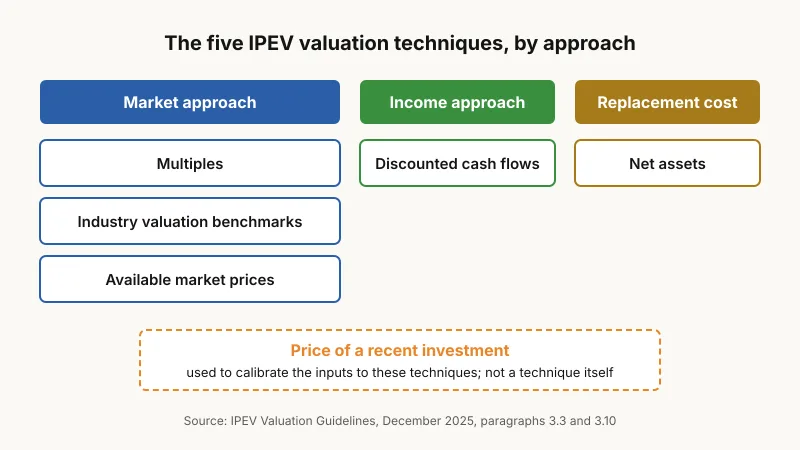
Section I, paragraph 3.3, lists the techniques a valuer should use, one or more of them, at each measurement date. They sit under three approaches, and the list is the same as in the 2022 edition.
IPEV valuation techniques by approach
Approach
Technique
Typically used for
What the Guidelines say about it
Market
Multiples
Established businesses with maintainable earnings or revenue
Apply an appropriate multiple to maintainable earnings or revenue, then adjust and allocate the enterprise value
Market
Industry valuation benchmarks
Sectors priced on a metric such as price per subscriber
Reliable as the main basis only in limited situations; more often a sanity check on other techniques
Market
Available market prices
Quoted investments and instruments with observable prices
For actively traded investments, available market prices are the exclusive basis for identical instruments
Income
Discounted cash flows
Businesses, or investments, whose value rests on projected cash flows
Applied to the company's cash flows or to the cash flows from the investment itself
Replacement cost
Net assets
Asset-intensive and investment businesses; some loss-making or marginally profitable companies
Derives enterprise value from the fair value of the company's assets and liabilities, then deducts and allocates
Two points are often misread. First, the price of a recent investment is not a technique. Paragraph 3.10 says it "should not be considered a standalone Valuation Technique": an orderly round generally represents fair value at its date, and it is used to calibrate the inputs to the techniques above. Second, for early-stage companies with several share classes, the Guidelines describe scenario-based methods, the option pricing method and a hybrid of the two as ways to allocate value between classes. Those allocation methods sit alongside the five techniques; they do not replace them.
The five IPEV valuation techniques under three approaches, with the price of a recent investment as the calibration point. Source: IPEV Valuation Guidelines, December 2025, paragraphs 3.3 and 3.10.
★ Key Takeaway
IPEV sets out five investment-level techniques: multiples, industry valuation benchmarks, available market prices, discounted cash flows and net assets. They answer one question: what is the fund's investment in this company worth at this measurement date? They are not the asset-level methods used to value an individual brand, patent or customer relationship.
Calibration, backtesting and known-or-knowable information
Three disciplines run through the whole document. None is new in 2025, but the edition expands the commentary on each.
Calibration (paragraph 2.6). When a fund's entry price is fair value, which is usually the case for an orderly transaction, the techniques the fund will use later should be tested with market inputs at the entry date, so that they reproduce the entry price. At later dates, the calibrated technique is rerun with current inputs. The 2022 edition already stated that calibration is required by accounting standards; the 2025 edition reorders and expands the explanation, recasts its example and adds a paragraph on calibrating to later rounds.
Calibration example (illustrative)
At entry
Next measurement date
Comparable companies' EV/EBITDA multiple
10.0x
12.0x
Implied multiple of the investment
8.0x (a 20% discount to peers)
9.6x if the relative discount holds; 10.0x if the absolute 2.0x gap holds
What the valuer decides
The entry inputs are the reference point
Whether the discount still reflects the differences between this company and its peers, applied on a consistent basis
The edition's own example starts from the same position, an 8x entry against peers at 10x, and is clear that the valuer does not carry the entry discount forward automatically. The calibrated inputs are a point of reference for judging what a market participant would pay now, and the valuer has discretion, based on the facts and circumstances, to decide on a consistent basis whether an absolute or a relative (percentage) movement in multiples is more appropriate. The same idea applies to an income approach, where the discount rate implied at entry is broken into its components, including a company-specific risk premium, and each component is updated.
Backtesting (paragraph 2.7). When a liquidity event occurs, such as a sale, a flotation or a new financing round, the valuer compares the price with the most recent fair values to understand the differences. The aim is not to find fault but to test the process: what was known at each measurement date, how it was used, and whether assumptions such as maintainable EBITDA or normalised net debt held up.
Known or knowable information. Fair value reflects information that exists at the measurement date and is available, or would reasonably be available through routine inquiry or due diligence. Events after the measurement date are subsequent events. The Guidelines give a practical case: if the latest reported EBITDA is one or more months in arrears and the valuer knows performance has moved significantly since, the stale figure is adjusted for the known trend. The 2025 edition expands the explanation of how to interpret the term. Our known-and-knowable glossary entry sets out the term.
What changed in the IPEV Guidelines 2025
The IPEV Board released draft amendments for consultation on 3 October 2025, closed the consultation on 29 October and published the final edition on 11 December 2025. In its own words, it "preserved the historical framework of the Guidelines while introducing targeted clarifications and enhancements in key areas". Appendix 3 of the edition lists the changes; the table below summarises them.
From consultation to effective date: the IPEV Guidelines 2025 timeline. Source: IPEV Board, privateequityvaluation.com.
Changes in the 2025 edition of the IPEV Guidelines
Area
What the 2025 edition changed
The Guidelines themselves
No changes except Guideline 1.4, reworded for clarity (the valuer assumes a sale at the measurement date "irrespective of whether" the company is prepared for one)
Introduction
The sustainability (ESG) discussion is separated out, and a new discussion of artificial intelligence is added
Price of a recent investment
Reconfirms that it is not automatically fair value, and clarifies that fair value will generally change from one measurement date to the next
Allocating enterprise value
The text on determining the debt to deduct is edited and reordered; "Accretion/Dilution" becomes "Expected changes in ownership share"
Known or knowable information
Expanded explanation of how to interpret it
Calibration
Text reordered and expanded, the example recast, and a paragraph added on calibrating to follow-on transactions; minor edits to the calibration text in the multiples guidance
Selecting techniques
Adds a discussion of scenario analysis
Contractual restrictions
Updated to reflect that FASB's 2022 changes to ASC 820 are now effective
Debt investments
Reordered, with added text for consistency and on convertible debt investments
Transaction price
New section on determining whether a transaction price represents fair value, aligned with IFRS 13 and ASC 820
Complex capital structures
Significant text added, particularly for early-stage and venture capital investments, and a new section on liquidation preferences
Fund interests
New section on secondary market discounts or premia
Section II
Transaction costs rewritten; real estate expanded; "Sustainability" replaces the ESG heading with expanded text; three new sections: limited information and co-investments (5.18), more frequent or more timely valuations (5.19), and venture debt, convertible loan notes, SAFEs and ASAs (5.20)
Removed after consultation
A proposed section on carried interest, which the Board judged "more of a disclosure issue than a valuation issue"
Five of these changes matter most in practice.
Artificial intelligence
The Introduction now addresses AI tools, including large language models, used to source data, perform calculations or support automated valuation models. The IPEV Board concurs with the IVSC Standards Review Board that AI "is a tool that can augment the valuation process when used with appropriate professional judgement", and states that "the Valuer remains fully accountable for all inputs, processes, outcomes, and conclusions of any valuation, including any outputs that may have been obtained from AI or related technologies."
Complex capital structures and liquidation preferences
Early-stage companies often carry several classes of preferred shares with different rights. The edition asks the valuer to work out how each class would participate in an exit, warns against applying a round price to other share classes without considering their rights, and cautions against overstating the value of liquidation preferences. It also says that "it is generally unacceptable to use CVM in isolation to support payouts of uncertain liquidation preferences", where CVM is the current value method, which allocates equity as if the company were sold at the measurement date.
SAFEs, ASAs and convertible loan notes (5.20)
The new section explains that these instruments share a right to convert into a share class issued at a future date, which may be at a discount to the next round's price and may be subject to a valuation cap. Valuation approaches may include an option pricing model or scenario analysis, and calibration remains a requirement where the instrument was issued at fair value. The edition adds that such an instrument "may not be a suitable calibration point" for other share classes.
Co-investments and limited information (5.18)
The obligation to measure fair value does not change for co-investments or where information is limited. The co-investor should use the lead investor's information but "reach their own Fair Value conclusion and not automatically adopt the lead investor's".
Whether the transaction price is fair value
The new section quotes IFRS 13 paragraph B4 and ASC 820-10-30-3A on when a transaction price may not be fair value at initial recognition: related parties, duress, a different unit of account, or a different market.
ℹ Note
What the 2025 edition did not change matters too. The five techniques are the same as in 2022. Calibration was already described as required by accounting standards. The text on maintainable earnings in the multiples section is substantively the 2022 text. Statements that the 2025 edition introduced these requirements overstate it.
How the 2025 edition affects a fund's quarterly valuation process
The Guidelines describe best practice for the valuation process as well as the valuation: a written valuation policy that incorporates the Guidelines, documented inputs and judgements, independent review by a valuation committee or external advisers, and backtesting. For a fund moving to the 2025 edition, the practical work falls into six steps.
1. Update the valuation policy
Reference the December 2025 edition and its effective date, and decide whether to adopt early. Record the approach to absolute or relative movements in calibrated multiples so it is applied consistently.
2. Review early-stage holdings with several share classes
Check that value is allocated between classes using a method suited to the company's stage, and that liquidation preferences are not overstated or supported by the current value method alone.
3. Inventory SAFEs, ASAs, convertible loan notes and venture debt
Record the key terms, the conversion mechanics and the realistic exit scenarios for each, and whether it can serve as a calibration point.
4. Revisit co-investments
Document how the fund reaches its own fair value where it relies on a lead manager's information, including how stale information is rolled forward to the measurement date.
5. Set out how AI tools are used
Identify where AI supports data gathering or calculation, and how the valuer reviews and takes responsibility for each output.
6. Keep the calibration and backtesting record
Retain the entry calibration, the movement in each input at each date, and a comparison of exit prices with prior fair values.
Market conditions add weight to this work. In a statement on 30 March 2026, the IPEV Board pointed to geopolitical uncertainty, pressure on software company valuations as growth expectations reset and AI changes business models, and heightened scrutiny of private credit valuations. Its conclusion was that "fair value is not simply a compliance exercise", and that fund managers must make sure that valuation methods remain rigorous and assumptions well supported.
Where intangible assets fit: investment level, not asset level
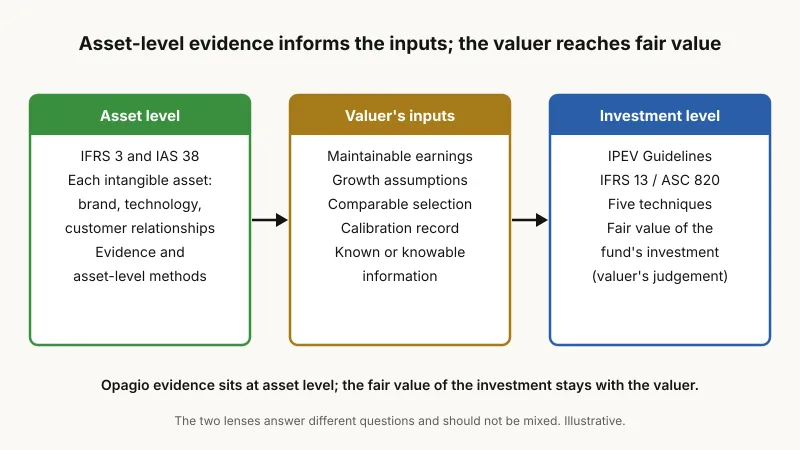
The IPEV Guidelines work at investment level. They value the fund's holding in a company. Intangible asset valuation under IFRS 3 and IAS 38 works at asset level. It values an individual brand, technology or customer relationship, usually with methods such as relief from royalty, the multi-period excess earnings method, with-and-without or a cost approach. The two answer different questions and should not be mixed.
Asset-level and investment-level valuation compared
Asset level
Investment level
Question
What is this individual intangible asset worth?
What is the fund's investment in this company worth at this measurement date?
Framework
IFRS 3 and IAS 38 (with IFRS 13 for the fair value definition)
IPEV Guidelines, applied under IFRS 13 or ASC 820
Typical asset-level and investment-level methods
Relief from royalty, MPEEM, with-and-without, cost approach
Multiples, industry valuation benchmarks, available market prices, DCF, net assets
Limited partners, fund auditors, valuation committees
Asset-level evidence informs the valuer's inputs; the investment-level fair value remains the valuer's judgement.
The lenses connect through the inputs. In most venture and growth companies, the intangible assets are a large part of what a buyer pays for. Evidence about them helps a valuer judge the inputs the Guidelines turn on: whether earnings are maintainable, whether growth assumptions in a cash flow forecast are supported, which comparable companies are genuinely comparable, and what was known or knowable at the measurement date. That evidence informs the inputs. It does not replace the valuer's fair value judgement.
✔ Example
A fund holds a growth-stage software company that it valued on a revenue multiple calibrated at entry. At the next quarter, peer multiples have fallen. The valuer has to decide whether the company's discount to its peers should narrow, widen or hold. A dated record of the company's customer retention, contracted revenue and the ownership of its core technology gives the valuer evidence for that judgement, and gives the auditor a trail to test.
Evidence for the inputs, not a substitute for the valuer
In Opagio Intangibles, a portfolio company's intangible assets are recorded in the Value Drivers Register across the Opagio 12, with the evidence behind each one. The Normalised P&L holds every earnings adjustment with its direction, amount, narrative and supporting documents, and the Asset Valuator values individual assets with asset-level methods. Funds can see those records across their holdings in one portfolio view. Opagio does not produce the fair value of a fund's investment or apply the IPEV techniques; that judgement, and the accountability for it, stays with the valuer. See how Opagio supports investors.
Frequently Asked Questions
What are the IPEV guidelines?
The IPEV guidelines are the International Private Equity and Venture Capital Valuation Guidelines, published by the IPEV Board. They set out best practice for measuring the fair value of private capital investments, such as venture capital, buyout and growth equity holdings, at each reporting date, in a way designed to be consistent with IFRS 13 and US GAAP (ASC 820). The current edition is dated December 2025.
What changed in the IPEV Guidelines 2025?
The Board changed only Guideline 1.4, for clarity. It expanded the explanatory text and the application guidance instead: a new discussion of AI, reorganised sustainability guidance, more on calibration and known-or-knowable information, significant new text on complex capital structures and liquidation preferences, and new sections on co-investments, more frequent valuations, and SAFEs, ASAs, convertible loan notes and venture debt.
When do the 2025 IPEV guidelines take effect?
The December 2025 edition is in effect for quarterly reporting periods beginning on or after 1 April 2026, and early adoption is encouraged. It supersedes the 2022 edition, which applied to reporting periods beginning on or after 1 January 2023.
Are the IPEV valuation guidelines mandatory?
No. The Guidelines themselves say that financial reporting standards do not require them to be followed. They are best-practice guidance, widely adopted because following them is a recognised way to measure fair value in line with IFRS 13 and ASC 820, and because limited partners and fund agreements often expect it. Where they conflict with law, regulation or an accounting standard, the latter prevails.
How many valuation techniques do the IPEV guidelines set out?
Five: multiples, industry valuation benchmarks and available market prices (the market approach), discounted cash flows (the income approach) and net assets (the replacement cost approach). The price of a recent investment is used to calibrate these techniques; it is not a technique in its own right.
Do the IPEV guidelines apply to UK funds?
Yes. The Guidelines are international, and UK Private Capital is among the 40 associations that endorse them, alongside bodies in Europe, North America, Asia-Pacific, Africa and Latin America. They are written to be consistent with IFRS 13 and ASC 820, and the Preface notes that frameworks using a similar definition of fair value may also find them relevant.
The 2025 edition asks more of the commentary behind each fair value than of the techniques themselves: how share classes are allocated, how hybrid instruments are modelled, how co-investments are judged, and how AI outputs are reviewed. Funds that update their policy and keep a clean calibration and backtesting record will find the transition straightforward.
David Stroll is Co-Founder and Chief Scientist at Opagio, where he leads research on intangible asset measurement, accounting standards and the productivity of intangible investment. Meet the team.
Share:
DS
David Stroll — Chief Scientist, Co-Founder
PhD in Productivity | 40 years in strategy and technical systems delivery
A comprehensive annual review checklist for goodwill impairment testing under IAS 36 and ASC 350. Covers triggering events, cash-generating unit identification, recoverable amount calculation, and disclosure requirements.
How the IFRS 13 and ASC 820 fair value hierarchy applies to intangible assets. Covers the three input levels, why most intangibles are Level 3, and the disclosure obligations that follow from the classification.
Your balance sheet shows cash, equipment, and perhaps some capitalised development costs. It does not show your customer relationships, your brand equity, your assembled workforce, or the technology platform your team spent years building. This gap between book value and enterprise value is not an anomaly — it is the defining feature of modern business. Here is why it matters and what to do about it.
We use essential cookies to make our website work. We'd also like to use analytics cookies to improve your experience. You can manage your preferences at any time.
Cookie Policy